
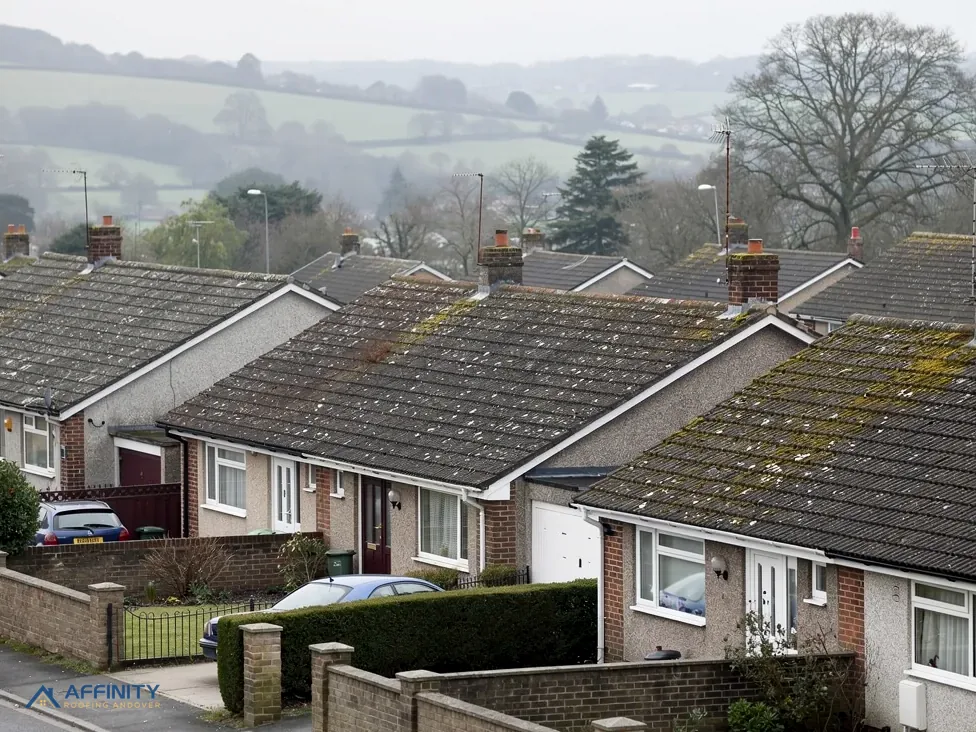
Roofers in Aldbourne
A Grade I church, the Village Cross and 83 listed neighbours
Aldbourne has 83 listed buildings within 500 metres of its centre, so we check the address against the list, then survey.
Aldbourne roofs around the church and the Cross

Church of St Michael
Listed Grade I on 22 August 1966 and in Church of England use, so roof repairs follow the faculty system.

Oak House and neighbours
Oak House, Rose Cottage and Bell Court are each Grade II, so a repair that alters their character needs consent.

The Village Cross
A scheduled monument within about 500 metres of the centre, with its own consent route for works on it.
Aldbourne between Ramsbury and Lambourn
Ramsbury lies south of the village, Lambourn north-east, Chiseldon north-west, Marlborough south-west and Hungerford south-east.
- Distance
- 24.4 road miles north of Andover
- Planning
- Wiltshire Council
The Aldbourne roof report
Local editionAldbourne, Wiltshire83 listings, a Grade I church, the downs
Aldbourne's roofs among 83 listings: who decides, what the downs add and how a scaffold is licensed
Aldbourne is a Wiltshire village of 1,865 people inside the North Wessex Downs, with a Grade I church and a scheduled monument at its heart. This report covers who decides on roof work here and what the heritage list asks of a repair.
Eighty-three listings and one council to ask
Aldbourne parish counted 1,865 usual residents at the 2021 Census, and Historic England's list holds 83 listed buildings within 500 metres of the village centre. That is a dense layer of heritage for a village, and it changes how a roofer works. Before we say anything about an address, we check it against the list. Wiltshire Council answers for the village in every other respect. It takes the planning decisions, runs the Building Control service from Monkton Park, Chippenham (0300 456 0113), and licenses scaffold on the road.
The downs add advice, not a second decision. Aldbourne lies within the North Wessex Downs National Landscape, once called an Area of Outstanding Natural Beauty. The partnership that looks after it has a purely advisory part in planning, and the primary role stays with Wiltshire Council as the planning authority, so a householder never applies to the partnership for a roof.
Two numbers decide whether a re-roof needs a building control application, according to the Planning Portal: 25 per cent of the building envelope and 50 per cent of the roof. Stay under both and the answer is normally no. Weight is a separate test. A new covering that increases the roof's load by 15 per cent or more needs Building Regulations approval, and the Planning Portal says to have the structure assessed before the work. A registered building control approver is an alternative to the council.
The way a ridge is held tells us a good deal. A ridge bedded on mortar is inspected for cracks and hollow sounds, while a dry-fix ridge, held by mechanical clips and fixings in place of mortar, is inspected for loose or missing parts. We note which system a roof has and photograph it, because a repair has to follow the method already there.
Beyond the ridge, we read the gutter line, the slopes, the valleys, and each junction with a wall or stack. Where it is safe to do so, we raise one or two tiles and photograph the battens and underlay hidden beneath. Each finding gets a picture and a line of explanation, and you see both before any price.
A single slipped tile does not set off all of this. The questions arise when a slope is failing, the roof's shape is changing or the house is listed.
An address on the edge of the village may lie outside the conservation area and still stand next to listed buildings, so the survey asks both questions separately. A neighbour's listing does not bind your roof.
St Michael's, the Cross and Aldbourne's conservation area
The Church of St Michael is listed Grade I (list entry 1034152, first listed on 22 August 1966) and is mapped as an Anglican church in use. Because the church is in Anglican use, repair work goes through the faculty system and not listed building consent, a faculty from the diocese's consistory court covering Aldbourne's church. If a roof survey would help that application, we supply close photographs and a plain account of the covering and the proposed repair.
Oak House (list entry 1034132) is Grade II, also first listed on 22 August 1966, and Rose Cottage (1034133) and Bell Court (1034148) are Grade II as well. For these and every other listed house, work that would alter the character of the building needs listed building consent, in addition to any planning permission. A repair in matching materials is where a proposal begins, and the application describes the covering, the ridge and the chimney flashings so the officer can see what changes.
Village Cross is a scheduled monument within about 500 metres of the centre (list entry 1004747). Scheduled monument consent covers works on the monument itself. A roof in the village is a separate question, though where a house stands close to the monument we check its mapped boundary on the national heritage list at survey.
The Aldbourne conservation area lies within about 0.75 km of the village centre. Inside it, any change that alters how a roof looks from the street is discussed with the council before work. Whether an Article 4 direction applies to your road is another question for Wiltshire Council, and we put it for you. Our guide to planning permission for roof work explains how dormers are judged on land of this kind.
With so many layers, the file we hand you lists which apply to your house and which do not. It is short for some addresses and long for others, but it is always written down, so that a later buyer does not have to repeat the research.
In a run of attached cottages a party wall question can arise when work reaches the wall you share with next door. A party wall surveyor is the person to consult, and we raise the point at the survey, not on the morning the scaffold arrives.
Photographs of the existing covering are taken before anything is lifted. If listed building consent is needed, they accompany the application, and if it is not, they remain your record of the roof as found.
“In Aldbourne, the heritage list is the first thing we read and the roof is the second.”
The scaffold licence, and the jobs we price
Scaffold built over a pavement or road in Aldbourne falls under section 169 of the Highways Act 1980, and Wiltshire Council grants the licence. Wiltshire Council has the firm erecting the scaffold apply through its MiPermit portal, one licence for each site, so no form reaches the householder. A scaffold wholly on your own land sits outside the scheme.
The fee depends on notice. Wiltshire Council charges £143.80 for an application lodged well ahead, meaning over three working days, and £164.70 for a later one. Each licence is valid for 28 days, and a marked parking bay beside the house would need its own suspension. These points go into the plan we send you, so licence, scaffold and work can be read in order.
Where a street is tight, the scaffold and its licence follow the frontage. We measure the width of the pavement, ask where deliveries can stop, and say whether the 28 days will cover the job or whether it needs staging. Where a consent decision is still awaited, the scaffold date waits for it.
The jobs are the usual ones. Roof repairs deal with slipped coverings, split ridge pieces and failed flashings. Chimney repairs cover a stack with weathered pointing or perished lead. Roof replacement is set beside repair in the survey, each case backed by the photographs.
On an older roof the question is repair or replace. Where the battens are sound and the fault is local, repair is the answer. Where the fixings are failing across a slope, a new covering is the sounder choice, and the pictures make the point better than we could. You decide with the evidence in front of you, and a second roofer can read the same photographs if you want another view.
When the work is done, we go through the finished roof with you using photographs taken at the same angles as the survey, so you can compare before and after. Anything left for a second visit is listed with a date.
Ramsbury, Lambourn, Chiseldon, Marlborough and Hungerford are all within reach. Each sits under a different mix of councils and designations, so each address is checked separately and the result is noted in the survey file.
On older chimneys we look at the flaunching (the mortar bed that holds each pot), the pointing of the stack and the flashing where the stack meets the slope, because those three joints let rain in first. Reclaimed slate and tile suit a listed house, since new material rarely weathers to match, and we note the source of any reclaimed pieces in the file.
Choose a service for Aldbourne





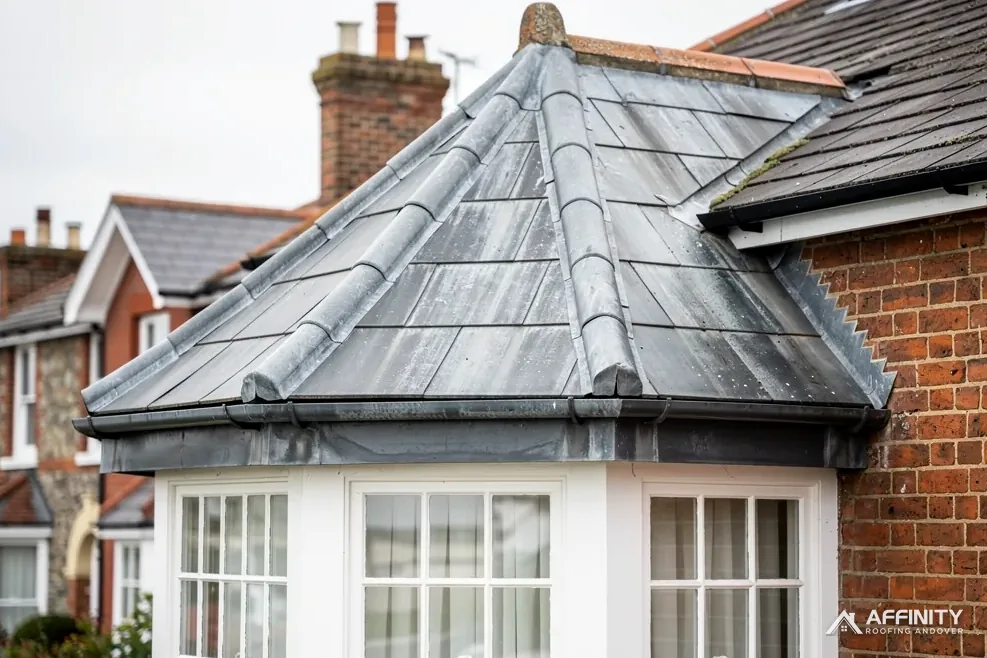
Aldbourne roofs: the church, the Cross and the downs
Can I re-tile an Aldbourne house that stands among so many listed buildings?
Yes, if your own house is not listed and no conservation area rule blocks a matching covering, though the check comes first. A listed neighbour does not make your roof listed. We check your address against Historic England's list and the council's map first. If the house is listed or inside the conservation area, consent routes apply, and we describe the existing covering in detail.
Does the scheduled monument at Village Cross affect nearby roofs?
Scheduled monument consent applies to works on the monument itself. A house roof nearby is a separate question, though a property close to the monument deserves a check. At survey we look at the monument's mapped boundary on the national heritage list, and the result goes into your file so the point is settled before work.
Who inspects a re-roof in Aldbourne?
Wiltshire Council, through its own Building Control service at Monkton Park, Chippenham. The North Wessex Downs partnership only advises on planning. A heavier covering, by 15 per cent or more, needs Building Regulations approval. Bigger jobs go to the council ahead of booking, and its written reply is filed with the survey photographs, so the route is on paper before the work begins.
How long does a Wiltshire scaffold licence last in Aldbourne?
Each licence is valid for 28 days. Wiltshire Council charges £143.80 for an application made over three working days ahead and £164.70 for less, and the scaffolding firm applies through MiPermit. A full re-roof on a long frontage may need staging within that period, which we plan with the scaffolder before the date is set.
Ask for an Aldbourne survey
Give us your address and describe the problem. A survey comes first, then one written price.
10-year workmanship guarantee, in writing.