
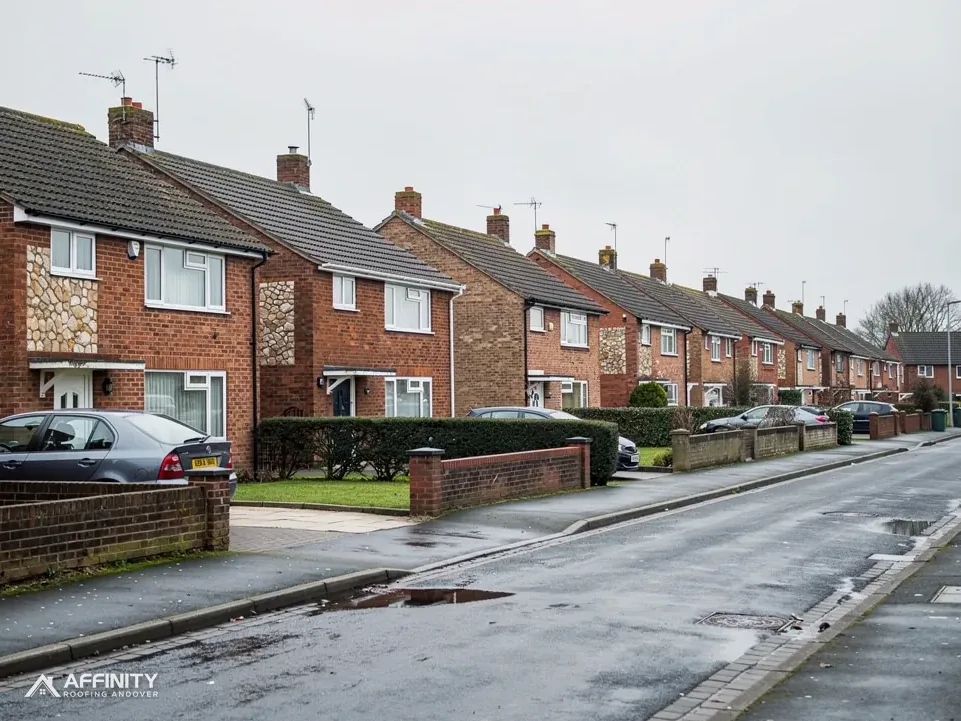
Roofers in Hungerford
A Georgian High Street, 103 listings nearby and the downs beyond
Hungerford has 103 listed buildings within 900 metres of its centre, a Georgian High Street, two conservation areas and the North Wessex Downs on its doorstep. We survey every roof before naming a price.
Hungerford roofs, from the High Street to the church
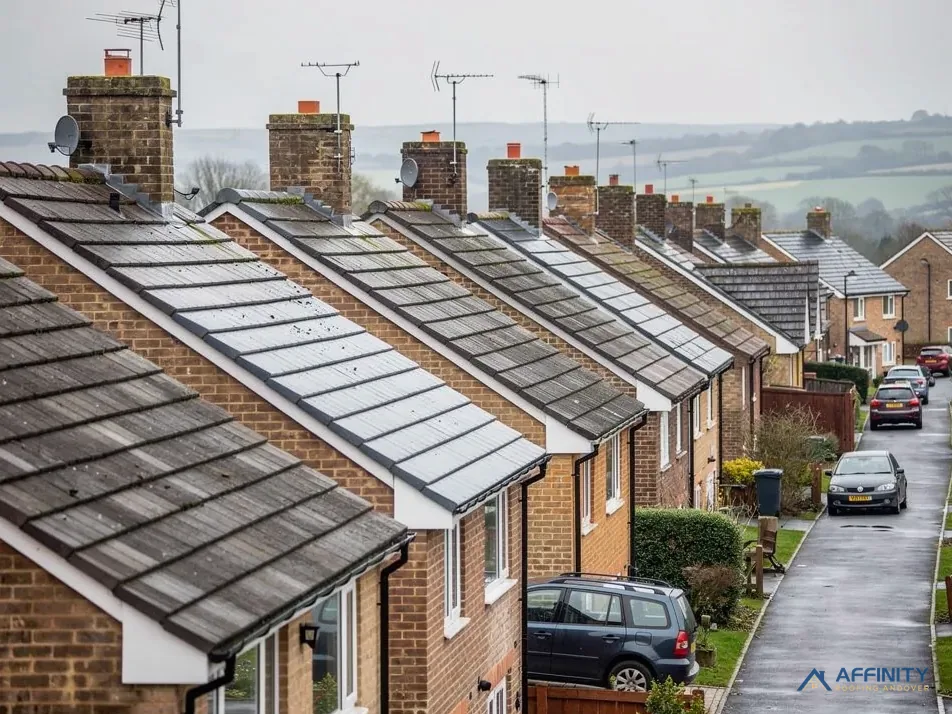
High Street fronts
Many Georgian buildings, built from pattern books, some with brick (mathematical) tile fronts, line the High Street itself.
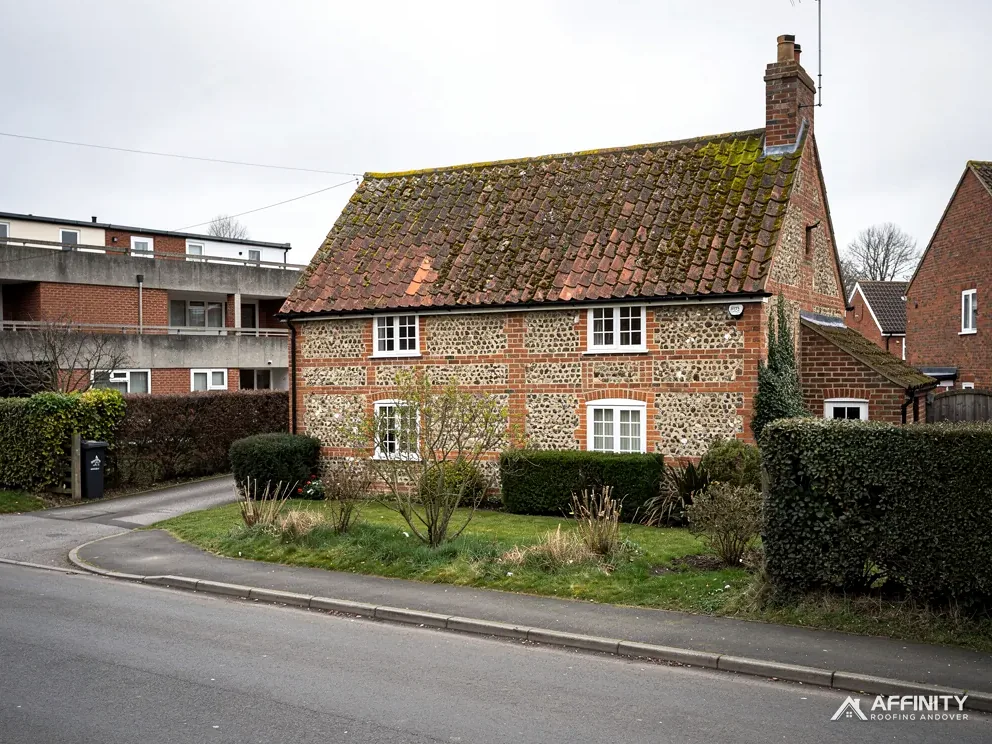
24 High Street
Grade II* listed (1210596), with The Bear Hotel and Riverside listed Grade II close by.
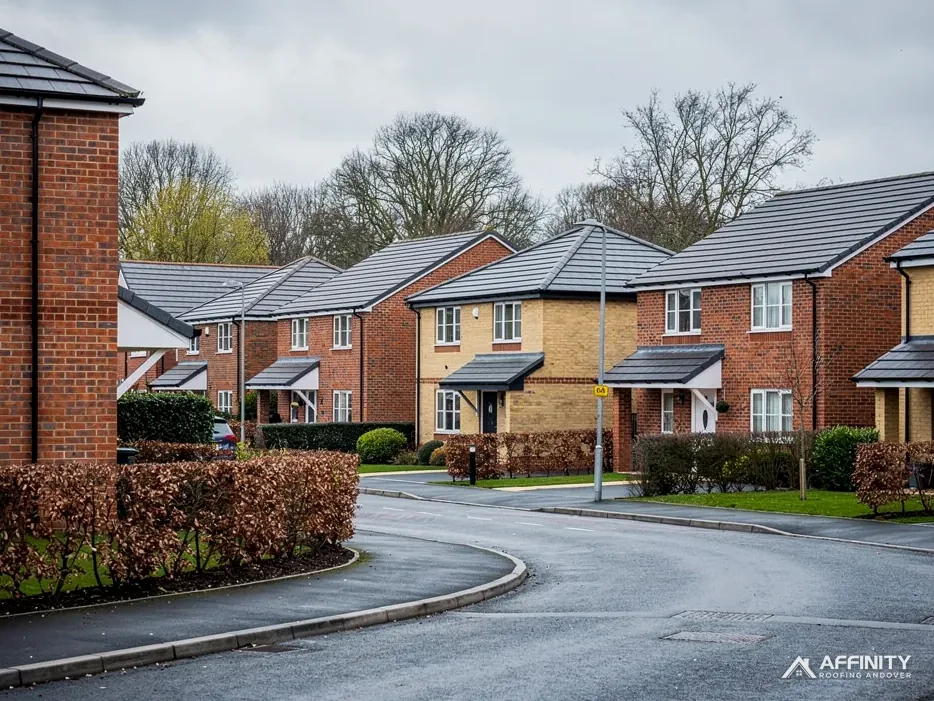
Number 84
The only remaining thatched cottage on the High Street, which belongs with a specialist thatcher.
Hungerford on the Berkshire border
Kintbury lies to the east, Inkpen to the south-east, Great Bedwyn to the south-west, Ramsbury and Aldbourne to the north-west and Great Shefford to the north-east of the town.
- Distance
- 17.2 road miles north of Andover
- Planning
- West Berkshire Council
The Hungerford roof report
Local editionHungerford, BerkshireA Georgian town and its hidden gutters
Hungerford roofs: a Georgian High Street, one unitary council and the lead gutters behind the fronts
Hungerford sits 17.2 road miles north of Andover, with West Berkshire as its council, inside the downs. Here is how permissions work in the town, what its listings and pattern-book fronts mean for a repair, and why parapet gutters need care.
A West Berkshire town inside the downs
Hungerford, a market town whose parish counted 5,866 usual residents at the 2021 Census, stands 17.2 road miles to the north of Andover, in the Berkshire district of West Berkshire. West Berkshire Council is the unitary authority: it decides planning, licenses scaffolds on the public highway and, with Wokingham Borough Council, runs Building Control Solutions (BCS), which answers on 0300 790 0580. The whole town sits inside the North Wessex Downs National Landscape, a designation that advises and does not decide.
The downs partnership's role is advisory, and the council is the planning authority for every Hungerford address. On the designation's effect: a dormer or other reshaped roof is a question for the council first, and the town's two conservation areas, Hungerford and Eddington, are treated alike. Mending or re-tiling a house roof to match is not touched by this, but a call to the council is cheap insurance.
The national yardsticks come from the Planning Portal: 25 per cent of the building envelope, and 50 per cent of the roof. Inside both, no building control application is normally asked for on a re-roof, and West Berkshire adds no percentage of its own. A shop or flat roof renewed in full is a different matter from a few tiles, and BCS is asked before the work is booked.
A covering 15 per cent heavier or more, or one whose fire behaviour would differ markedly, needs Building Regulations approval wherever the building stands. Registered building control approvers (registration has been required since April 2024) can inspect in place of BCS, and which route applies is settled before the price is set.
A town has flats and commercial premises as well as houses. Householder permitted development rights do not apply to flats, because a dwellinghouse for those purposes excludes a building containing flats. A shop or office is not a dwellinghouse either, so its roof alterations are put to the council first, and our commercial roofing surveys begin with the deck and the drainage.
We read a High Street roof from three places: from the pavement with a long lens, from a ladder or the scaffold close up, and from inside the loft where it can be reached. The three views are set side by side in the report, so a fault seen from the street can be traced to its cause under the covering. A parapet is the low wall at the edge of a roof, the gutter behind it is a parapet gutter, and the flashing is the metal strip sealing each junction; the report uses the words plainly.
Pattern books, mathematical tiles and 103 listings
Hungerford has around 125 listed buildings, according to the Hungerford Virtual Museum, and Historic England's list holds 103 within about 900 metres of the town centre. Number 24, High Street is Grade II* (list entry 1210596). The Bear Hotel (1210476) and Riverside (1210477) are Grade II. The Church of St Lawrence is Grade II* (1289541, first listed on 6 February 1962) and OpenStreetMap shows it as a working Anglican church, so roof works there go via the faculty system.
Many of the town's Georgian buildings were built from pattern books, and its few stone buildings nearly all date from the decade or two after 1810. A pattern-book front means repeating details: the same pitch, the same eaves, the same parapet. Matching a roof repair to a neighbour is therefore easier than in a village of one-off cottages, and a mismatch shows more.
Some High Street fronts use brick, or mathematical, tiles, which are uncommon in the town. They are wall tiles that imitate brickwork, not roof tiles, but they sit directly below the roof edge, so a repair to the parapet or the eaves must not damage them. The survey records any such front before scaffolding is planned against it.
Number 84 is the only remaining thatched cottage on the High Street. Thatch is a specialist thatcher's work, and we repair the tiles, slates, lead and gutters around it. For every listed building, listed building consent covers change touching its special character, and consent is in hand before any scaffold is ordered. Our guide to listed building roof repairs sets out the route.
Whether an Article 4 direction touches an address in the Hungerford or Eddington conservation area is for West Berkshire Council to say. What any direction removes is a question for the council, and the answer goes on file with the survey.
Where two neighbouring fronts share a party wall, the Party Wall etc. Act 1996 can apply to work such as cutting back a chimney breast. The notice must be given at least two months ahead, and disagreements go to a party wall surveyor, not to building control. On a pattern-book terrace the neighbour's roof is usually a few centimetres away, so the survey records the shared line and the report says who needs to be told.
Reclaimed tiles and slates are the usual answer where a visible repair must match. They arrive weathered, which new stock takes years to do, and sourcing them takes time, so the report gives a likely wait before a date is promised.
“Behind a Georgian High Street front, the gutter is lead and the failure is quiet.”
Parapet gutters, lead and a scaffold on the High Street
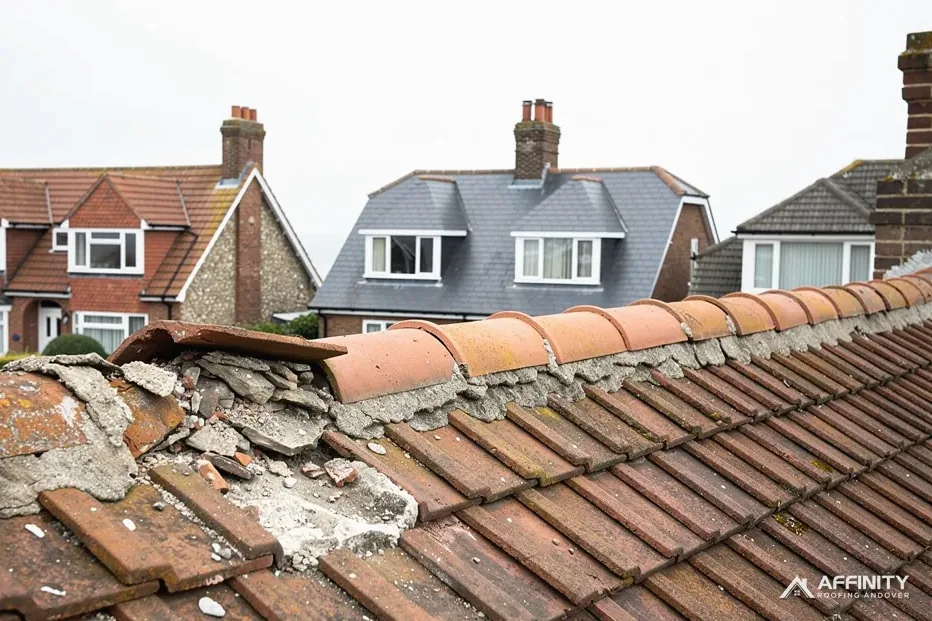
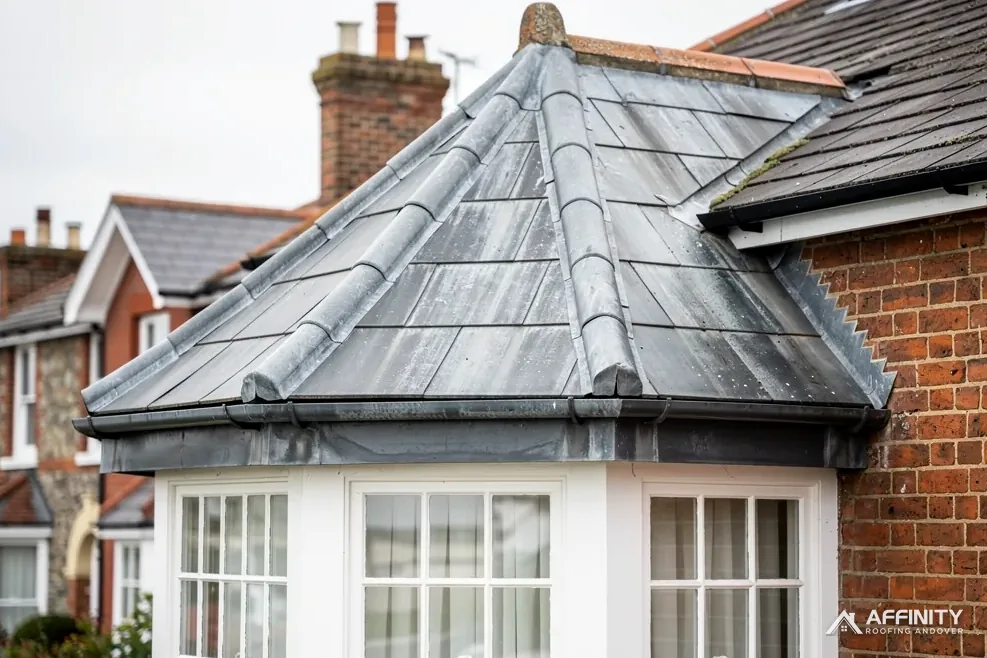
Behind a Georgian front the roof often hides: a low parapet wall at the edge, with a lead-lined gutter running along its foot. This is a parapet gutter, and it fails quietly, with a split seam or a lifted flashing letting water into the wall below. Leaves and snow collect behind a parapet too, so its outlet is cleared at every visit. Lead sheet is sold in codes. Royston's brochure lists codes 5 to 8, from 2.24 mm to 3.55 mm thick, for the gutters set into parapets and boxes, and Approved Document C refers lead roofing to BS 6915.
Lead lasts. HomeBuilding gives lead on a flat roof 60-100 years, and MyJobQuote says lead flashing can last over 80 years, a floor and not a promise (Sept 2026). That does not make it immune: stretched joints, torn seams and rotten boards beneath are how it fails, and the survey checks the boards as well as the lead, because a perfect sheet on a rotten board is still a leak waiting to happen. Our lead roofing work is described seam by seam in the report.
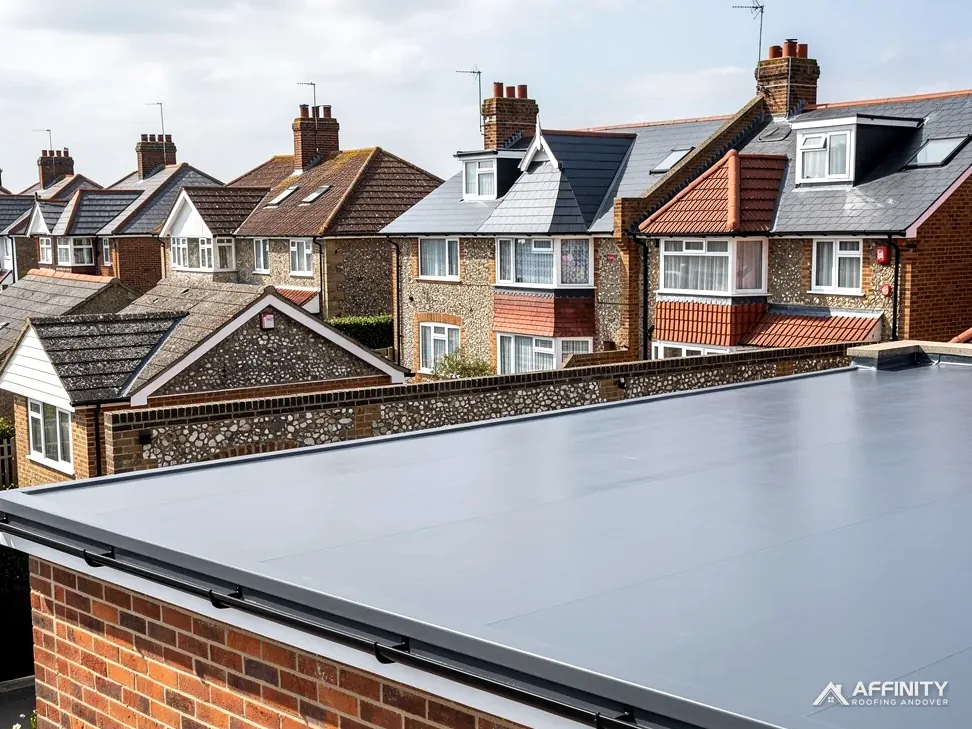
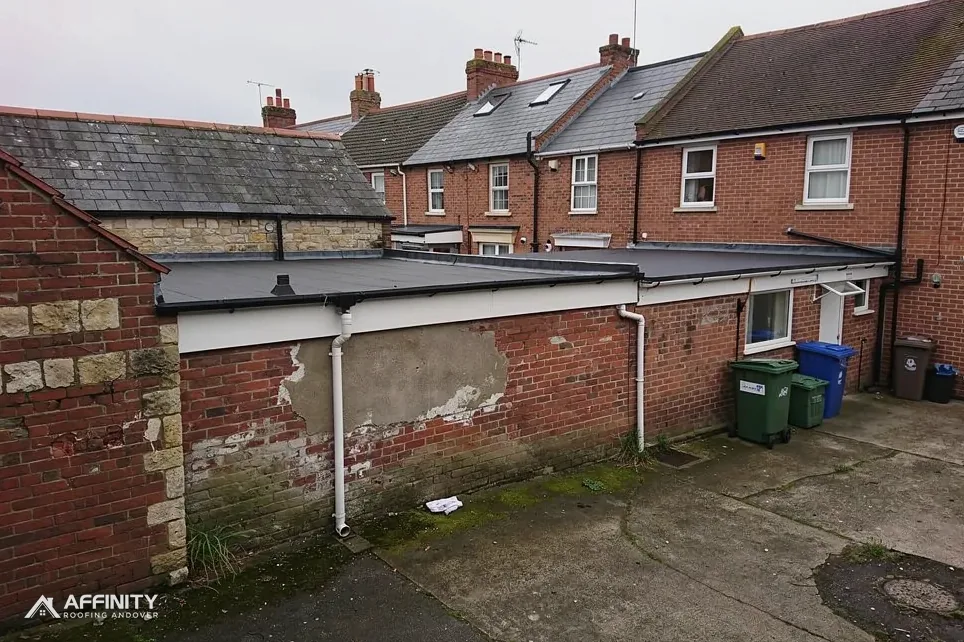
A shop or flat roof behind the front has a different problem: the fall. BS 6229:2025 keeps a minimum finished fall of 1:80 for flexible-membrane roofs, and a roof that holds water has run out of fall. The Environment Agency's Flood Map for Planning also puts some of the land within about 250 metres of the centre of Hungerford in Flood Zone 3, a river-flood map that says nothing about roofs but explains why we trace every downpipe to its outlet.
Scaffolding on the High Street itself is on the public highway, so section 169 of the Highways Act 1980 applies. Under West Berkshire Council's page the applicant must be a scaffolding provider and not the resident, with 10 working days' notice or more. West Berkshire's fee is £125 plus £71 a week, and a private road needs no licence.
MyJobQuote gives around £540 for a full roof valley replacement (MyJobQuote, Sept 2026), a typical UK figure that a survey turns into a price for your roof. If a gutter overflows into a wall, a temporary cover goes on first and the lasting repair follows. In a market town the street is busy, and a High Street scaffold is planned around deliveries, bus stops and shop hours, which is agreed with the occupiers before the licence application goes in. The scaffold plan keeps the pavement passable and the shop entrances open, the site is swept daily, and nothing is fixed to a decorative front without agreement.
Hungerford roofs: fronts, lead and the scaffold
Do mathematical tiles on a Hungerford High Street front affect roof repairs?
They sit just below the roof edge, so repairs to the parapet or eaves must not damage them, and a scaffold plan has to avoid them as well. They are wall tiles imitating brick, not roof tiles. The survey records any such front first, and the scaffold is planned to rest no boards on them and fix nothing to them without agreement.
How do I know if a parapet gutter in Hungerford is failing?
Look for damp stains on the wall beneath the parapet, lifted flashings, or water on the roof that does not drain. MyJobQuote says lead flashing can last over 80 years, so age alone does not prove failure. We check seams, boards and outlets from the scaffold and photograph what we find, then explain in plain words whether a patch or a new run of lead is needed.
Who decides a roof application in Hungerford, given the downs designation?
West Berkshire Council decides; the downs body advises. On that land and in a conservation area, plans for a dormer go to the council first. Mending a roof or re-tiling to match raises nothing extra, and BCS handles building control on 0300 790 0580.
How is scaffolding on the High Street licensed and charged?
West Berkshire Council's fee is £125 plus £71 a week, with 10 working days' notice or more, and it requires a scaffolding provider as applicant. It generally offers only a 50% refund before grant, and licensing does not cover private roads. The scaffolder is dealt with by us, and the fee is carried in the price you receive.
Hungerford and the villages around it
Have a Hungerford roof checked over
Tell us the road and attach a snap; a survey, the council check and one price follow.
10-year workmanship guarantee, in writing.