
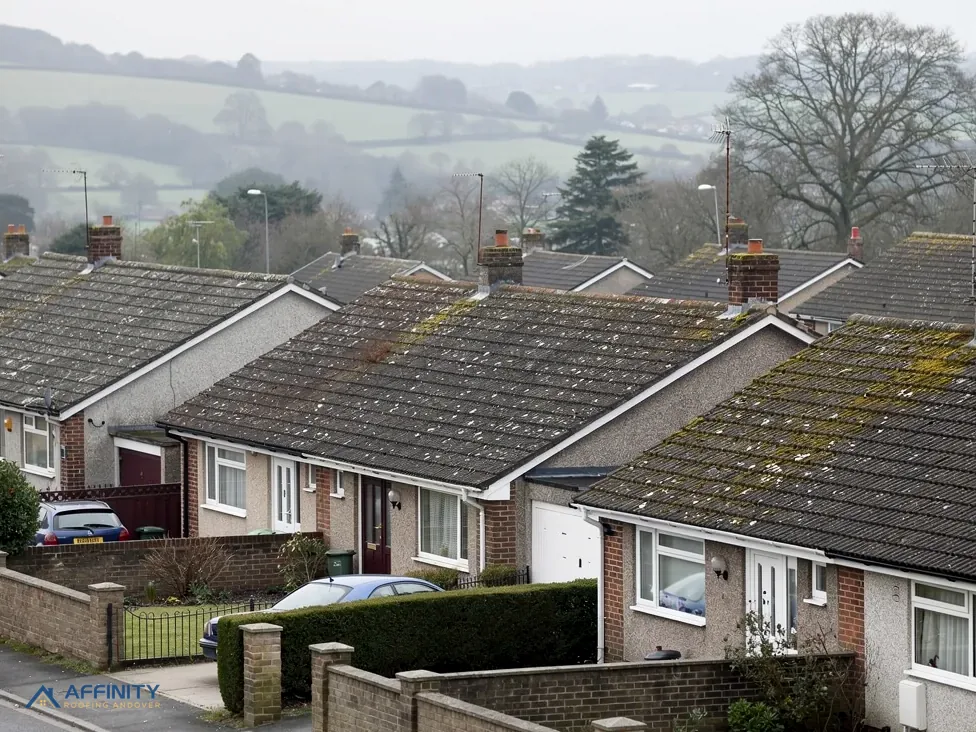
Roofers in Lambourn
Grade II* houses, a Grade I church and the old Cross
Lambourn has 56 listed buildings within 500 metres of its middle, and the downs designation covers the lot. We survey each roof and photograph what we find, whatever its age.
Lambourn roofs, from Newbury Street to the Cross

Grade I church
St Michael and All Angels, the parish church, has been Grade I listed since 6 February 1962.

Three Grade II* houses
21 Newbury Street, Parsonage House and College House are all listed Grade II*.

Lambourn Cross
Lambourn Cross is a scheduled monument within about 500 m of the centre, close to the conservation area.
Lambourn between Great Shefford and Aldbourne
Great Shefford lies to the south-east, Aldbourne and Ramsbury to the south-west, Hungerford to the south and Kintbury further to the south-east and Chiseldon to the west.
- Distance
- 25.9 road miles north of Andover
- Planning
- West Berkshire Council
The Lambourn roof report
Local editionLambourn, BerkshireListings, the downs and storm damage
Three Grade II* houses and a Grade I church: how Lambourn roof work is cleared
Lambourn lies 25.9 road miles north of Andover within a National Landscape. This report covers its listings and scheduled cross, what the downs designation does and does not decide, storm damage, typical repair costs and the West Berkshire scaffold licence.
Fifty-six listings and a scheduled cross
Lambourn is crowded with protected buildings. Historic England's list holds 56 listed buildings within 500 metres of the village point. The parish church, St Michael and All Angels (list entry 1113695), has been Grade I listed since 6 February 1962. 21 Newbury Street (1113701) was listed Grade II* on 10 September 1951, and Parsonage House (1113704) and College House (1136235) are Grade II* as well. The 2021 Census counted 4,222 usual residents in the parish, so ordinary houses sit among the listed ones, and they get the same survey as the listed ones.
St Michael and All Angels is an Anglican church in active use, which puts repairs under the Church's faculty system, not under the council. A closed church or another denomination would follow a different route, and a church roof belongs first to those who look after the building. For the houses, listing is West Berkshire Council's business. Listed building consent from the council is needed for any change to a listed house's character, though the house keeps the ordinary permitted development rights. Matching tiles, slates and lead come first in any proposal we send it.
Lambourn Cross is a scheduled monument (list entry 1006994), recorded within about 500 metres of the centre. A scheduled monument has a consent regime of its own, and the Secretary of State, not the council, decides it. A roof is not the Cross, and ordinary roof work in the village does not touch it, but skips, scaffold and materials are kept clear of it, and the survey flags any plot close by, and you are told what was found and what it means for access. The Lambourn conservation area is mapped within about 0.75 km of the centre too. Its boundary comes from West Berkshire Council, and we check your address against it.
On a Lambourn job the effect is mostly on the order of events. We find out whether the house is listed, in the conservation area, or both, then photograph the roof closely, and only afterwards propose a repair. If consent is needed, it is sought before any scaffold is booked. The listed building roof repairs guide goes through each consent route step by step.
None of that slows a leak repair that needs no consent, and nobody should leave water coming in while a form is considered. Those jobs fall under roof repairs, with a survey and photographs first. Where the fault is a flashing or a few slipped slates, that is what is mended, and a larger job appears only when the survey shows it is needed.
What the downs designation does not decide
Lambourn lies within the North Wessex Downs, a designation formerly known as an AONB and now called a National Landscape. The partnership that speaks for it is candid about its limits. It points out that AONBs and National Parks have equal status in landscape value and legal protection, but that only National Parks have independent authorities with their own planning functions. For Lambourn, then, the council takes the decision, Natural England is consulted by law, and the partnership advises.
West Berkshire Council therefore decides a Lambourn planning application, not the downs team. That is a practical gain for owners, because one office, with one set of officers, handles the listed building, conservation area and National Landscape questions together. The designation still has force in one respect, and it is a narrow one. It counts as article 2(3) land, so a dormer or other change of roof shape is a question for the council's planners. Ordinary repair and re-covering in matching tiles are judged differently. At the survey we tell you which side of that line your job sits, and why.
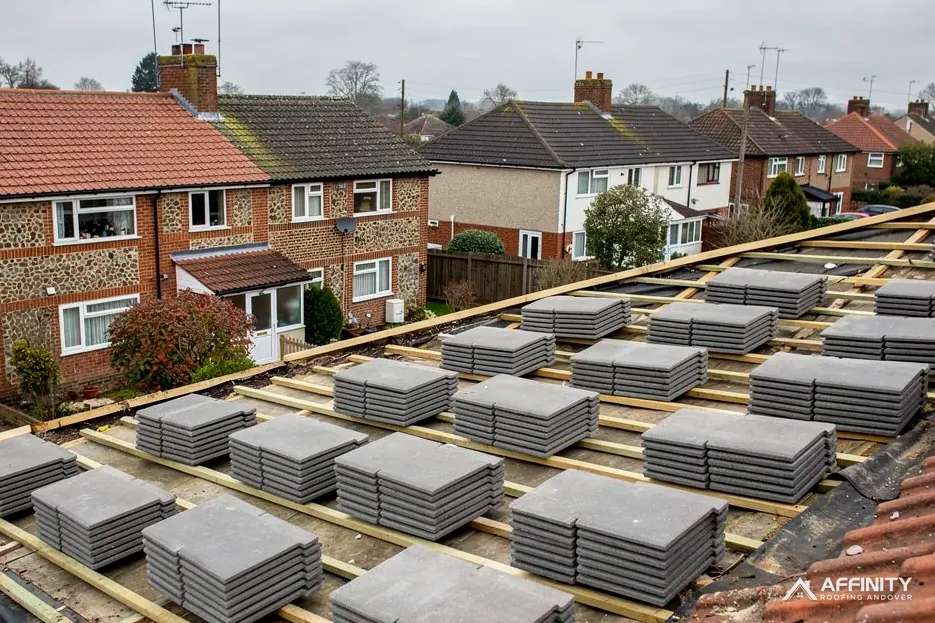
For building control, West Berkshire hands its work to Building Control Solutions (BCS), the partnership with Wokingham Borough Council, on 0300 790 0580, and a private approver can stand in for it. The national yardstick, from the Planning Portal, is 25 per cent of the building envelope and 50 per cent of the roof, and a covering that is 15 per cent or more heavier needs approval whatever the percentages. Substituting a heavier tile for slate is the kind of swap that can trigger the check, because the rafters were sized for the lighter covering. The structural engineer or surveyor the Portal mentions looks at spans, timber sizes and condition, and we arrange that before the covering is ordered, not after it arrives on site.
The Environment Agency's Flood Map for Planning records Flood Zone 3 within about 250 metres of the village point. It describes ground, not any one house, and leaves the fixing of slate or tile exactly as it would be elsewhere. In practice gutters, hoppers and downpipes get a thorough look at every survey, because a roof that cannot shed its water soaks the wall beneath.
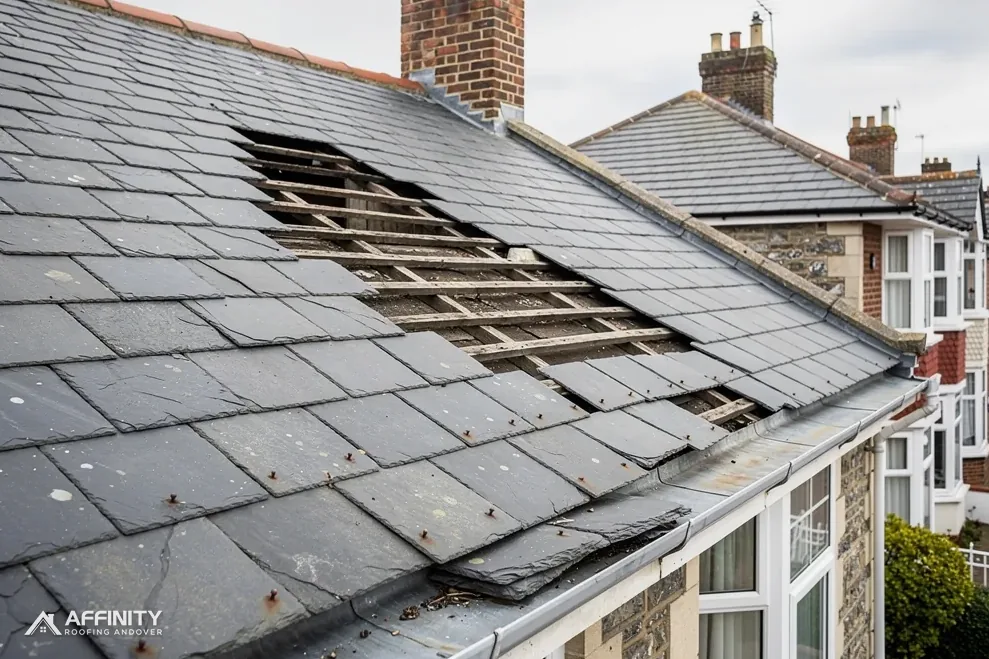
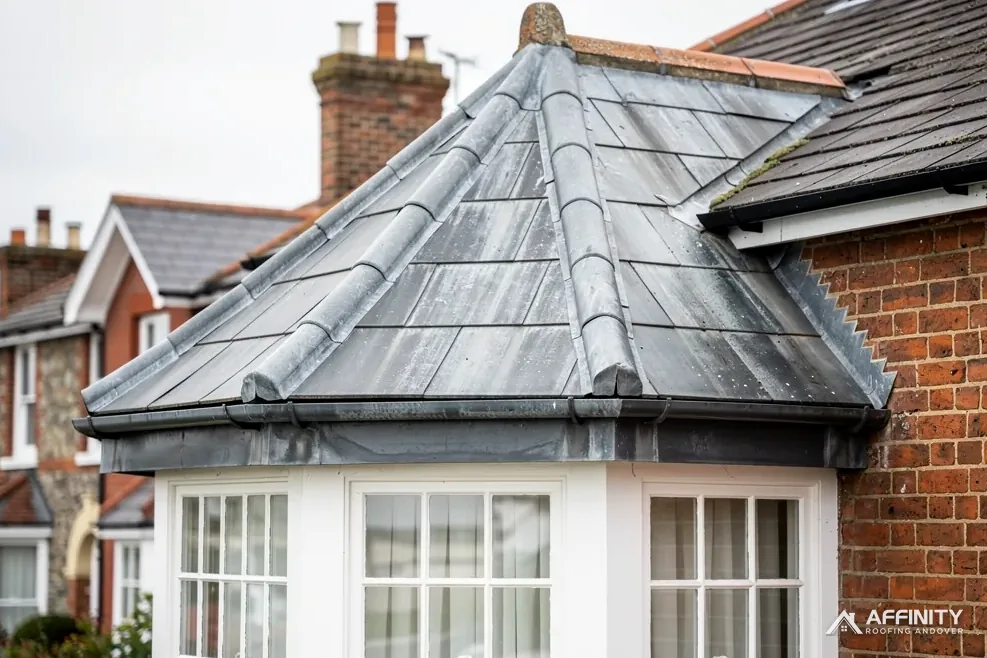
The oldest roofs call for the most patience. On slate, slate roofing explains how we handle a failed fixing, and on lead the lead roofing page does the same for flashings and valleys. A split lead valley can look minor from the lane yet leak for months, so the survey goes into the roof space where access allows.
“Lambourn's roofs sit among listings and a National Landscape, but West Berkshire still decides.”
Storm damage, the insurer and a scaffold licence
When a storm strips tiles, the first call should go to your insurer, before any roofer. After that comes a temporary make-safe, and the photographs and receipts for it belong in your claim file. The Financial Ombudsman Service treats a storm as normally meaning damaging wind with rain, hail or snow, though it accepts storms without high wind and says heavy rain, hail or snow on its own can qualify. It also weighs the Beaufort scale. Insurers vary, so the definition that counts is the one in your own policy, and we never promise that a claim will succeed. The Ombudsman's helpline is 0800 023 4567.
What a roofer can usefully do is secure the house and record the damage. We photograph what has moved, what is cracked and where the roof is open to the weather, so the insurer sees the picture we see, and we describe the repair in plain words. A tarpaulin, or a handful of tiles refitted, keeps the weather out while the permanent job is arranged, and the photographs show the insurer what was done and why. Every receipt for that interim work should be kept.
The permanent repair is planned like any other: survey first, then, for a listed house or one in the conservation area, the consent route. Then comes the scaffold. The highway licence for scaffold comes from West Berkshire Council, under section 169 of the Highways Act 1980, and the council expects the request from the scaffolding provider, not the householder. West Berkshire Council charges £125 plus £71 per week and requires ten working days' notice. A private road needs none.
Because the notice is long, a storm repair that needs road scaffolding must be planned with some care. Dates come from you first, then the licence, and where a roof is dangerous in the meantime it is made safe on the day. The licence fee sits inside your one total price alongside the hire and the clearance of waste, so no separate bill follows.
Which? has reported that only 32% of storm-related claims made in 2024 resulted in a payout, which is why we treat the claim as yours and the repair as ours.
Typical UK ranges help set expectations, and they are national guides, not our prices. Which? (November 2025) puts a repair covering up to six broken or missing roof tiles at £75 to £400 per job, excluding VAT, and MyJobQuote (October 2026) gives around £650 as the average roof repair cost in 2026. Extensive storm damage costs more. The written quote after the survey fixes your own figure for the whole job.
Repairs and re-roofs across Lambourn



Lambourn roofs: listings, the downs and storms
Does a Grade II* listing change how a Lambourn roof is repaired?
The grade does not change the route. Any work that affects the character of a listed house needs listed building consent from West Berkshire Council, and the house keeps the permitted development rights any house has. The start is repair in matching materials, with close photographs, and a question to the planning team before any scaffold is ordered.
Is planning in Lambourn decided by the downs partnership?
No. The partnership is advisory, and West Berkshire Council decides planning applications in Lambourn, with Natural England as statutory consultee. Where it bites is on dormers and other alterations to the roofline. A patch repair, or a new covering in matching tiles, is treated differently, and we confirm that with the council before booking.
What should I do first after storm damage to a Lambourn roof?
Ring your insurer before anything else, then secure the roof, and file photographs and receipts. How your policy defines a storm decides the claim, and no payout is promised. The Financial Ombudsman Service, on 0800 023 4567, handles disputes. We survey the damage, photograph it and set out the repair clearly, whatever the insurer decides.
How long does a West Berkshire scaffold licence take for a Lambourn house?
West Berkshire Council wants ten working days between application and erection, and charges £125 plus £71 per week. It expects the request from the scaffolding provider, not you, and ten working days is a long wait when a roof is open. Private-road scaffold sits outside the licence. In an emergency the roof is made safe first, then the licence follows while the roof is covered.
Villages and towns around Lambourn on the downs
Ask for a survey of your Lambourn roof
Say which house and add a photo. We survey, work out what consent is needed and give one written price.
10-year workmanship guarantee, in writing.