The short answer
Neither wins outright. Natural slate lasts longest, with HomeBuilding giving Welsh slate 100+ years against 40 to 50 for plain concrete tiles, but it costs more and needs a roof of at least 20 degrees. Tiles suit lower pitches and tighter budgets. The right choice depends on your house, its existing roof and any conservation rules.
Lifespan, pitch and cost
On lifespan, slate is ahead. HomeBuilding gives Welsh slate 100+ years, Spanish natural slate 75 to 100 years and reclaimed Welsh slate 50 to 80 years. For tiles it lists clay at 60 to 80 years and plain concrete and Double Roman at 40 to 50 years. Marley's own estimate for its roof tiles is around 60 years, with a note that this is no warranty. Treat every one as a typical range and never a promise, since upkeep moves a roof's life either way.
On pitch, slate is more demanding. BS 5534 indicates a minimum of 20 degrees for natural slate. Some concrete tiles go lower: Marley lists its smooth Mendip at 15 degrees and Double Roman at 22.5 degrees, while its plain tile needs 35. The data sheet for each product governs, so ask for it.
On cost, HomeBuilding prices a three-bedroom semi of 65 m2 in plain concrete tiles between £10,000 and £15,000 including labour, scaffolding and insulation, and Welsh slate on the same house at up to £18,000 (HomeBuilding, September 2025). Those are typical UK figures, not our price. Cost guides such as these are national figures, so the survey fixes the price for your own roof.
How each one looks
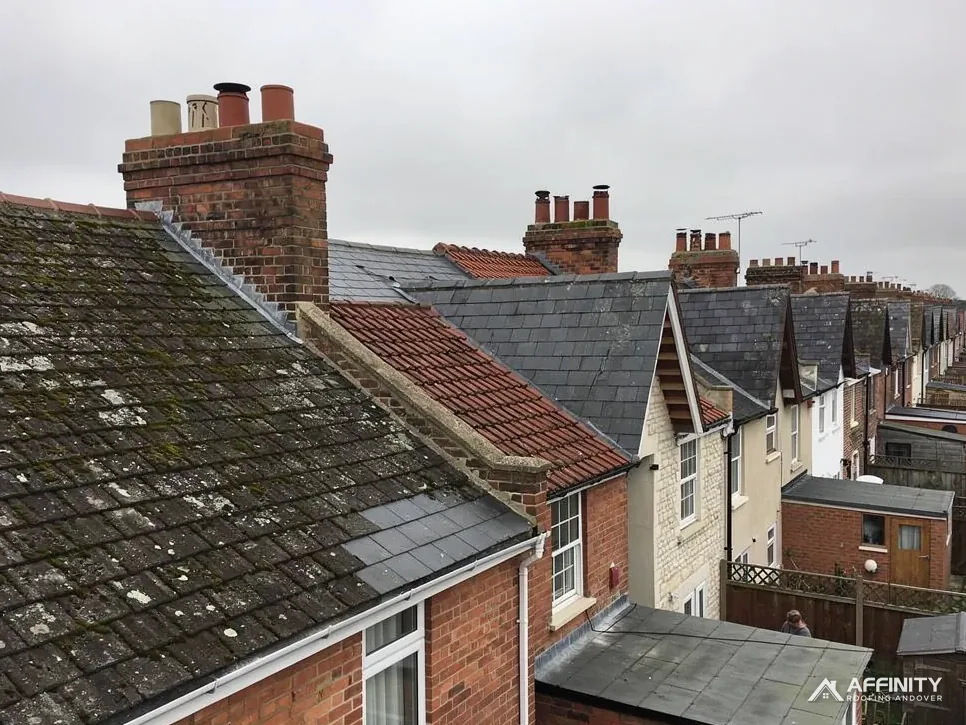
Slate gives a flat, fine-grained surface with sharp shadow lines between the courses. Tiles show more relief, with a visible thickness at the tail and, on interlocking types, a pattern of ribs and valleys. Seen from the road, a slate roof reads as one smooth plane and a tiled roof as a textured one.
Which suits a house is partly a matter of the neighbours. A terrace or village street where every roof is slate will look wrong with a different covering, and in some places the council has a view. In the Article 4 conservation areas it names, Basingstoke and Deane wants slate and clay roofs to keep their material, and it calls concrete tiles and artificial slates unlikely to pass. Only its own addresses are covered by that. Elsewhere, ask your own planning authority.
Clay tiles share some of slate's character, being a natural fired material that fades and weathers over time. Concrete tiles are more uniform. If you want to switch from one to the other, our answer on replacing a slate roof with tiles deals with the practicalities.
Repairs and maintenance
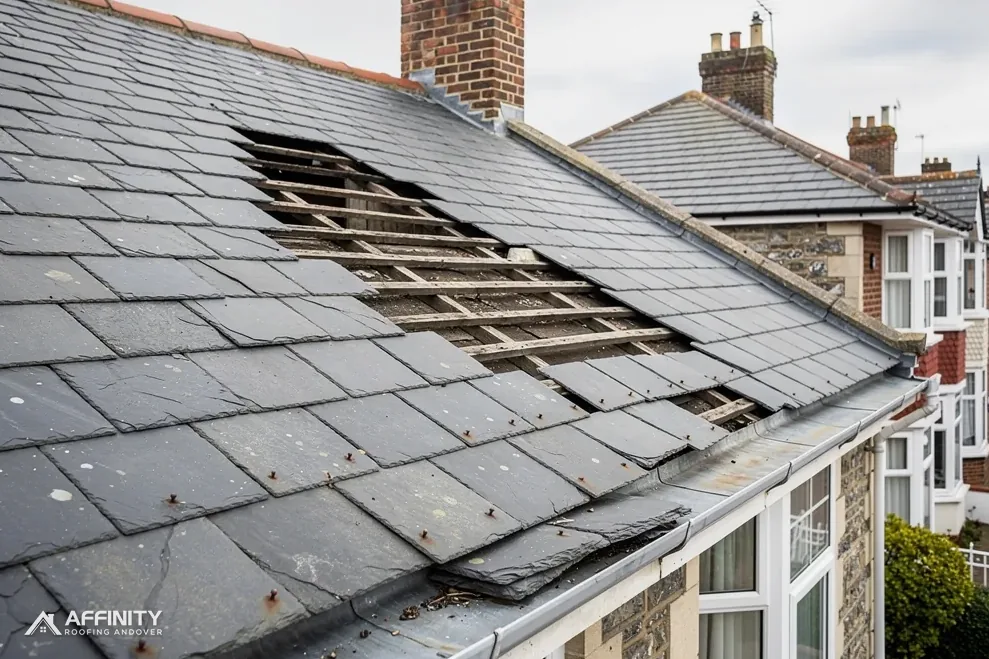
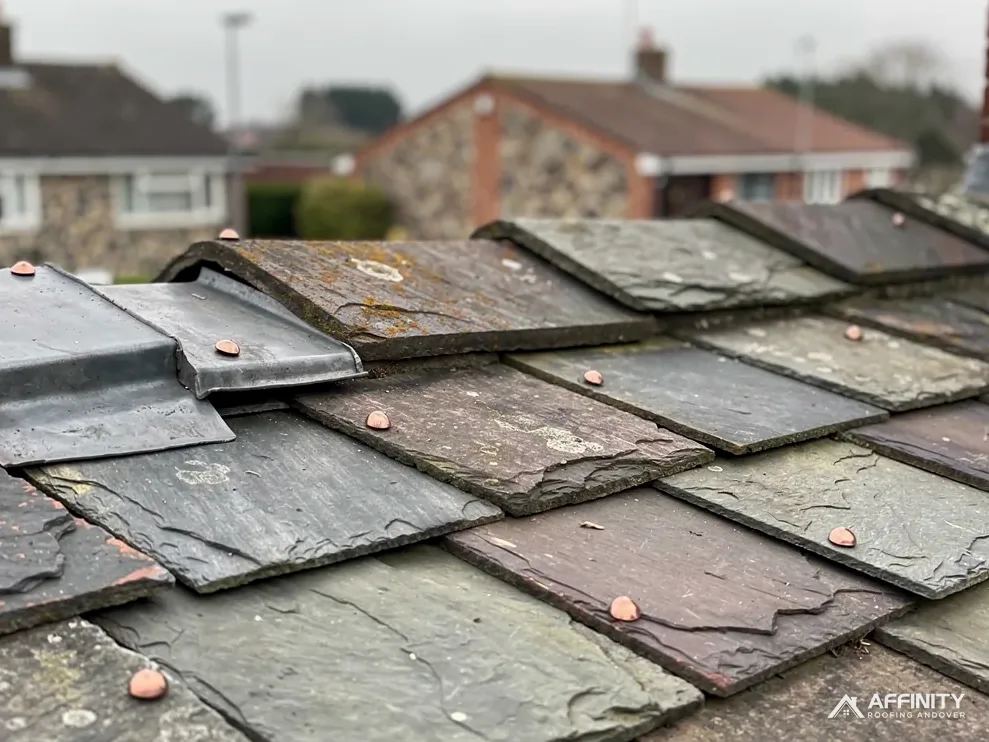
Repairs follow the construction. A slate is held by two nails near its head, so a replacement starts with a slate ripper to cut the old nails, and the new slate is then held by a tingle or hook. A tile is hung from a nib over the batten and often nailed through, and a broken one can usually be lifted and swapped in a short job.
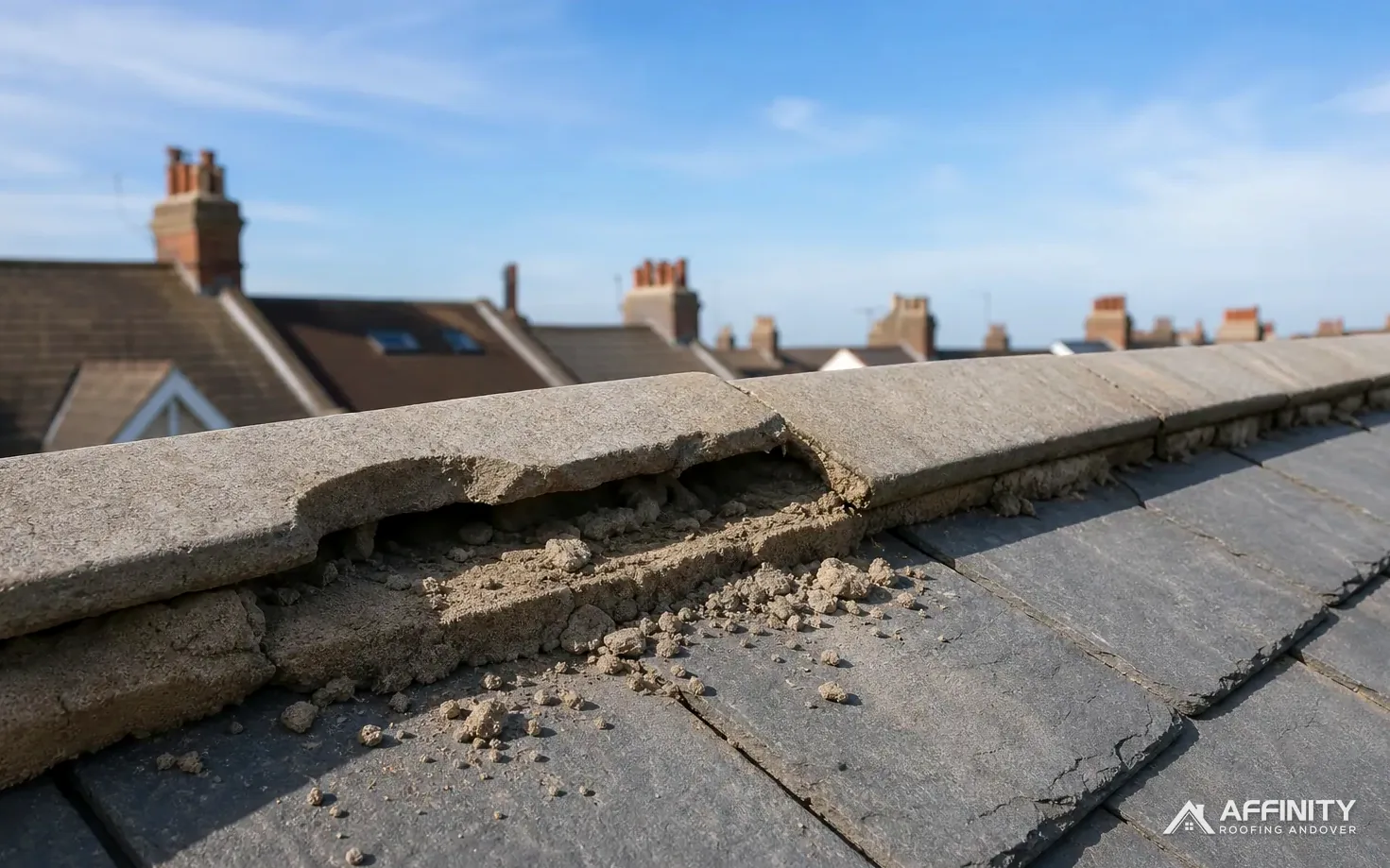
Both can last far longer than the fixings. The failure on slate is usually nail sickness, where old iron nails give out and slates slip while still sound. On tiles the common problems are cracked or porous tiles, failed mortar on ridges and hips, and moss.
Matching matters in either case. A slate from another quarry, or a tile of a different batch, will show. Reclaimed slate is often the best match for an old roof, and for tiles the roofer needs the make and profile, which we identify on the survey. For a cracked slate, our answer on replacing a single slate shows what is involved, and cracked slates are the usual reason for that repair.
Which to pick for your roof
Start with the roof you have. If it is slate and sound, repair it, because replacing slate with something else can alter the look and may need consent. If it is concrete tile and a surveyor says the tile is tired, a like-for-like replacement is usually the lower-cost route.
Then check the pitch. A roof under 20 degrees cannot be covered in natural slate under BS 5534, and a roof under the minimum for a given tile cannot take that tile. The structure matters too. If you change coverings, the weight can shift, and the Planning Portal sets the 15 per cent line for Building Regulations approval. Our answer on slate roof weight works through the test.
Finally, think about how long you will stay. A slate roof pays back over decades, so it suits a house you plan to keep, while tiles meet a shorter horizon at lower outlay. We survey the existing roof, explain which of these it supports, and give you one total in writing for whichever option you prefer. Our slate roofing page has more.