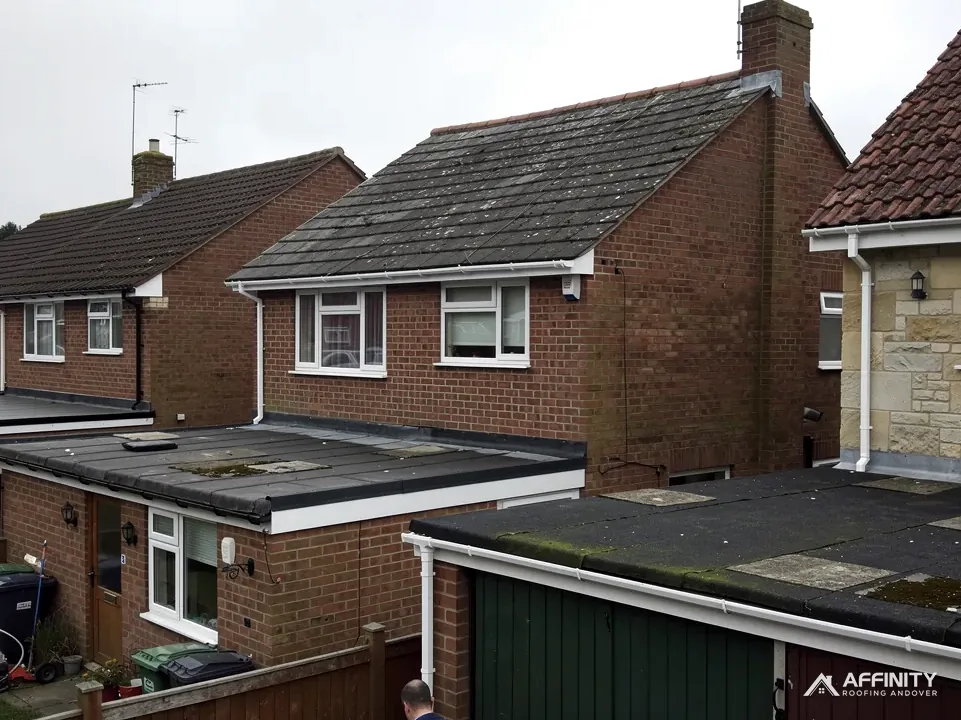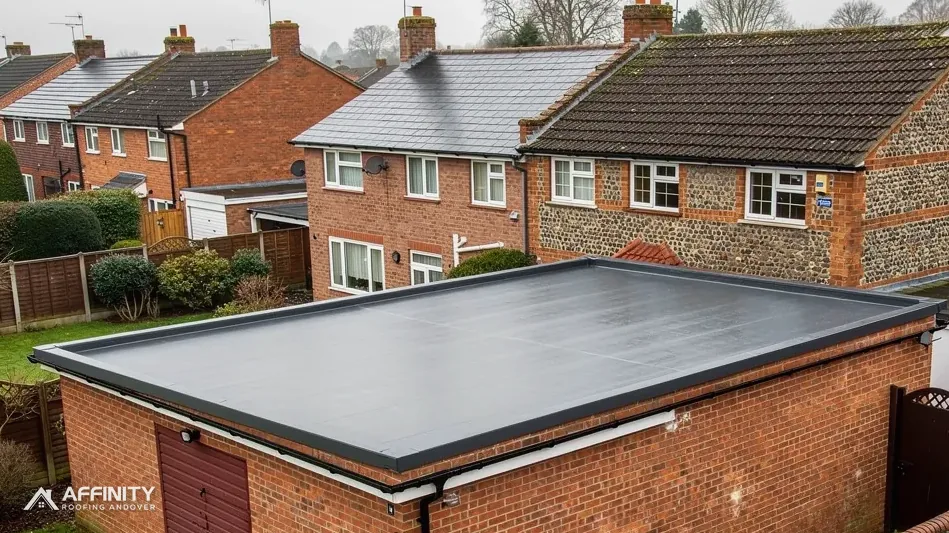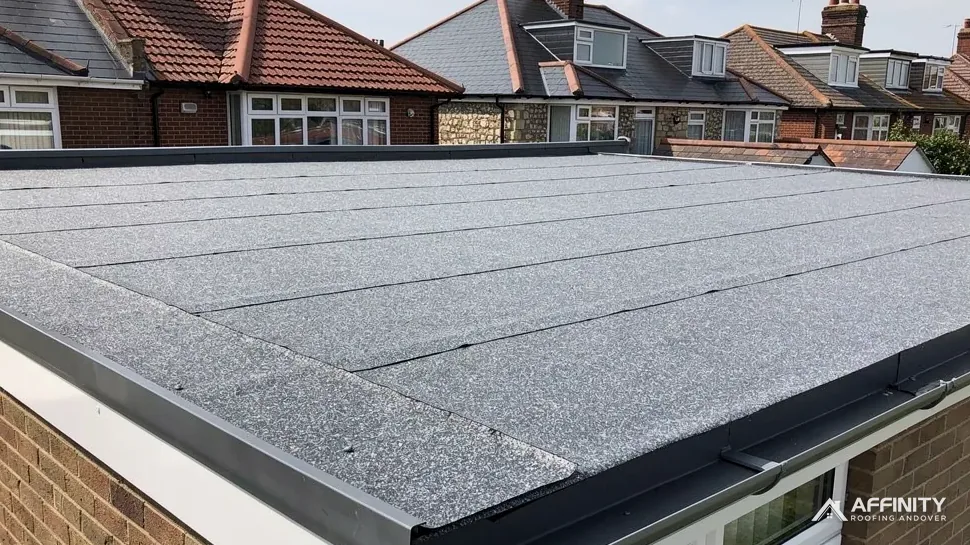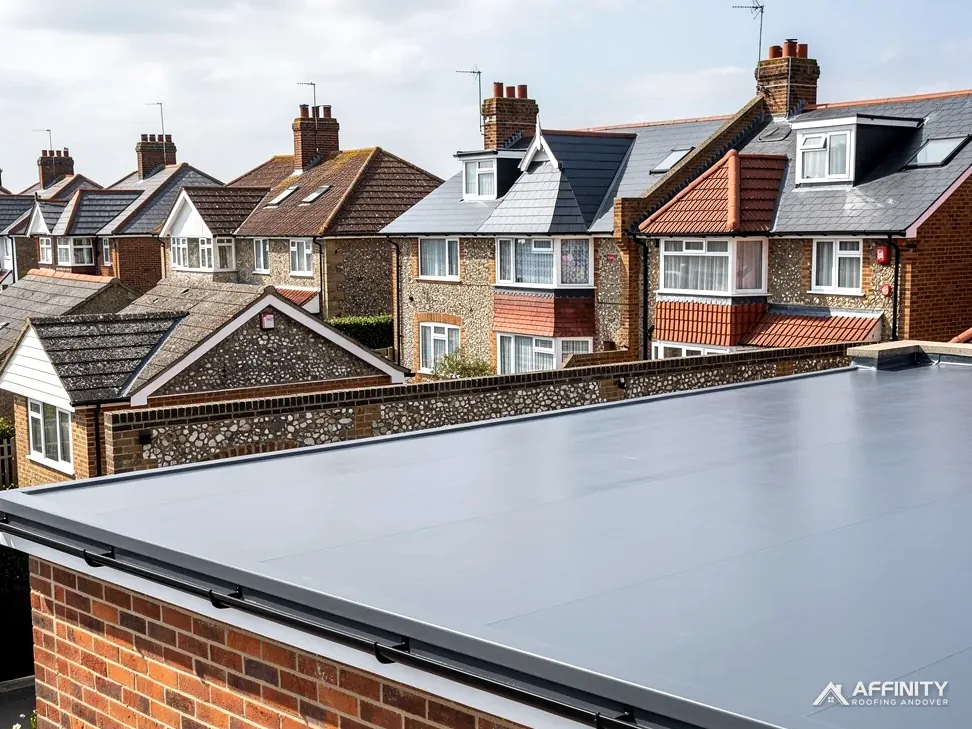
GRP stands for glass-reinforced plastic, the material usually just called fibreglass. On a flat roof it is not delivered in rolls. It is built up on the spot: liquid resin is worked into sheets of glass matting until the whole roof is covered by one continuous layer with no overlaps to peel back.
That is both its strength and its weak point. A skin with no joints sheds water well and takes foot traffic, but it is rigid, so it cannot stretch if the boards under it move. Trouble on a GRP roof can start below the surface rather than in the plastic itself.
This guide sets out how a GRP roof is made, what it does well, where it fails, how long it is said to last, what the material costs and what a repair involves. A flat roof is never truly level: it is set to a gentle slope, called a fall, so rain runs towards the gutter, and that fall matters a good deal to fibreglass. Our flat roofing hub covers the other coverings if you are still choosing.
How a GRP roof is built up
Every GRP roof begins with the deck, which is the layer of boards or sheets the covering sits on. Fibreglass is bonded straight to the deck, so the deck has to be dry, firm and laid to the right fall before anything else happens.
The laminate
The laminate is the structural part of the roof. Resin is brushed or rolled onto the deck, glass matting is pressed into it, and more resin is worked through the matting until it is saturated and the air is rolled out. Once the resin cures, it is hard, light and waterproof. The matting is what stops the cured resin cracking like an unreinforced sheet of plastic.
The topcoat
The topcoat is a pigmented resin finish applied over the laminate. It gives the roof its colour and a smooth, sealed surface, and it carries the wear from sun and from feet. Because the laminate underneath is a dull, fibrous grey, the topcoat is the part you see, and the part that ages first.
Between the deck and the laminate there is often a thin layer of insulation or a vapour barrier on a warm roof, which is a roof insulated above the deck. On a cold roof the insulation sits below the deck instead, between the joists. Either way, the fibreglass itself does not insulate; it only waterproofs, which is why the make-up underneath needs thought as well.
Edges and trims
At a wall junction, or where the roof runs out over the gutter, the laminate is finished with preformed trims. These upstands and drip edges are worth looking at closely on a survey, because they are where a continuous skin has to turn a corner, and corners are where any weakness shows first.
What GRP does well
Fibreglass has stayed popular on small roofs for good reasons, and it is worth saying what they are before getting to the problems.
No joints to open
A felt or membrane roof is made from sheets that overlap, and every overlap is a joint that can open and let water in. A GRP roof has no laps across the main area. When the laminate is laid properly, the only places that can leak are the edges and the details, which makes a leak far easier to trace.
Walk-on and tough
Once cured, GRP is hard enough to walk on, which suits a roof over a garage or a ground-floor extension where someone may step out to clean a rooflight or reach a gutter.
Shape and colour
The resin is wet when it is laid, so it follows awkward shapes such as curves, steps and the base of a dormer cheek without cutting and folding. The topcoat can be supplied in a range of colours. A neat, even finish matters on a rear extension that is looked down on from the bedroom windows.
Fewer maintenance chores
A well-laid GRP roof does not need re-bedding or re-torching, and it does not rely on a layer of chippings or paint to keep the sun off it, because the topcoat is the protective layer. Leaves and moss can be swept off, a soft brush is enough, and a garden hose can rinse a dusty surface. That low upkeep is a quiet reason it suits roofs that are hard to reach and rarely visited.
Where fibreglass roofs fail
GRP is rigid, and almost every serious problem follows from that single fact.
Cracks from deck movement
Timber boards swell and shrink with moisture and flex under load. A rigid skin bonded to them has nowhere to go, so hairline cracks open along board joints and around fixings. Our answer on GRP roof cracking looks at how to tell a surface crack in the topcoat from a split that has gone through the laminate.
A deck that was damp when it was covered
If the boards held moisture when the resin went on, that moisture is trapped. It can bubble the surface, weaken the bond and rot the deck from within. A thorough moisture check and a dry weather window are part of a sound job, which is why GRP laid in poor conditions so often fails early.
Standing water
Ponding, where water sits in a shallow pool after rain, is a design problem rather than a fibreglass one. BS 6229:2025, the code of practice for membrane-covered flat roofs, expects a finished fall no flatter than 1:80, and IKO advises designing for 1:40. A GRP roof with a dip in it will collect dirt in that pool, discolour and wear faster there. Our guide to flat roof ponding explains what causes the dips.
Sun and age
The topcoat takes the weather. Over the years sun fades and chalks the pigment, and foot traffic wears through to the laminate on a path that is walked every week. Once the glass fibres show through, water can wick along them into the deck, so a roof that looks only dull can be closer to failure than it seems.
Poor edges
Weak trims, unsealed penetrations for pipes and rooflights, and badly formed upstands are common sources of leaks and have nothing to do with the age of the roof.
Lifespan, as a typical range
Lifespans are published ranges, not promises, and they only apply to a roof laid well on a sound deck.
What the guides say
HomeBuilding gives GRP a typical life of 25 to 30 years (Sep 2025). Less gives 25 to 40 years (Oct 2026). The sources overlap but do not agree, so treat 25 to 40 years as the span the two guides cover, and expect the bottom of it where the deck has moved or the fall is poor.
What shortens it
Deck movement, trapped moisture, repeated ponding and edge details that were never sealed all take years off a roof. A topcoat that has chalked or worn through to the laminate underneath is a sign that the surface needs recoating before water reaches the glass fibres.
A written lifespan from a manufacturer is a different thing again. A product warranty and a roof's working life are two different things, so never read one as the other.
Ask any installer how long the topcoat is expected to last before recoating, and what they will do about the deck. Their answer tells you more than a headline figure does.
Comparing with other coverings
HomeBuilding's lifespans for the same year are 25 to 30 years for EPDM, a synthetic rubber membrane, and 10 to 15 years for felt; Less gives EPDM 30 to 50 years and felt 10 to 20. If you are weighing coverings, our guide to torch-on felt roofs sets the oldest mainstream option beside this one, and the answer on GRP roof lifespan goes further into what to expect.
What the material costs
Prices for flat roofs vary widely with access, size and the state of the deck, so any figure below is a published guide and not a quote for your roof.
Supply cost per square metre
HomeBuilding's supply-only table (Sep 2025) puts GRP at £110 per m2, against £105 for EPDM and £65 for felt. Supply-only means the material alone: it leaves out the labour, the deck work, edge trims and scaffold that make up a finished roof, so it is not a price per m2 you can multiply by your roof area.
Complete small roofs
For a finished job, Less puts a 15 m2 garage roof at £1,200 to £2,500 (Oct 2026), and MyJobQuote gives flat roof replacement as between £1,500 and £6,000 (Oct 2026). Which? puts a new felt roof for a standard single garage (6m x 3m) at £1,400 to £3,500, and £1,950 to £4,000 for other materials or where new boards are needed, all ex VAT (Nov 2025). These are typical UK ranges.
All of these ranges sit close together at the small end and spread out quickly as size and access change, which is why the published guides cannot settle on one number.
What moves the figure
Board replacement, an awkward access path, the number of rooflights and pipes, and the height of the upstands all push the price up. Our guide to the cost of a new flat roof goes through them. The written quote follows the survey, once we have seen the deck itself.
Repair, recoat or replace
A GRP roof that has failed is not automatically a roof that must be torn off. The question is what has failed.
Surface wear
If the topcoat is faded or chalky but the laminate beneath is sound and the deck is dry, the roof can often be cleaned and recoated. That restores the sealed surface and the colour.
Local cracks and edges
A crack along a board joint can be ground out and laminated over, and a failing trim or upstand can be rebuilt. This works when the cause was a one-off, such as a pipe that was never sealed. It does not work when the whole deck is moving, because new cracks will open next to the repair.
Replacing the covering
When the deck is soft, the roof is ponding badly or cracks keep returning, the sound answer is to strip back to the structure, renew the boards, set the fall and lay a new covering. Under Approved Document L (England) re-waterproofing a flat roof is renovation of the roof, so insulation is normally part of the job; our guide on warm deck and cold deck roofs explains the options.
A word on timing
Resin and topcoat cure properly only in dry, mild conditions, so a replacement is best planned for a settled spell rather than rushed through damp weather. If the roof is leaking now, a temporary patch can hold until the right conditions arrive, and an active leak gets a temporary cover before anything else.
On a survey we check the deck with a moisture reading and the underside from inside, so you see why we recommend repair or replacement before you decide.