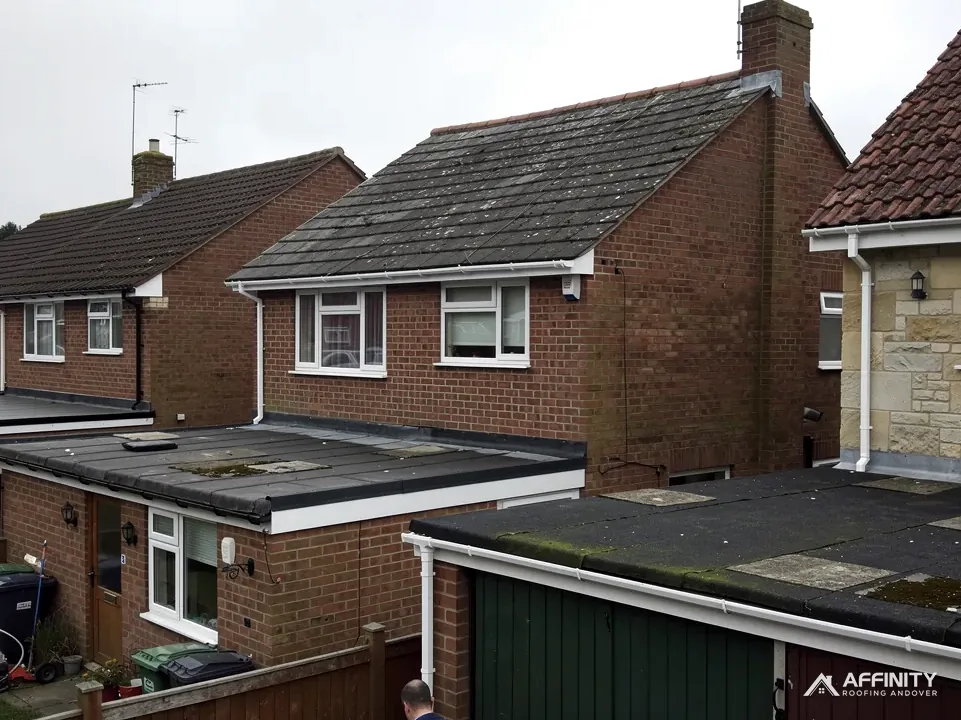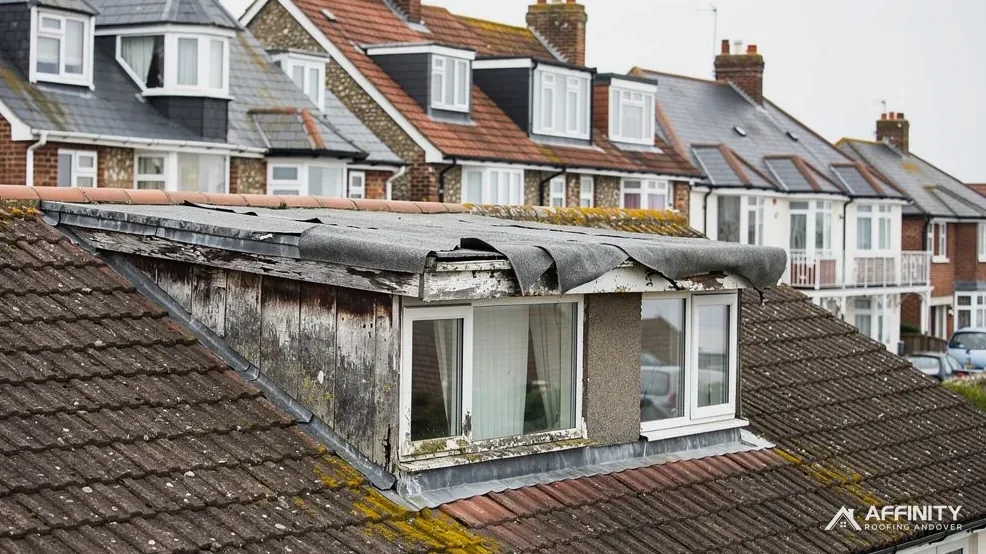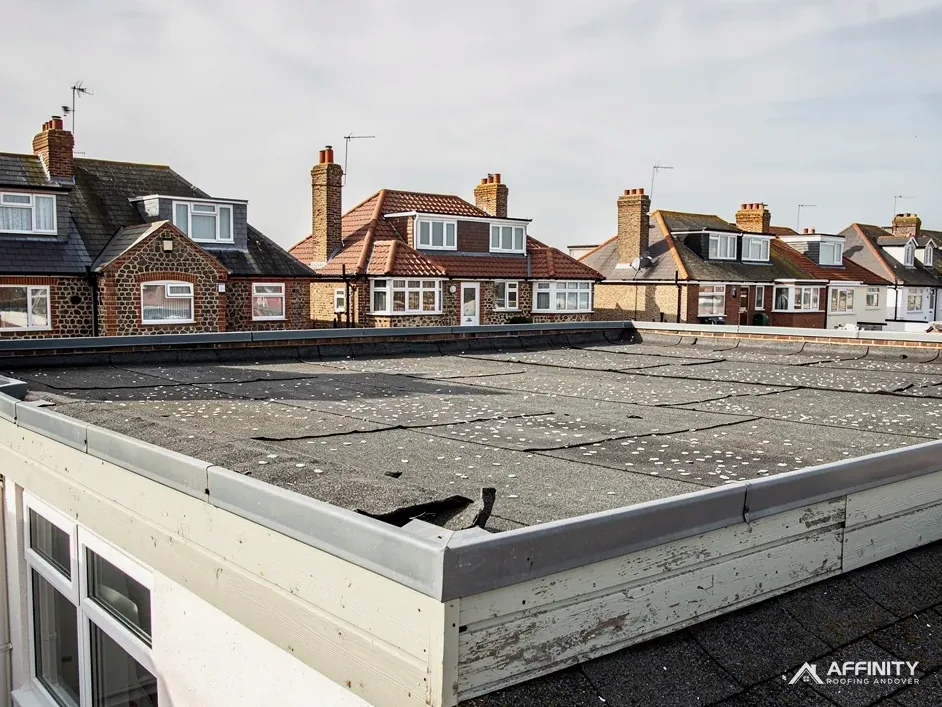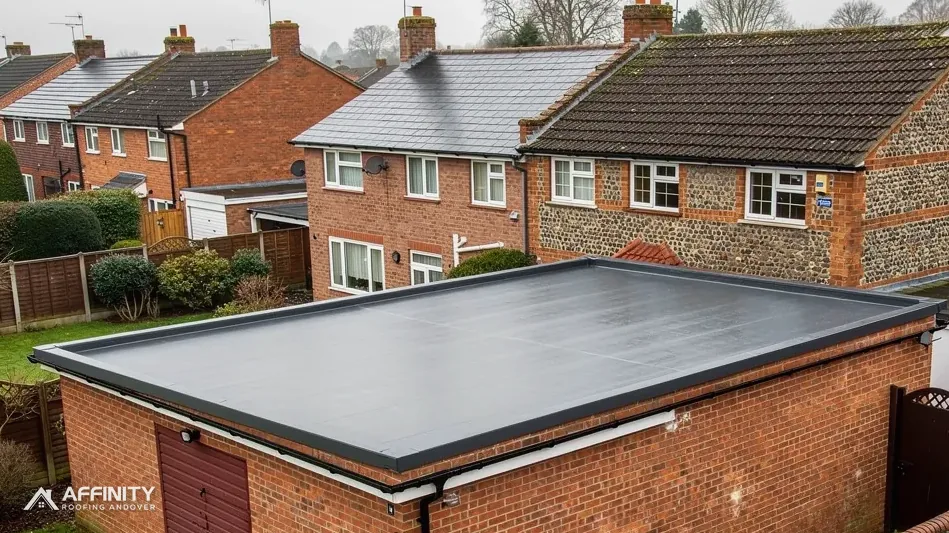
Garage roofs get less attention than house roofs, and they pay for it. Many are flat or nearly flat, lightly built and left alone until a stain shows on the ceiling or water drips onto the car. By then the covering may be at the end of its life, and the deck beneath may have taken in water.
Replacing one is usually a straightforward job, but two things make a garage different from a house roof. The first is the choice of covering, which is wider than on a typical house roof: felt, rubber, fibreglass or a profiled sheet. The second is the possibility that an older garage has a roof of corrugated asbestos cement sheet, which has to be identified before anyone climbs on it and must be removed with care.
This guide sets out the options, explains the asbestos position as the Health and Safety Executive describes it and gives the published cost ranges with their sources. It sits under our flat roofing service, for owners of attached and detached garages and outbuildings.
Replacing a garage roof: the four coverings
Yes, and it is usually a short job. The question is what suits the garage, and four coverings are common.
Felt
Built-up or torch-on felt is the traditional choice. Layers of bitumen-based sheet are bonded to the deck, either with a flame or with cold adhesive. It is familiar, widely fitted and repairable, though its life is shorter than the alternatives. Torch-on work uses a naked flame, so the timber around the roof and the fixings below are protected and the roof is checked for hidden hot spots after the last roll is down.
EPDM rubber
EPDM is a single sheet of synthetic rubber, laid in one piece over the roof where the size allows, and glued at the edges. A garage roof is a good fit for it, because the roof is small and simple. Seams are few and the finish is clean, which is why EPDM is a popular choice for a small, simple roof where the owner wants it to last.
GRP fibreglass
GRP is glass fibre set in resin, laid wet on a timber deck and sealed with a top coat. It forms a joint-free skin, which suits roofs with awkward corners and many upstands, and it needs a rigid deck so it does not crack.
Sheet roofing
A pitched or low-slope garage may be covered in profiled sheets, such as corrugated or box-profile panels of metal or fibre-based material. Replacement sheets in modern materials give a light, quick roof for a detached garage, provided the pitch and fixings suit the sheet.
Our guide to how much a new flat roof costs compares the coverings on price.
Felt, EPDM and GRP: how long each lasts
The published lives help you weigh the choices, but treat them as guide figures, not promises, and note that the sources differ.
The figures
HomeBuilding gives felt 10-15 years, EPDM 25-30 years and GRP 25-30 years. Less gives felt 10 to 20 years, EPDM 30 to 50 years and GRP 25 to 40 years. EPDM is the clearest case of disagreement, so it is better to read both than to pick one.
What the differences mean
Felt is the least costly to buy and the shortest to last. EPDM and GRP cost more at the start and are expected to run for longer. Which suits a garage depends on how long you expect to keep it, how much you value a lower first cost and how much you mind coming back to it.
The deck matters more than the covering
A good covering on a bad deck fails early. Timber boards that have soaked up water, joists that have sagged and ponding that has been there for years all shorten the life of anything laid on top. We look at the deck whenever we can, and we show you the photographs.
Fall
A garage roof still needs a fall, and an old one that has lost it will pond. Water on a small roof soon gets into a weak joint. On membrane roofs the finished-fall minimum in BS 6229:2025 is 1:80, and IKO advises designing for 1:40. Our answer on how long a felt flat roof lasts goes through the felt case in more detail.
Is the garage roof asbestos cement
Garages built or refurbished before 2000 may have roofs of asbestos cement, a material used for decades in corrugated sheets, rainwater goods and other products. HSE's advice is plain: treat a pre-2000 building as containing asbestos until a test shows otherwise.
Why it matters
Asbestos cement is stable when it is intact, but the fibres are dangerous if they are released. HSE guidance A14 describes asbestos cement roofs as always fragile, which is why nobody should stand on one. A weathered sheet can look sound and break under a foot.
Telling it apart
You cannot reliably tell by looking. Asbestos cement sheet and its modern replacements look alike from the ground, and HSE notes it is difficult to tell asbestos insulating board from non-asbestos equivalents. Corrugated, grey, weathered sheets on an older garage are a reason to get it checked, and so are sheets with a faded cement look, a mossy surface or a ridge piece that is a different colour from the rest.
What to do
Do not drill, break, scrub or jet-wash the sheets. A survey by someone qualified to sample the material gives a definite answer. MyJobQuote puts an asbestos survey at around £325 (9 September 2026). If the roof is confirmed or assumed to contain asbestos, plan the replacement around that.
Other asbestos in a garage
Soffits and boards, gutters and flues in older garages can also contain it, and a rotten bargeboard or a cracked gutter may be the first thing to be disturbed. Our short answer on whether my garage roof is asbestos sets out the checks.
Careful removal of asbestos cement sheets
Removing an asbestos cement roof is regulated work, but the regulations distinguish between kinds of work. HSE puts the removal of asbestos cement items, roof sheets and gutters among them, in the non-licensed class when they are taken off with care and are not broken up. That covers sheets that have weathered but are otherwise in one piece.
What careful means
The sheets are unfixed and lowered whole, not smashed, thrown or dropped. Fixings are cut or unscrewed, not broken out. The area below is protected and kept clear. The sheets are wetted where that suits the method, and workers wear suitable protective equipment.
When it becomes notifiable
Work that will leave the material badly damaged or in pieces moves into the notifiable non-licensed category, which brings extra duties, such as notifying the enforcing authority and keeping records. A roof that has crumbled, collapsed or been struck by a falling branch may fall into this group.
Asbestos insulating board
Asbestos insulating board is different. Licensing applies to AIB work that will run beyond a short duration, and AIB can be found in external soffits, so it is checked first.
Our approach
We check the garage before anything is touched, explain in writing which category the job falls into and describe the method. Where the survey points to work beyond careful removal, we set out what that means before a date is agreed.
Waste, skips and the paperwork
Where the sheets go matters as much as how they come off. Asbestos waste is hazardous, and the rules for it are strict.
Wrapping and labelling
Under EM9, HSE's waste guidance, the waste is wrapped twice over and each layer labelled. Sheets are wrapped in heavy plastic and sealed with tape, and the packages are labelled, so no one handles them unknowingly.
Never in an open skip
An open skip, a household bin and general waste are all ruled out for asbestos waste. HSE allows lockable or sealed skips for suitable loads, and the waste travels to a facility that is permitted to take it. Never put asbestos in a normal skip, because the fibres can spread across a drive or a street.
The paperwork
Hazardous waste moves on a consignment note. GOV.UK's household exemption for domestic hazardous waste leaves asbestos waste out, so asbestos always travels inside the regulated system. Carriers must be registered as upper-tier waste carriers, so ask any firm to show you its registration.
Your own garage
If you take the sheets down yourself, you still have duties for the waste, and the first of them is to keep the sheets whole. The council cannot take it with household rubbish, and a tip may refuse it. A contractor who arranges the whole chain saves the risk.
Asbestos is not only a garage matter
The same rules apply to any roof. Our work on this is described on the survey and written into the price.
Garage roof costs and what sets the price
The published ranges show the scale, and none is a price for your garage.
Garage roof ranges
MyJobQuote gives a garage roof replacement as between £750 and £3,500, with an average of £1,500 (26 October 2026). Which? priced new felt on a single garage of 6m by 3m at £1,400 to £3,500, and £1,950 to £4,000 for other materials such as PVC or EPDM with new boards, all ex VAT (Nov 2025). Less gives £1,200 to £2,500 for a garage of 15 m² (27 October 2026).
Asbestos roofs
MyJobQuote gives asbestos roof removal at around £2,750 (9 September 2026), and a survey at around £325. Those are typical UK figures and depend heavily on size, access and disposal.
What sets your price
The roof area, the covering, the state of the deck, the access, the number of upstands and the disposal all matter. A garage with a fibreglass skin and a sound deck is a different job from one with sheets that must be taken down and wrapped. Check whether any quote includes VAT, access and waste. Ours follows the survey and arrives as a single written total, so you are never left guessing what is in it.
Building control and planning
Replacing a covering in the same material raises the re-roofing question. The Planning Portal's tests, less than 25 per cent of the building envelope and less than 50 per cent of the roof, are the starting point, and your building control body decides. Check with Test Valley Borough Council's planning team if the garage is listed or in a conservation area.