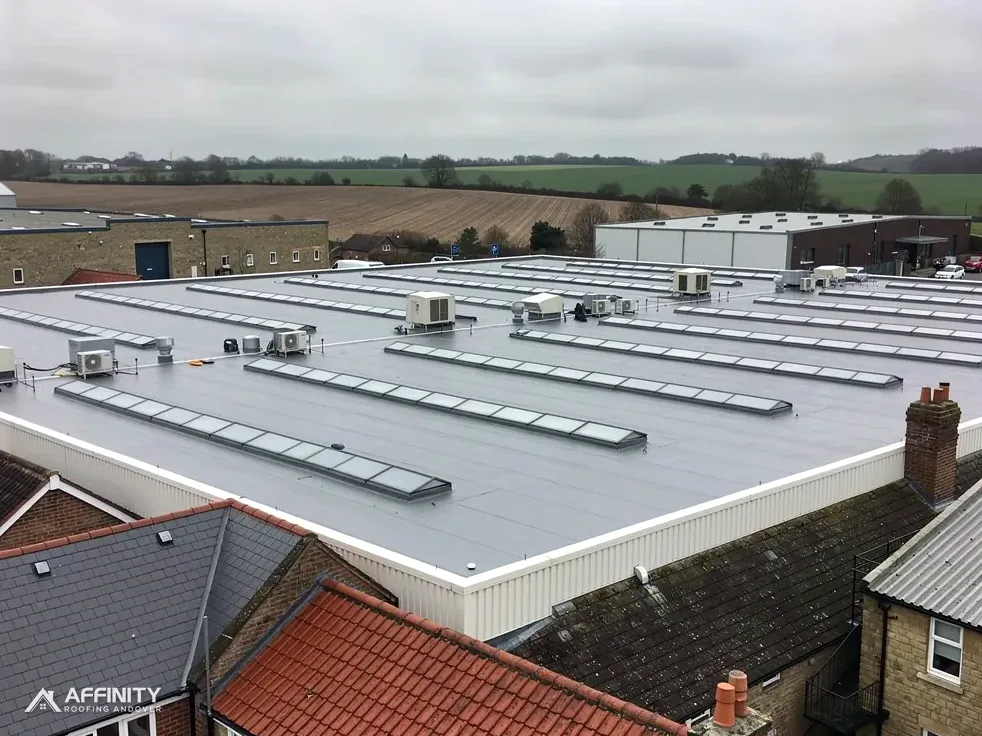
Walk the roof of a typical industrial unit and you will find a run of long, shallow troughs between the ridges. These are valley gutters, also called box gutters, and they sit between two slopes. Everything that falls on both sides drains into them, and then flows along to an outlet at one end or into a rainwater pipe through the wall.
That makes the valley the hardest-working part of the roof. It takes more water than any other part, it is often the lowest point, and it is the place where leaves, bird droppings and silt collect. It is also frequently where a leak first appears inside the unit, as a drip onto the floor or onto stock in the middle of the building rather than at the walls.
When a valley gutter has failed, the options are to patch it, to re-line it or to rebuild it. This guide explains why they leak, what the lining systems are and how each behaves, what to look for at the outlets and in the falls, and how the survey leads to a written price. It is written for the unit owner, the landlord and the facilities manager, not for the specialist.
Why box and valley gutters leak
A valley gutter is a waterproof lining laid in a channel between two slopes. It leaks when the lining is breached, when the channel cannot carry the water or when the outlet cannot clear it.
Age and fatigue
Linings age. Metal sheet cracks where it has flexed with the temperature, felt splits along its folds, and sealed joints dry out and open. The longer a lining has been in place, the more of these small failures it carries.
Debris and standing water
Leaves, moss, litter and silt collect in the bottom of the gutter and hold water against the lining. Standing water speeds up ageing, and a blocked outlet can let the gutter fill to the point where water spills over the edge, or up under the sheets on either side, and into the building.
Poor falls
Valleys are meant to drain. BS 6229:2025 keeps a minimum finished fall of 1:80 in internal gutters, and IKO advises designing for 1:40. A gutter that has sagged, or was laid too flat, holds a pool that never leaves, and the lining below it fails early.
Damage from outside
Maintenance staff walking in a gutter, tools dropped into it and plant fixed through its sides all puncture linings. Gutters are often used as access routes because they are flat, which is the worst use for a thin lining.
Overflow and capacity
A gutter sized for lighter rainfall, or serving a larger roof area than it was built for after an extension, overflows in heavy rain even when it is clear.
Reading the signs from inside and out
A leaking valley usually announces itself. The skill is in working out where the water entered, which can be some distance from where it drips.
Inside the building
Look for drips along the line of a valley, stains on the lining or ceiling beneath it and damp patches that return after each heavy shower. Water can run along a purlin or the underside of a sheet before it falls, so the drip point is often downstream of the fault. Rust on the underside of metal sheets near the valley is another clue.
On the roof
From a safe position we look for splits, lifted edges, ponding and signs of repairs. Old patches stacked on patches suggest a lining that has failed more than once. Sealant that has cracked, fixings that have lifted and silt at the low end all tell part of the story. Looking at the outlet shows whether it is clear and whether the lining turns into it properly.
At the ends and the sides
The ends of a valley, where it meets a gable wall or a parapet, and the sides, where the sheets lap over the gutter edge, are details where water gets in. We check upstands, end stops and lap sealants as part of every survey.
Photographs and moisture checks
We photograph each defect and, where useful, check insulation and boards near the valley for moisture. The results show whether the problem is a local failure or a lining at the end of its life. Our guide to commercial roof condition surveys describes what you receive.
Lining systems and how they compare
There is no single best lining. The choice depends on the existing gutter, the access, the budget and how the roof is built.
Lead
Lead sheet has a long record in gutters. Lead can last for over 80 years, a lower bound given by MyJobQuote for lead flashing. Royston Lead's brochure lists codes 5 to 8 for box gutters and tapered valley gutters, the heavier gauges suiting the harsher duty, while code 3 is for soakers only. Lead sheet roofs follow BS 6915, via Approved Document C, not BS 6229, which covers flexible membranes. It is heavy and carries a higher material cost than most alternatives.
Single-ply membrane
PVC, TPO or EPDM sheet can be formed to the gutter and welded or bonded to the roof coverings on either side. EPDM is published at 25 to 30 years by HomeBuilding and at 30 to 50 years by Less, so the lifespan is a range. Our guide to single-ply membrane roofs covers the family.
GRP and liquid systems
Glass-reinforced plastic is laid in the gutter as a rigid, jointless shell. HomeBuilding gives GRP 25 to 30 years, and Less 25 to 40. Liquid-applied linings can be reinforced and brushed or rolled into awkward shapes. Both rely on a clean, sound base.
Felt
Built-up felt, with HomeBuilding at 10 to 15 years and Less at 10 to 20, is the older, lower-cost choice and the shortest-lived of the group.
We recommend a system after the survey, with the reasons.
Outlets, overflows and keeping water moving
A lining can be perfect and the gutter still fail if the water cannot leave. Outlets are the other half of the system.
Outlet size and position
An outlet has to be large enough for the flow from the roof area it serves. A gutter with a single small outlet at one end may handle ordinary showers and flood in a heavy storm. Where gutters have been extended, or the roof has taken on more area, adding or enlarging outlets can be part of the lining job.
Outlet details
Where the lining meets the outlet, it must be bonded or clamped to the outlet body and finished with a guard to keep debris out. A poorly made outlet joint is a common leak. We rebuild the joint as part of a new lining and fit leaf guards where blockage is likely.
Overflows
An overflow is a safety measure that sends excess water out through the parapet or end wall, where it is seen and does no damage, before it can rise high enough to spill into the roof. A gutter with no overflow depends entirely on its outlet. Adding one is often a sensible improvement.
Downpipes and below
Rainwater pipes can block below roof level, where nobody looks. For rainwater guttering, Brett Martin gives a fall of 1mm for every 600mm, so a run that has dropped in the middle will keep a pool. We check that the whole path is clear. Our answer on why a commercial roof drains badly deals with the problems that follow.
Repair, re-line or rebuild
The survey leads to one of three routes, and the right one depends on how much of the gutter is still sound.
Patching
A small split, a failed joint or a damaged outlet collar on an otherwise sound lining can be patched. Of the three it disturbs least, and for a lining within its expected life it can be enough. A gutter that has been patched repeatedly, though, is telling you something.
Re-lining over the old
Where the existing gutter structure is sound but the lining has failed, a new lining can often be laid over the old, with proper preparation. This avoids stripping the whole gutter and keeps the work short. The old lining must be dry and stable, and the new one must be compatible with it. We test the base before recommending this route.
Strip and rebuild
If the boards beneath are rotten, the insulation is wet or the falls are wrong, re-lining only hides the faults. The sound answer is to strip the gutter back, repair the base, correct the falls and fit a new lining and outlets. It is the largest job, and it delivers the longest life.
Whole-roof thinking
When the roof around the gutter is close to worn out, lining the gutter within a wider scheme lets one set of access and disruption serve both. Our commercial roof maintenance guide shows how a programme avoids this sort of surprise.
In each case the photographs record the lining and the base before you decide. On an older unit we also check the asbestos register first, because HSE's starting assumption for a building dating before 2000 is that asbestos is there, and asbestos cement sheets beside a gutter are fragile.
Cost drivers and getting started
Valley gutter work is priced after a survey. The gutter in front of us determines the figure, and a number quoted in advance would rest on guesses.
What drives the price
The length and width of the gutter, the lining system chosen, the amount of base repair, the number and size of outlets, the access to the roof and the number of valleys on the building all matter. Occupancy during the work and the condition of the sheets either side add further factors. Lead lengthens the bill, liquid systems shorten it on awkward shapes, and a gutter that needs its falls corrected is a bigger job than one that needs only a new skin.
Programme
We agree the order of work with you, valley by valley, so that the building stays dry throughout. Dates move with the weather, and the plan allows for that.
What you receive
A written account of what we found, photographs of each defect, our recommendation and one written total price for the agreed work. If the survey reveals extra problems, we explain them before anything changes.
Getting started
Tell us where the drips appear and which valleys run above them. A few photos from inside help, as do any earlier repair records. We arrange the survey from there. Our commercial roofing hub sets out the wider range of roof types and buildings we handle.