Look along the laps of a profiled metal roof on an industrial unit and you may see thin orange-brown lines creeping out from the edge of each sheet. The paint is lifting a little way in from the edge, and the lines follow the cut ends. The middle of the sheet looks fine. That pattern has a name, cut-edge corrosion, and it is a normal way for a coated steel roof to show its age.
Owners often read it as a sign that the whole roof has failed. Sometimes it is. More often it is an early warning that can be dealt with long before water comes in, if someone looks at it at the right moment. Left alone, the rust works under the coating, loosens it and eats into the steel itself until the sheet can no longer shed water.
This guide is written for the people who own or manage the unit, not for roofing specialists. It explains where the corrosion comes from, how to recognise it, what treatment involves, when a sheet or a whole slope should be replaced instead, and how a survey separates the two. It contains no repair prices because the cost depends on the roof in front of us.
What cut-edge corrosion actually is
A profiled steel roof sheet starts life as a flat coil. The steel is coated on both faces with a protective layer, usually zinc with paint over the top, and the coil is then rolled into its profile and cut to length. Everything that protects the steel is on the faces. The edge that the shears leave behind has no coating on it at all.
The bare edge
That fresh edge exposes a thin strip of raw steel to damp air. Rain runs across it, condensation settles on it and in the laps between sheets, water is held against it. Steel exposed to water and air rusts. The coating does slow the process, but it cannot stop rust moving sideways under the paint once it has a foothold.
How it travels
Rust takes up more room than the steel it replaces. As it forms under the paint it pushes the coating away from the sheet, which exposes more steel, which rusts in turn. The result is a band that creeps in from the edge, narrow at first and wider as the years go by. It follows the cut ends at the eaves and ridge, the side laps and any place where a sheet was trimmed on site, such as around a roof light or a penetration.
Where it does most harm
Edges that hold water suffer worst. A sheet laid with a shallow slope, or a lap where water pools and dries slowly, will corrode faster than a steep, well-drained run. That is why fault-finding on these roofs begins with the drainage as much as with the metal itself.
How to spot it before it leaks
You do not have to be a roofer to notice the signs. A walk around the building and a look at the roof from a safe place on the ground, or from a window or mobile platform, tells you a good deal.
On the outside
Look for orange or brown staining along the edges of sheets, especially at the lower ends where they overhang the gutter. Look for paint that is blistering, flaking or standing proud of the sheet. Look at the gutter for rust flakes and grit, which wash down and collect there. Streaks running down the wall beneath the eaves can show where rusty water has been falling for some time.
On the inside
From inside the building, check the underside of the sheets near the laps and eaves. Pinpoints of daylight are a serious sign. So are drip marks on the floor or on stock, dark stains on the lining or the insulation, and damp patches that reappear in the same place after heavy rain.
On the roof itself
A close inspection shows the depth of the damage. Surface rust that has not yet broken the steel can be brushed and treated. Rust that has flaked away to leave pitted or thinned steel, or a hole at the edge, is a different matter. We check by hand and by eye, and record each affected edge in photographs.
Do not walk on a metal roof to find out. Some sheets will carry weight and some will not, and corroded steel can fold or tear. Roof lights beside a sheet can crack. If you cannot see the edge from the ground, ask for it to be checked safely. Our guide to fragile roofs and working at height explains why.
Treatment: what it involves and where it works
Treating cut-edge corrosion means stopping the rust and rebuilding the protection that has been lost. It works when the steel underneath is still sound.
The sequence
First, the edge is cleaned back. Loose paint and rust are brushed or abraded off until we reach sound metal or a firmly bonded coating. Next, a rust-inhibiting primer goes on the bare steel, and then a protective coat on top of that, taken beyond the area of damage and onto good paint so the edge of the new coating is not itself a place for water to creep under. Where the lap geometry allows, a sealant bead or edge tape at the lap keeps water off the cut face afterwards.
Why it works
The repair replaces the missing barrier on the cut edge, so the steel is no longer exposed to water. Doing it before the steel has lost thickness extends the life of the sheet and delays the cost of replacement. For a roof that is otherwise in good condition, it is often the most economical step available.
Why it does not always work
Treatment cannot restore steel that has been consumed. If the corrosion has thinned the edge, perforated the sheet or made the lap unsound, a coat of paint covers a failing structure and gives a false picture. Treatment also fails where the cause persists: a lap that holds water will soon corrode again unless the lap or the fall is addressed as well.
On a survey, we show you the affected edges in photographs and say whether each one is treatable or not. A mixed roof is common, with some edges sound and others past saving.
When the sheet has to be replaced
There comes a point where treating an edge is no longer the right answer, and it helps to know where it falls.
Signs the sheet is past treatment
A sheet should be replaced when the steel at its edge has holes, when rust has run well in from the edge and thinned the sheet across the width of a lap, when fixings have corroded through and no longer hold, or when the sheet has begun to deform and no longer seals against its neighbour. A sheet that flexes noticeably under a hand pressing on the edge has lost its stiffness along with its thickness.
Replacing individual sheets
If only a few sheets are affected, they can be replaced individually. The new sheet must match the profile, and it must lap correctly with its neighbours or leaks follow. Fixings and sealants are renewed at the same time. Our answer on replacing individual roof sheets sets out how that works and where it stops being sensible.
When a whole slope is the answer
If corrosion runs across a whole slope, patching sheet by sheet costs more over time than renewing the covering. A new covering can go on in two ways: strip and replace, or overclad, which means fitting fresh sheets above the old ones. Our answer on overcladding a metal roof explains when it suits.
Old sheets and asbestos
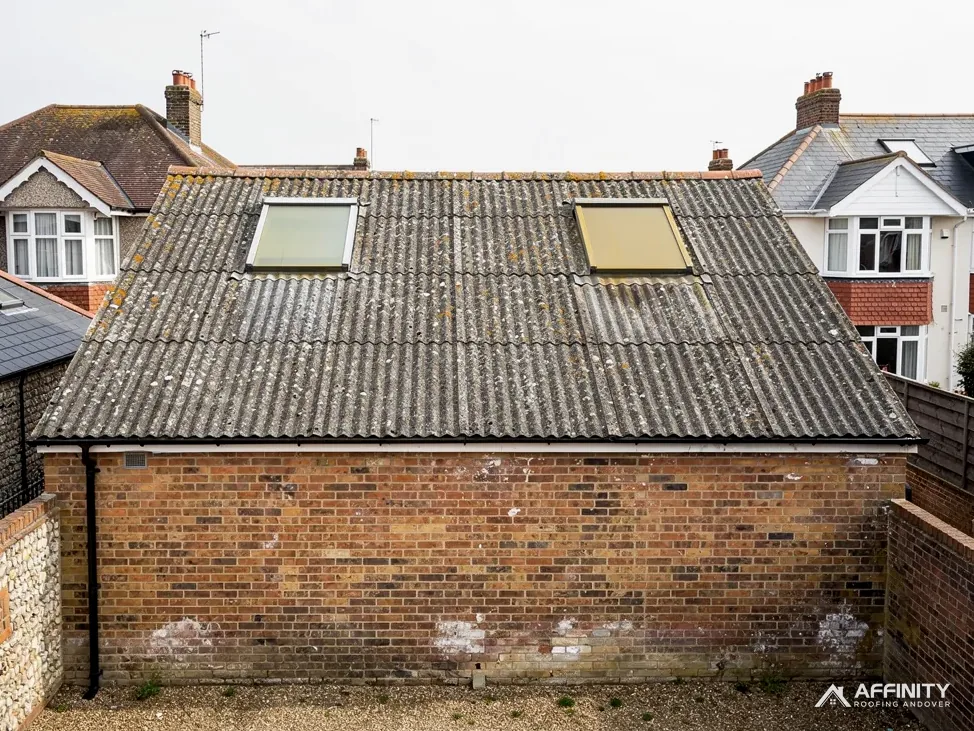
On buildings from before 2000, older sheets may be asbestos cement and not steel. Any such sheet is fragile and must be identified before work, a check we make on every survey.
Slowing it down once it has started
Because the bare edge is unavoidable, the practical aim is to slow the damage and plan for the end of the sheet's life.
Routine care
Clear the gutters and valleys, because water that cannot drain stays against the edges. Remove moss, leaves and debris that hold moisture. Look at the roof after severe weather and after any trade has been on it. A yearly look at the edges, planned into the roof maintenance programme, spots changes while they are still small.
Coating the edges early
Treating an edge in the first few years, when only the outer coating has gone, is cheap compared with treating it once rust has spread. Some owners choose to coat cut edges across a whole roof as a planned job, with the aim of pushing back the date of replacement. Whether that pays depends on the age and condition of the sheets. A survey can show whether the steel is thick enough to be worth protecting.
Keep records
Photographs of edges from year to year show how quickly corrosion is moving. A rate of change you can see lets you budget properly for treatment or replacement and gives a landlord and tenant a shared basis for deciding who pays for what.
Tell us what you can see
The more you can tell us, such as when the roof was built, what was done to it before and where it leaks, the better. A building owner who knows the roof history saves time and avoids wrong guesses.
Photos of orange edges from the ground, taken each year from the same spot, tell you more than a single close-up taken once.
Survey, quote and next step
Deciding between treatment and replacement is a matter of reading the roof, and that begins with a survey.
What the survey covers
We inspect edges, laps, fixings, roof lights and gutters, from safe access, and look at the roof from inside where we can. We photograph the affected edges and note which can be treated and which cannot. Where the roof is old enough to raise the possibility of asbestos cement, we ask for the register or arrange a check before any sheet is touched.
What drives the price
The extent of the corrosion, the area of roof, how many edges can be treated against how many must be replaced, the access needed, and whether staff and stock remain inside all affect what the job costs. No single figure fits every roof. After the survey you receive one written total price.
Treat now or replace later
For a roof with sound steel and early corrosion, treating the edges now is usually the sensible route. For a roof with deep corrosion, spending on repairs may only delay the day of replacement. Where the answer is close, we set out both options with the cost drivers of each, and you choose.
Making a start
Give us the address with a few pictures of the orange edges, or tell us where the roof leaks. Our commercial roofing page lists the other systems we work on, and our guide to commercial roof condition surveys shows what you will receive.