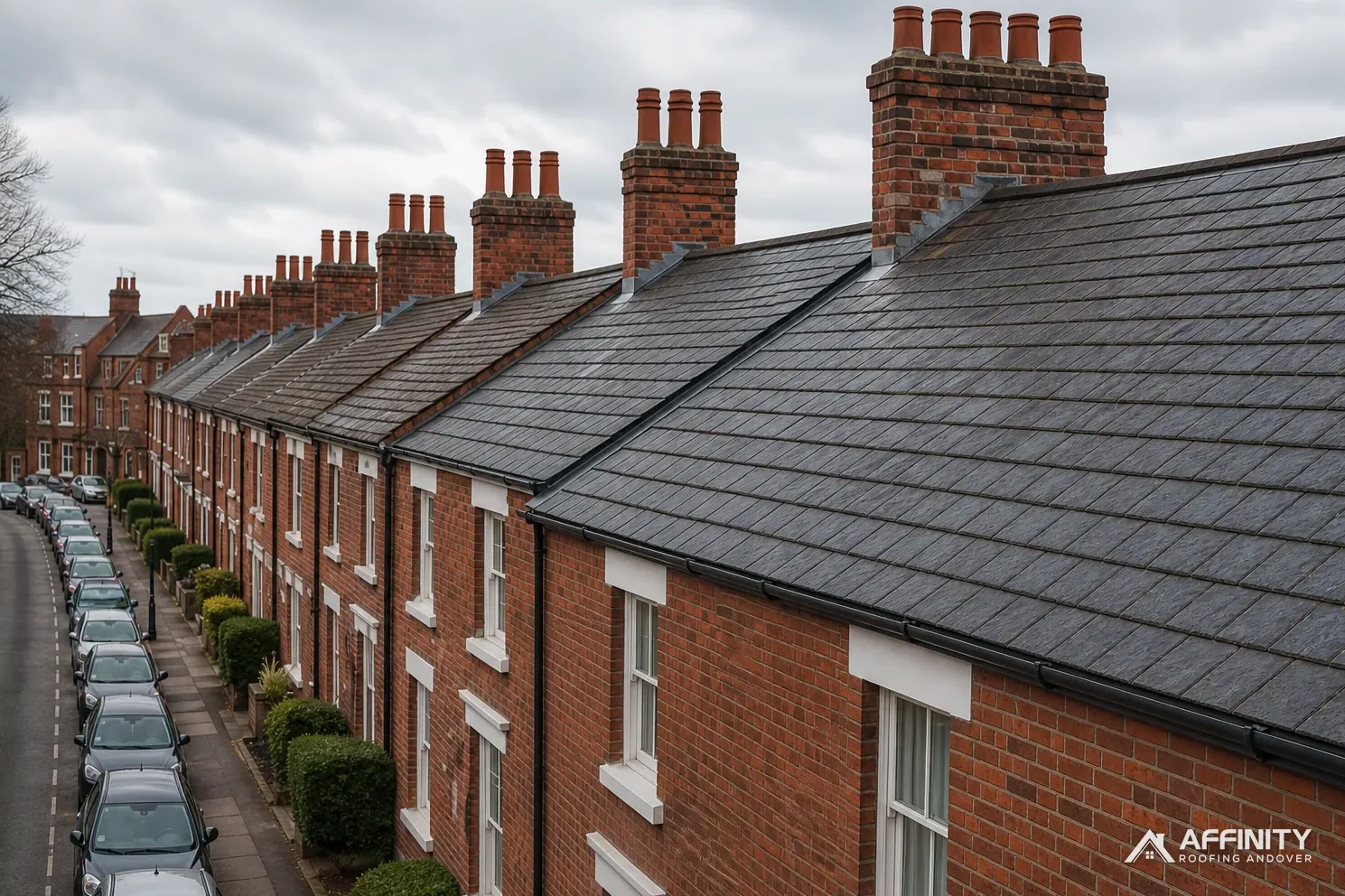
The short answer
Usually, yes. Chimney work is done at roof height, where a ladder offers no safe platform, so a scaffold or a tower is the norm. Only a minor job on a low stack may be reached another way. Where the frame would stand on a public pavement or road, the highway authority licenses it first, and that is a matter to settle with your scaffolder.
Why a ladder is not enough
Repairing a chimney means standing beside its top with both hands free, handling heavy bricks, mortar and lead. A ladder leaned on the roof gives no level footing and nowhere to set materials, and a cracked stack cannot be leaned on at all.
Most chimney work is therefore done from a platform. A full scaffold rises up the side of the house, with boards at working height and guard rails along the edge. A scaffold tower, a freestanding frame on wheels or legs, can be enough for a lower stack on an extension or a bungalow. A crawling board or roof ladder suits a quick look from the slope but cannot support rebuilding.
The choice follows the height of the stack, the pitch of the roof, the ground around the house and the task at the top. A tall house with a ridge stack calls for full scaffold, whereas a stack above a single-storey extension may need only a tower.
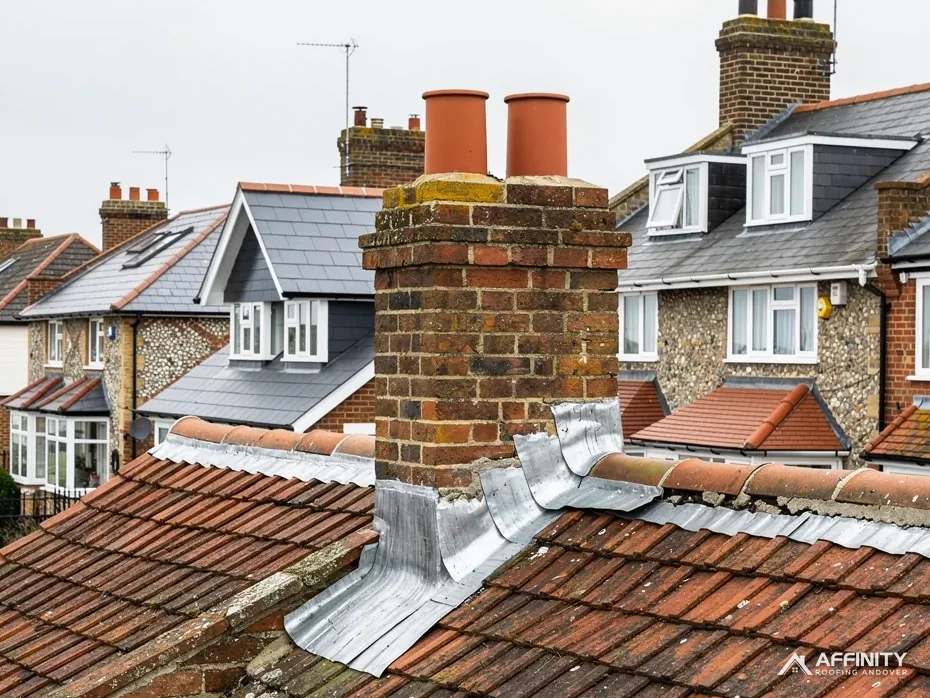
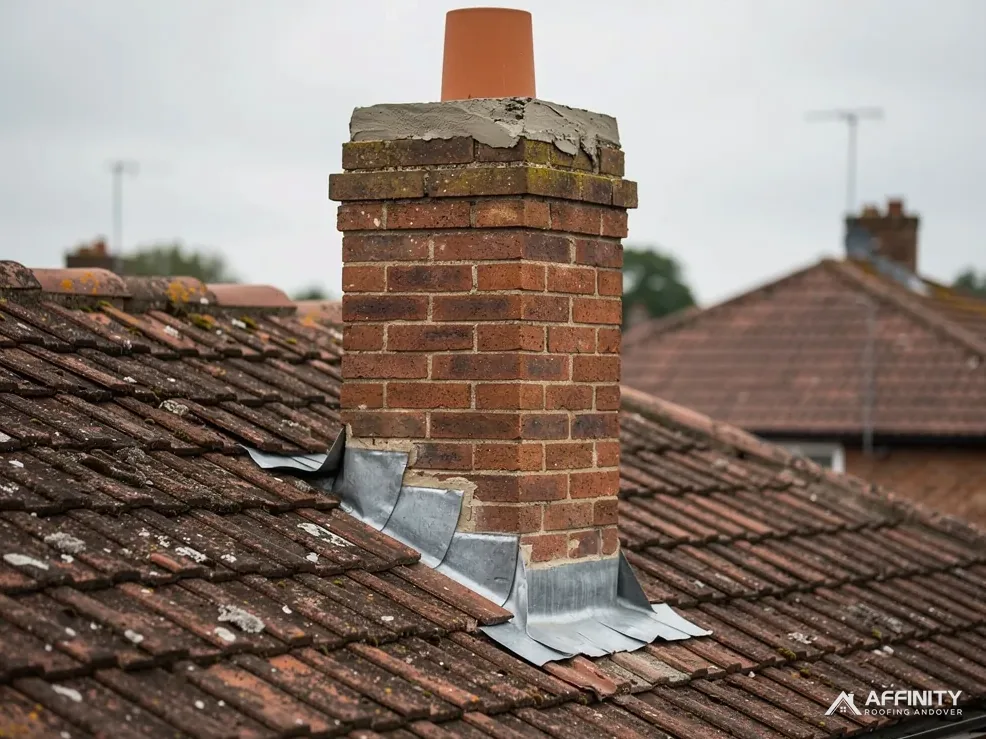
The same platform lets us photograph the stack at close range, so you can judge the pictures before agreeing to anything.
What a chimney scaffold looks like
A scaffold built for chimney work differs from one built for gutters. It rises above the eaves, often with a platform at stack height or just under the pots, so the roofer can lean in rather than out. Guard rails and toe boards run round the edge, and the frame is tied to the building so it cannot sway.
Hampshire County Council expects the scaffolds it licenses to follow BS EN 12810 and 12811, or with NASC guidance TG20:13. Those standards cover design and assembly, and a reputable scaffold firm builds to one of them whether or not a licence is involved.
When a stack is coming down, the platform has to remain until the stack is dismantled and the roof beneath is made good. A scaffold struck too early forces the finishing to be done from a ladder, which defeats the purpose.
Since poles and boards are a big share of the effort, book them once for the whole job. If you are planning leadwork, repointing and a new cap on one stack, say so at the start, so every task is done under one set of poles. The chimney repairs hub lists the work that combines well.
The highway scaffold licence
Section 169 of the Highways Act 1980 brings any scaffold that stands on or reaches over a public road or pavement under the highway authority's licensing. Across Test Valley, Andover included, the authority is Hampshire County Council, and the district councils there grant none. Wiltshire Council and West Berkshire Council hold the role in their own areas.
Hampshire County Council wants the scaffolding firm, not the householder, to submit the application. Hampshire County Council's charge is £211.90 on application for the first 2 weeks, then £72 for each further 2 weeks, and it asks for ten clear working days ahead of the start, with no extensions.
Wiltshire Council routes applications through its MiPermit portal, from the company erecting the frame. Wiltshire Council's fee depends on the notice given, £143.80 with more than three working days or £164.70 with fewer, and a licence runs for 28 days. West Berkshire Council also expects the scaffolding provider to apply, at £125, plus £71 per week, with no less than ten working days.
Hampshire County Council and West Berkshire Council both state that a private road needs no licence. Wherever one is needed, leave the notice period before your start date, and ask the scaffolder to handle it.
Planning the access, and the price
Raise the question early, because access governs timing. A licence needs notice, so a repair that cannot wait may start from a tower on the private side of the house, or in a different order. A stack that is dropping brick can be made safe first, then repaired properly once the scaffold is up.
Neighbours matter as well. A scaffold that needs to stand on their land needs their agreement, and a party wall notice may be required if the work touches a shared wall. Our answer on party wall notices for a chimney breast covers that.
Access is one of the factors that sets the price of a chimney job, with the height, the number of faces and the repair itself. It sits inside the one written total we give after the survey. Where you hold several quotes, see whether each includes scaffold and VAT, so the totals mean the same thing.
If a stack is already shedding bricks, send a photo before arranging anything, and we will advise on a make-safe first and the access for the full repair afterwards.