The short answer
A rendered chimney is repaired by finding out what is behind the render first. Small cracks can be sealed or patched if the render beneath is firm, but hollow or blown render has to be cut back and replaced, and a stack with water behind it needs the cause fixed before anything is covered again. Re-rendering the whole stack is the answer when the damage is widespread.
What a crack in the render is telling you
Render is a coat of sand and cement, or sometimes lime, spread over the brickwork. On a chimney it protects exposed brick, but it has a weakness: it cannot be seen through. A crack on the surface may be shallow and harmless, or it may be the visible end of a larger fault underneath.
Hairline cracks that wander across the face often come from the render drying and shrinking. A crack that runs in a straight line, particularly at a brick course, can follow a joint in the brickwork behind. A stepped crack or a bulge points to movement in the stack itself.
The simplest test is sound. Rapping the surface gives a solid note where the render is bonded and a dull, hollow one where it has parted from the brick. Hollow render is no longer doing its job, because it has lost its grip and rain can run behind it unseen.
Staining below a crack, damp patches on the chimney breast indoors and algae streaks all hint that water is passing through. Fine cracks can be sealed. Wide or hollow areas cannot, because the material beneath is already compromised.
Water behind the render
When water has got behind render, it soaks the bricks and mortar and then has no easy way out. Frost expands the trapped moisture, which pushes the render away from the brick and widens every crack. Salts carried by the damp can also stain the finish. The process feeds itself, which is why a small fault can become a large one over a few winters.
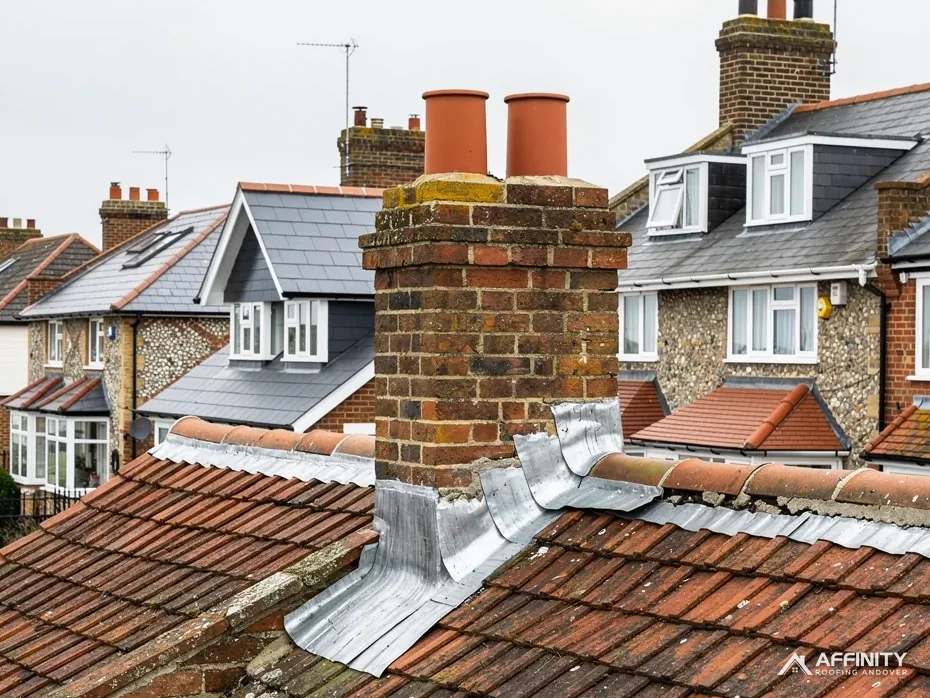
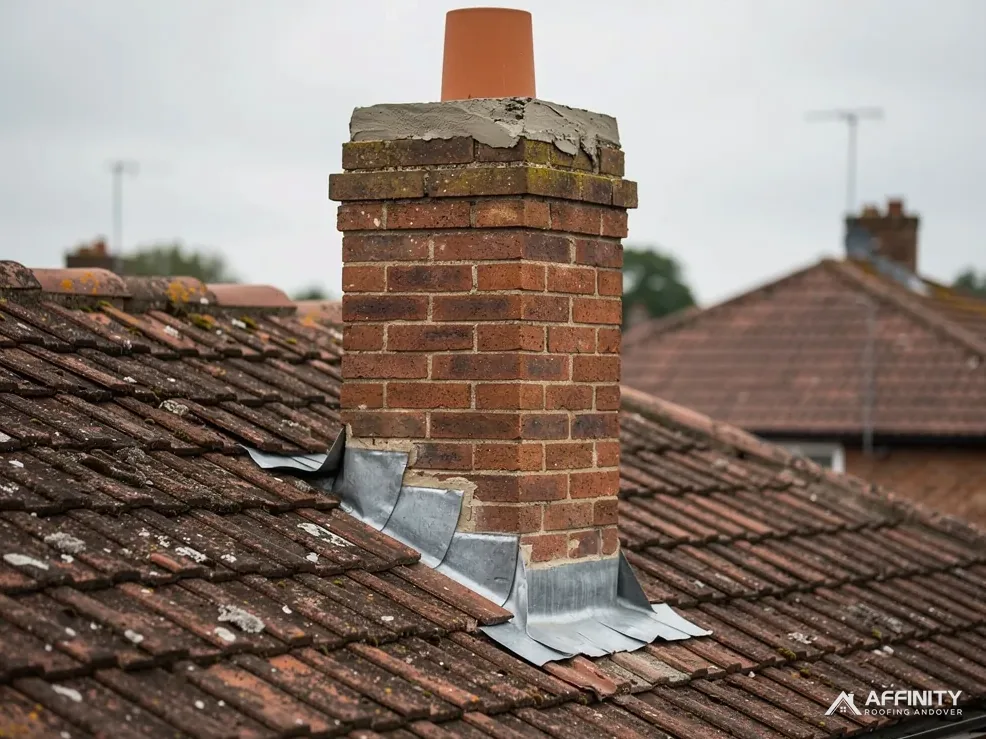
The entry point is often higher up. A cracked flaunching, the sloped mortar cap at the top, lets rain run down inside the stack. A pot with no cover, or lead that has lifted at the base, does the same from below. Fixing the render without dealing with these leaves the cause in place.
For that reason we inspect the entire stack, not only the cracked patch. We check the top, the pots, the lead and the brickwork exposed where the render has fallen away. Often the bricks underneath are in better shape than the render suggests, and a cut-back reveals sound masonry that only needs repointing before it is covered.
Where the bricks are crumbling, they are replaced first. Our answer on spalling chimney bricks explains why.
Patch, cut back or re-render
There are three levels of repair. The first is a seal or a small patch, suitable only where the render is firm all round and the crack is fine. The second is cutting back the hollow areas to a firm edge, then repairing the exposed brickwork, then rendering again in coats. The third is stripping the whole stack and re-rendering it, which is the right call when hollow areas are widespread or the finish is failing on several faces.
Mix and finish matter. A new render should suit the old one and the brick, so it does not crack away at the junction. Fresh render also needs time to cure and must be protected from frost and heavy rain while it sets, which affects when the work can be done. Our page on chimney waterproofing describes what else can protect a stack afterwards.
Painting over cracks is the quick option and rarely the lasting one. Paint can hold a damp stack looking fine for a season while the problem grows behind it.
Work from one scaffold or tower can cover render, flaunching and lead in a single visit, which saves paying twice for access. For the full range of work on stacks see our chimney repairs page.
What a quote depends on
The cost of repairing a rendered stack follows from a short list: the height and number of faces, the access, how much render must come off, whether bricks need replacing and whether the flaunching and lead are included. A small patch on a low, easily reached stack is a very different job from re-rendering a tall stack that rises from the ridge.
Because so much hides under render, the real price comes after a survey. We climb to the stack, photograph each face, tap and probe the render, and record where it is hollow. The photographs let you see the same areas we see, and they form the basis of the quote.
You then receive a single written total, rather than a figure given over the phone from a description of a crack. Anyone quoting without a look at the stack is guessing what lies behind the render.
If the stack proves to be sound and only the surface is tired, the repair is modest. If the survey finds movement, we report it, and the answer may be partial rebuilding. Either way, you can see the reasoning in the pictures before deciding.