
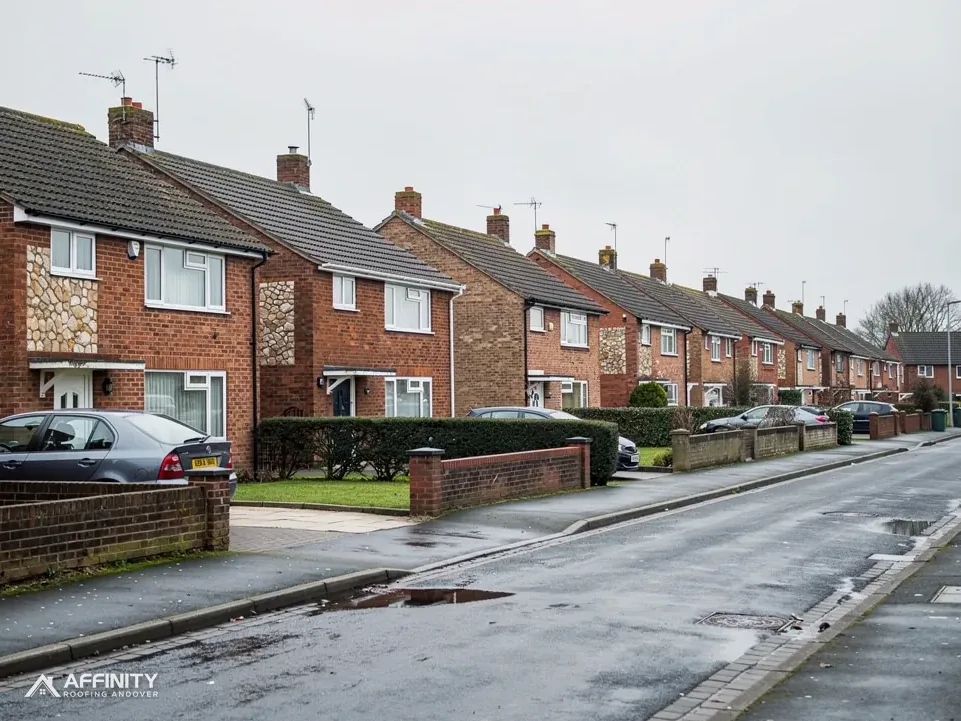
Roofers in Wilton
A Wiltshire town with Grade I houses and a ruined church
Wilton has 152 listed buildings near its centre, several of them Grade I, and the centre lies in Flood Zone 3. We examine each roof before quoting.
Wilton roofs, from the House to the High Street

Wilton House and its grounds
Wilton House and the Palladian Bridge, both listed Grade I on 4 August 1951, with Washern Grange also Grade I.

The church and its ruin
The Church of St Mary and St Nicholas, Grade I, and the ruined church nearby, a scheduled monument.

Conservation-area town houses
Homes inside the Wilton conservation area, which reaches within about 0.75 km of the centre, where appearance changes are scrutinised.
Wilton west of Salisbury
South Newton lies to the north and Salisbury to the east, with Laverstock beyond. Dinton and Fovant lie west, Alderbury south-east and Porton north-east.
- Distance
- 21.8 road miles south-west of Andover
- Planning
- Wiltshire Council
The Wilton roof report
Local editionWilton, WiltshireGrade I houses and a scheduled monument
Grade I buildings and a ruined church: how a Wilton roof is cleared
Wilton is 21.8 road miles from Andover, a Wiltshire town of 4,303 residents with 152 listed neighbours near its centre. Read on for how consent works for houses, churches and a scheduled monument, and what a Flood Zone 3 centre means for drainage.
Three desks, one Wiltshire council
Wilton is a Wiltshire town, and the 2021 Census lists its parish as Wilton (Wiltshire), to tell it from other places of the name elsewhere. The census counted 4,303 usual residents. The council is Wiltshire Council, a unitary authority, so one body settles the planning question, licenses scaffolding on the road and answers building control. For a roof job that means three desks in one organisation, with no district or county office in the chain.
Wiltshire Building Control takes inspection bookings and payments on 0300 456 0113, from 9am to 4:30pm on weekdays. The council runs the service itself from Monkton Park in Chippenham. A homeowner may appoint a registered building control approver, on the register in force since 6 April 2024, in the council's place, and if you do, our survey notes go to that approver and the technical questions follow.
The first call usually decides how the job runs. If a roof touches a listed building, a conservation area or a scheduled monument, planning comes first, and the dates for everything else wait on its answer. If it touches none of those, building control may be the only question, and a quick call settles whether it is even that.
Wilton has plenty of the first kind. Its listed buildings include at least four at Grade I, and a conservation area and a scheduled monument also fall inside a short radius of the centre. In a place like that, a clean answer to the consent question is worth more than a cheap quote. We establish the position at the survey and write it on the first page of your folder.
Only Wiltshire Council can say whether an Article 4 direction touches your address. That question goes to the council, with the address, before any price is set.
A roof that needs only a few tiles replaced is routine upkeep. The survey says so briefly, with a picture beside the note, and the job goes ahead without paperwork. Even then, the photographs are kept, so the next roofer can see what was done and when.
Owners of larger historic properties often have an architect or conservation adviser already. We work alongside them, supplying the photographs, the measurements and the repair specification, and leave the application to whoever holds the consent file. One set of pictures then serves everybody. Where no adviser is involved, the same record goes straight to the council's planners.
For heavier work, weight matters. Covering a roof with something that weighs 15 per cent more than before is a Building Regulations question, and the structure is checked first.
Wilton House, the Palladian Bridge and the old church
The National Heritage List records 152 listed buildings within about 900 metres of the centre of Wilton. Wilton House is Grade I (list entry 1023762, first listed on 4 August 1951), and so are the Palladian Bridge (1023763) and Washern Grange (1023764). Wilton's Church of St Mary and St Nicholas is also Grade I (1365914, listed on the same date in 1951). Few towns of this size can claim as much.
The parish church is Anglican and still holds services, so its roof follows the faculty process. Catholic and Methodist churches answer to their own arrangements; a Quaker or Unitarian building, or any church that has shut, needs listed building consent. Whoever looks after a church building should say which denomination it is and whether it is in use, so that the survey fits the right route.
The Ruined Church of Ss Mary and Nicholas is a scheduled monument within about 500 metres of the centre (list entry 1005637). Works that affect a scheduled monument need scheduled monument consent, which is granted by the Secretary of State, not the council. A tiled roof on a nearby home leaves it untouched, yet any digging or heavy plant close to it is something to ask about before starting.
On listed houses the route is listed building consent. Altering the covering, the pitch or an opening changes what makes the building special, and Wiltshire Council's planners decide. Our guide to listed building roof repairs sets out the steps. Sound old slates or tiles are lifted, graded and reused wherever possible, and only the gaps are filled with new ones.
The Wilton conservation area reaches within about 0.75 km of the centre, and the area holds roofs to a stricter standard of appearance. An owner of an unlisted house there should telephone the council before altering colour or material. The council's map answers the question for any one address, and it is read before a price is given.
Roofs on buildings of this rank can be large and intricate, with lead valleys, parapet gutters and tall chimneys. Surveying them takes time, and it is done from a tower or the scaffold, one junction at a time.
Close-up photographs are taken at arm's length wherever we can reach, with a scale marker in frame, and wide shots from the ground, so the roof can be read from the folder without a second visit. Planners, architects and conservation advisers can then work from the same pictures, and a later contractor can see exactly what was found and when.
“In Wilton the consent question comes first, and the tiles come second.”
Flood Zone 3 drainage and the 28-day licence
Environment Agency maps put the centre of Wilton in Flood Zone 3. A roof cannot alter that, but it is one of the places where water is controlled or lost. Parapet gutters, hopper heads and downpipes carry the rain to the ground, and a blocked outlet on a big roof can pour a great volume against a wall. The survey follows each downpipe to its end and photographs any gully that is choked.
If a scaffold has to occupy the road, Wiltshire Council's MiPermit portal issues the licence. As Wiltshire Council sets it out, whoever supplies the scaffolding applies, and the fee is £143.80 for notice beyond 3 working days or £164.70 for less. Licences of every type are valid for 28 days, and scaffolding and hoarding are separate.
A large listed roof can use all of 28 days and more. We plan the work so that the covering is stripped and made watertight early, with the lead and ridge following. A large listed roof may need a second licence, and if so the plan states it at the outset, since a repeat application repeats the fee and the delay.
Wilton roofs get the services the survey points to. Roof repairs deal with slipped slates, cracked tiles and failed flashings, lead roofing covers the valleys, gutters and abutments on older buildings, and slate roofing covers re-slating where the nails have rusted away.
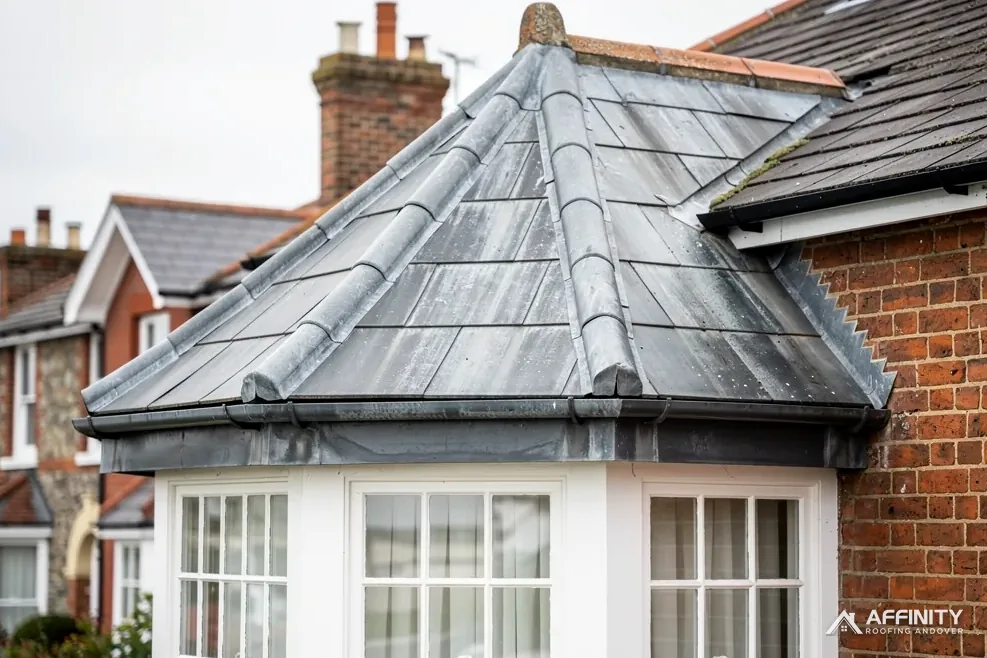
Lead deserves a word. On old roofs it lines valleys, parapet gutters and chimney flashings, and MyJobQuote says lead flashing may last more than 80 years. It can split at a fold, lift at a fixing or be stolen, and a patch laid against the grain of the original work fails again. The photographs show its condition, and a repair is made to suit the way the lead was first laid.
Water coming in is met with an immediate cover, and the repair follows. A shop, hall or office gets that cover promptly, with the repair timed around opening hours.
Shops and offices on the town's streets share some complications. A pavement scaffold needs a clear route for pedestrians, a bay marked in the road needs its own suspension, and the tenant on the ground floor needs to know when deliveries will be affected. We plan those points at the survey and note them for the scaffolder.
Gutters on old streets deserve the same attention as the roof. A leaking joint stains the wall below, and the stain is often blamed on the stone or the damp course. The photographs show whether the gutter is the cause. A failed joint is often a quick fix.
Fixes and replacements in Wilton





Wilton roofs: Grade I listings, the monument and drainage
Does the scheduled ruined church in Wilton affect a nearby roof job?
Only if the work touches the monument. The Ruined Church of Ss Mary and Nicholas is a scheduled monument within about 500 metres of the centre, and works that affect it need scheduled monument consent. A normal roof repair elsewhere leaves it alone, but ground work or heavy plant close to it would call for a question first.
Which consent route covers a roof repair at a Wilton church?
Wilton's Church of St Mary and St Nicholas is listed Grade I and still in use for worship in the Church of England, so the faculty process covers its roof. Catholic and Methodist churches use separate schemes, while listed building consent applies once a church has closed. Say which denomination applies, and whether it is in use, when booking.
How many days does a scaffold licence run for in Wilton?
Every Wiltshire Council licence type is valid for 28 days. Wiltshire Council's fee is £143.80 for notice beyond 3 working days and £164.70 for less, and whoever supplies the scaffolding makes the MiPermit application. Hoarding is a separate licence. A large listed roof may need a second licence, which we flag at the start.
Why does Flood Zone 3 matter to a Wilton roof?
The centre of Wilton lies in Environment Agency Flood Zone 3, so keeping roof water away from walls matters. Gutters, parapet gutters, hopper heads and downpipes should end at sound drains. Each run is traced at the survey, and a leaking joint or a blocked outlet is photographed for you to see.
Wilton's neighbours near Salisbury
Start a Wilton roof job with a survey
Send an address and photo. Consent is checked first, and one written total follows.
10-year workmanship guarantee, in writing.