
Roofers in Mortimer
Red brick cottages, the Fair Ground and the Hampshire border
Mortimer stands on the Berkshire side of the Hampshire border, so the council that answers for a roof here differs from the one two miles away.
Mortimer roofs from the Fair Ground to the Common

Red brick cottages
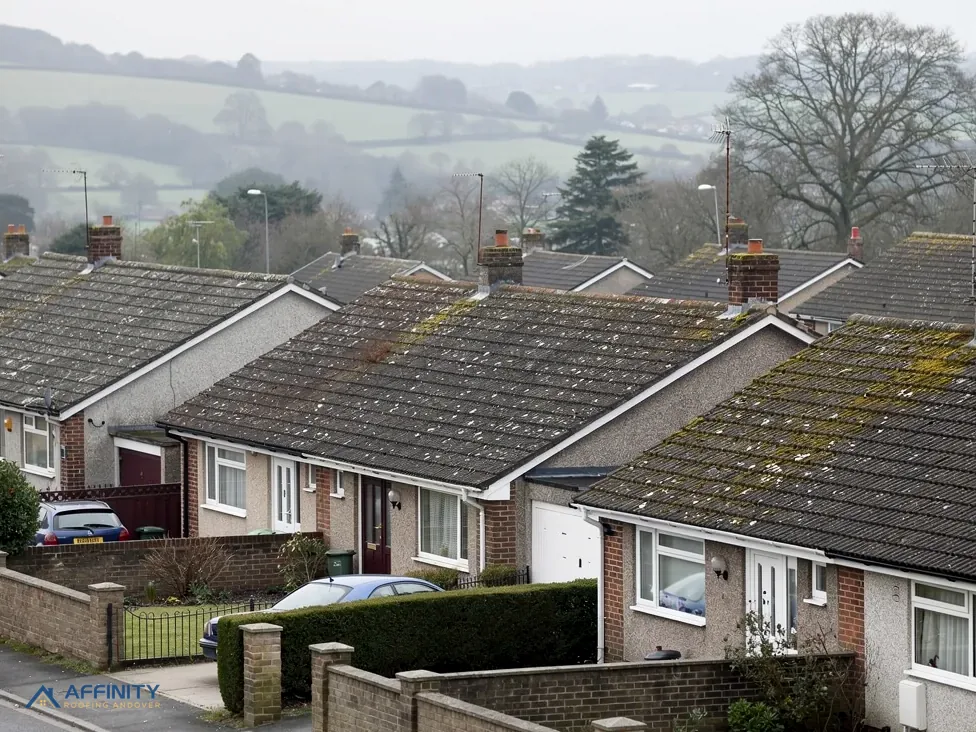
In 1923 the VCH described the village as containing several large houses and many cottages of red brick.

Old village and new
A large open space known as the Fair Ground divides the old village from newer buildings near Mortimer Common.

St Mary the Virgin's church
In 1923 the VCH placed the church a little south of the main street, near Foudry Brook.
Mortimer between Burghfield Common and Silchester
Burghfield Common lies north, Silchester and Pamber Heath south-west, Bramley south, and Tadley and Aldermaston to the south-west and west.
- Distance
- 23.9 road miles north-east of Andover
- Planning
- West Berkshire Council
- Council
- West Berkshire Council (unitary)
The Mortimer roof report
Local editionMortimer, BerkshireA border village and a thin heritage record
Mortimer's roofs on the county border: which council answers, and what the record leaves to the survey
Mortimer is a Berkshire village of 2,929 people on the Hampshire border, south-west of Reading. This report explains which councils plan, inspect and license a scaffold here, and why a survey matters where the heritage record is thin.
A border village and the council across it
Mortimer is a large village on the Berkshire side of the Hampshire border, south-west of Reading, and the 2021 Census counted 2,929 usual residents in its built-up area. The border matters to a roofer more than to most. Silchester, only a couple of miles to the south-west, is in Hampshire and answers to Basingstoke and Deane Borough Council. Mortimer answers to West Berkshire Council, a unitary authority that decides planning and also manages the highways, which is not the case for Silchester. Two roofs a short drive apart can follow quite different council paperwork.
Inspection under the Building Regulations in Mortimer comes from Building Control Solutions, or BCS (0300 790 0580), which West Berkshire and Wokingham run together. Silchester's inspectors work for the Hampshire borough instead. At the very first enquiry we note which side of the line your address is on, since that decides whom to ask about almost everything that follows.
For a re-roof the Planning Portal sets two cut-offs, 25 per cent of the building envelope and 50 per cent of the roof. Keep under both and building control seldom needs an application. We work to those figures in Mortimer, and BCS is asked about any job that sits near either one ahead of the booking. Anyone who prefers can appoint a registered building control approver in its place.
Weight is the second check. Should the new covering be 15 per cent or more heavier, it needs Building Regulations approval, and the Planning Portal advises assessing the structure beforehand. Concrete tiles going onto a roof built for lighter material are the textbook case. We measure the rafters, the timbers under each slope, and write down their size and spacing.
The surveyor climbs from the gutter line: eaves first, then slopes, ridge, and every junction with a wall or stack. On the way we note broken or displaced coverings, crumbling mortar and flashings, the strips that seal a joint, that have come adrift. Every finding is tied to a photograph, and the pictures sit beside the written comments in the report you receive. Access for the survey itself is simple: a ladder at the eaves, a camera and a notebook. Where part of a roof cannot be reached safely, the report says what we could not see, instead of guessing.
A modest fault does not call for the full process. One broken tile or a lifted flashing is a small repair and is described as one. Council questions only arise when a slope has failed outright, the roof is to take a new shape, or the house is listed, and the answers reach you on paper.
Red brick, the Fair Ground and a thin heritage record
Mortimer's written history is more about land than buildings. In 1923 the VCH described a large, scattered village with a station on the Reading and Basingstoke railway, containing several large houses and many cottages of red brick. It also recorded that a large open space known as the Fair Ground divided the old village from the newer buildings on the borders of Mortimer Common, and that Mortimer Common and other lands were inclosed in December 1804 under an Act of 1802.
Those lines describe a layout, not a roof survey, and a century has passed. What they give us is a sense of two eras living side by side: older cottages, and later houses near the Common. A repair that suits one will not always suit the other, so each is treated on its own terms. The VCH in 1923 also located St Mary the Virgin's church a little south of the main street, near Foudry Brook.
The heritage record is thin. Historic England's list holds no listed building within about 500 metres of the centre, and whether a conservation area covers a street is for West Berkshire Council's map to say. Before any covering is proposed, your address is checked on the list and on West Berkshire Council's map, and a listed house cannot be altered in character without consent.
Whether an Article 4 direction applies to your road is for West Berkshire Council to answer, and we put the question to it wherever there is doubt. Our guide to planning permission for roof work describes the treatment of a dormer or any similar alteration. Alterations are treated differently from repairs and matching re-covering, and the survey says which category your project falls into.
With few designations to lean on, the survey carries the weight. We photograph every junction, record the fixings and, when we can reach safely, raise a couple of tiles to show the battens and underlay beneath. If your house is one of the red brick cottages the 1923 VCH mentioned, the photographs also record the brickwork around chimneys and gables, where mortar tends to give up first. The inclosure of 1804 concerned land, not roofs, and a survey of your own house says far more about its covering than any history can.
That record is useful beyond the repair. A later buyer, a surveyor or the council can read what the roof was, what was found and what was done, without anyone having to climb up again.
“Two miles from Mortimer's red brick cottages, a different council answers for the roof.”
A scaffold licence charged by the week
A scaffold that crosses a pavement or part of the road comes under section 169 of the Highways Act 1980. In Mortimer the licence is West Berkshire Council's to grant. West Berkshire Council requires the scaffold provider, and not the resident, to put in the application, so you do not touch the form. It wants at least ten working days' lead before the scaffold is due up.
Materials are ordered only after the survey is agreed, and tile or slate is matched to the existing roof by size, colour and thickness. For a street of mixed ages this is the step where mistakes creep in, and holding a sample against the roof beats a catalogue number. If we cannot match a tile, you hear before the order is placed.
West Berkshire Council charges £125 for the licence plus £71 for every week it runs. A long job costs more in licence fees than a short one, which is why we sequence the work to keep the scaffold up only as long as the roof needs it. Private ground sits outside the scheme altogether, and we confirm at survey whether your plot is private.
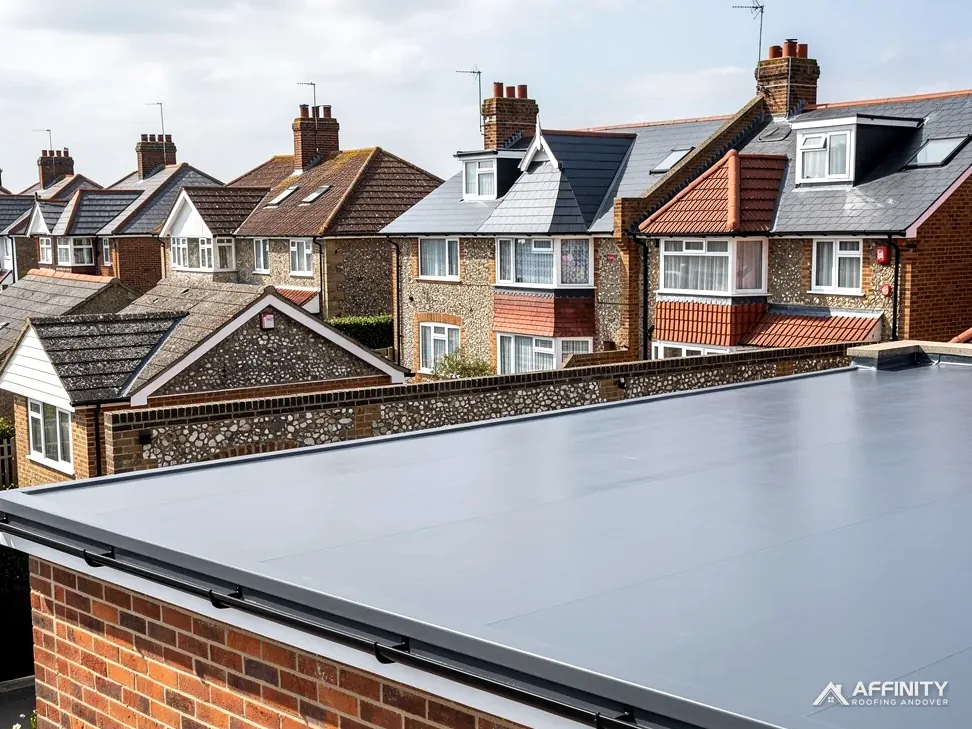
The work is the everyday kind. Roof repairs deal with slipped and cracked tiles and with flashings that have lifted. Flat roofing covers extensions, porches and garage roofs where a membrane has failed at a seam or an upstand. Chimney repairs take in stacks with weathered pointing or a failed flashing.
On a flat roof the first question is drainage: does the water reach the outlets, or does it sit? A flat roof that holds water will fail again if only the surface is patched, so the report names the fall as the cause when it is. Ponding is photographed on a dry day and again after rain, where the weather allows.
The test for repair or replace is simple. If the battens hold and the damage is local, repair is the answer. When fixings are giving way over a whole slope, a fresh covering is the wiser route, and the photographs show which case you have. The decision is yours, taken with the evidence on the table and no pressure.
Burghfield Common, Silchester, Pamber Heath, Bramley, Tadley and Aldermaston are all close. The county border runs between several of them, so each address gets a separate council check, and the outcome is noted in your file before a price is prepared.
On site, access is rigged with care, waste is cleared as it is produced and the roof is made watertight at the close of each day, so the house is not left open overnight.
Where we can help in Mortimer





Mortimer roofs: the border, the record and the licence
Can the brickwork of an old Mortimer cottage be repaired when the roof is re-covered?
Yes, and it often makes sense to do both in one visit. We photograph the brick and mortar around chimneys and gables, note where the pointing has failed and match the repair to the old mortar. If the house is listed, the list is consulted first, since consent is needed.
Is a Mortimer roof inspected by Hampshire's council or Berkshire's?
Berkshire's. Building Control Solutions, run by West Berkshire and Wokingham together, inspects Mortimer roofs, as it does for the rest of West Berkshire, while Silchester a couple of miles away falls to Basingstoke and Deane. A covering at least 15 per cent heavier than the present one needs Building Regulations approval, and BCS sees larger jobs before booking.
Is there a conservation area or listed building near the centre of Mortimer?
Historic England's list holds no listed building within about 500 metres of the centre, and West Berkshire Council's map is the place to check for a conservation area. Your address is looked up on Historic England's list and West Berkshire Council's own map, and the council is asked where there is doubt. The reply is kept in your notes before a price is given.
How much is the scaffold licence for a Mortimer house?
West Berkshire Council charges £125, plus £71 for each week, and requires the scaffolding provider to apply, with ten working days' lead. Scaffold on ground that is wholly yours needs no licence. Whatever licence cost arises forms part of your one price, and the plan sets the dates to keep the weeks to a minimum.
Ask about a Mortimer roof survey
Tell us your Mortimer address and what you have noticed. We arrange the survey and quote one written price.
10-year workmanship guarantee, in writing.