The short answer
Often, yes. A few tiles on a low roof can be replaced using a roof ladder or a tower, with no full scaffold. Access is decided by height, the pitch, what is below the work and the safest way to reach the spot, not by the number of tiles. A scaffold standing on the highway needs the highway authority's say-so first, which a ladder job avoids.
Ladder, tower or scaffold: what decides
There are three ways to reach a roof, and each suits a different job. A roof ladder is a ladder fitted with hooks that catch the ridge, resting flat on the slope so that it spreads the load and gives a firm base. A mobile tower stands on the ground and brings a platform up to the eaves or a low slope. A full scaffold encloses the building with decks, rails and boards, and it is built to be used for days.
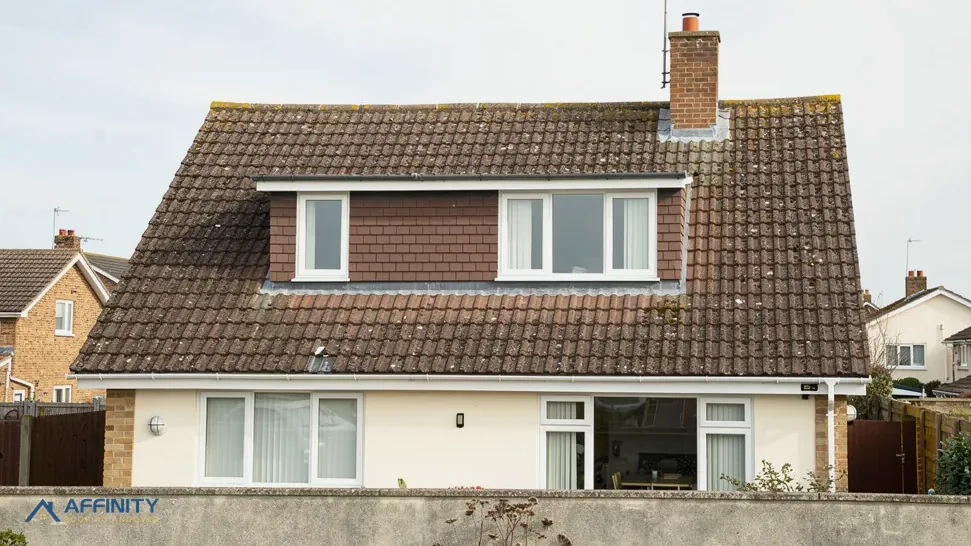
The choice follows the site. A low roof over a porch, garage or single-storey extension can be reached with an ordinary ladder topped by a roof ladder. A tile near the eaves of a house may need only a tower. A tile high on a main slope, above a path, a conservatory or an entrance, is a different matter, because working at that height needs edge protection, and anything dropped lands where people walk.
Pitch matters too. A steep slope makes a roof ladder harder to use safely, and a slippery surface, whether wet, mossy or frosty, changes the answer. The tiles themselves can be fragile, and some break under a boot.
So the question is never just how many tiles. It is how a person gets to them, works on them and gets down again safely.
Check the ground as well: soft, sloping or cluttered ground under a ladder foot or tower leg changes the safe choice.
What the price guides say
Published cost guides give a sense of what a small job costs. A Which? cost guide from November 2025 puts the cost of fixing from one to six standard roof tiles that are broken or missing at £75 to £400, excluding VAT. MyJobQuote, in October 2026, gives around £215 for replacing five roof tiles. Both are typical UK ranges for the repair itself, and a small repair is often planned around a ladder or tower so that access stays in proportion to it.
The same guides show why that cannot always be done. When the work needs a full scaffold, its cost joins the repair and can outweigh it. We tell you at the survey which access the job needs, so you see what you are paying for.
The written total we give includes access. If scaffold is needed, the price says so as part of the one figure. Please do not climb up to save the cost. A fall from a pitched roof is a serious injury, and tiles are easily broken underfoot, which turns one repair into several. Our answer on cracked roof tiles explains why a single tile is worth fixing.
Does a scaffold licence come into it?
Scaffolding kept entirely inside your own boundary needs no licence. Scaffolding that stands on the public highway, pavement included, or reaches out over it, does. Section 169 of the Highways Act 1980 makes it an offence to erect scaffolding that obstructs a highway without a licence from the highway authority.
For Hampshire addresses, the highway authority is Hampshire County Council, not the district council. Hampshire County Council expects scaffolding companies to apply for their customers, needs ten clear working days' notice before a licence can start, and charges £211.90 for the first 2 weeks and £72 for each additional 2-week period. Other authorities set their own terms, so the details differ elsewhere.
That lead time is a reason to ask early. A small tile repair that needs only a ladder or tower from your own drive or garden avoids the licence altogether. If the job needs scaffold on the pavement, the licence is sorted out between us and the scaffolder, and we plan the dates around it.
For a repair that cannot wait, a make-safe from a ladder or tower can cover the damage while the proper access is arranged.
How we decide at the survey
We start by studying the roof from the ground, then turn to access: the height, the slope, the surface below and any obstacles. We photograph the damaged tiles and the route to them, and we say plainly which access the job needs and why.
If a ladder or tower will do, that is what we use. If scaffold is the safe way, we tell you, and we explain the licence and the lead time where the highway is involved. You are not asked to accept a scaffold for a job that does not need one, or a ladder for a job that does.
The price depends on the access, the number and type of tiles, and what the survey finds beneath them. One written total follows. You see the photographs of the tiles and of the access route before any work is booked. Wider tile work is covered on our pitched roofing hub.