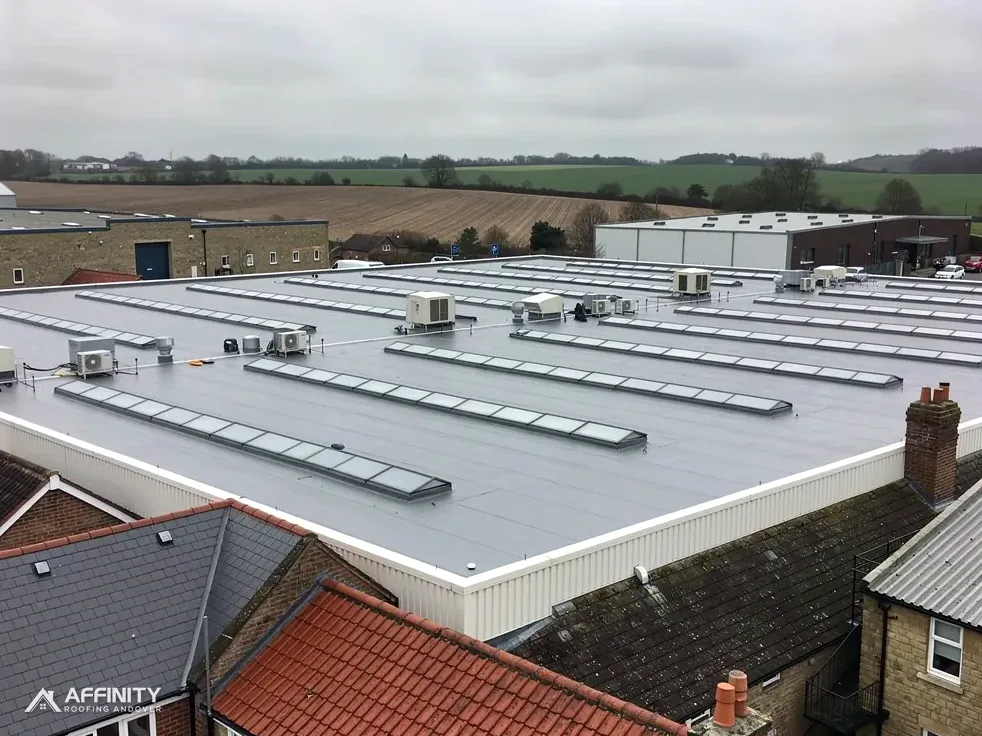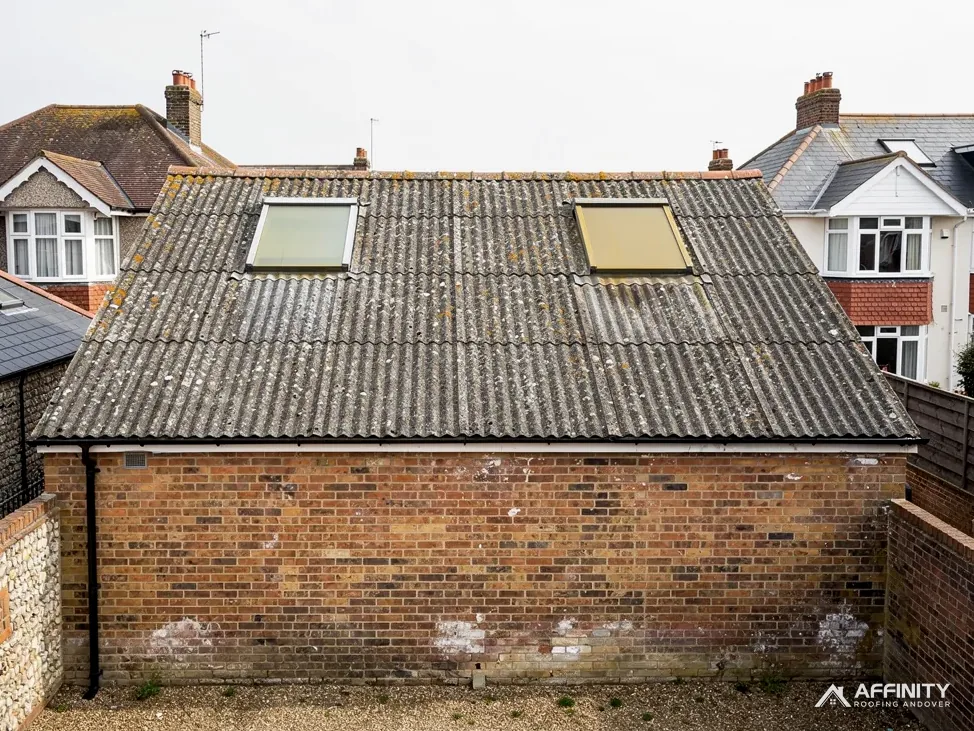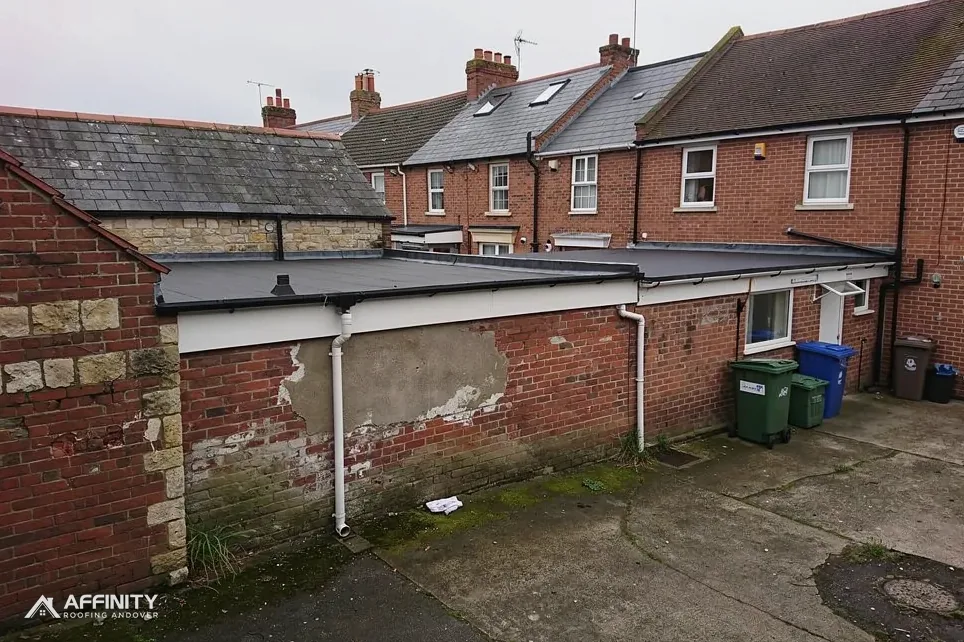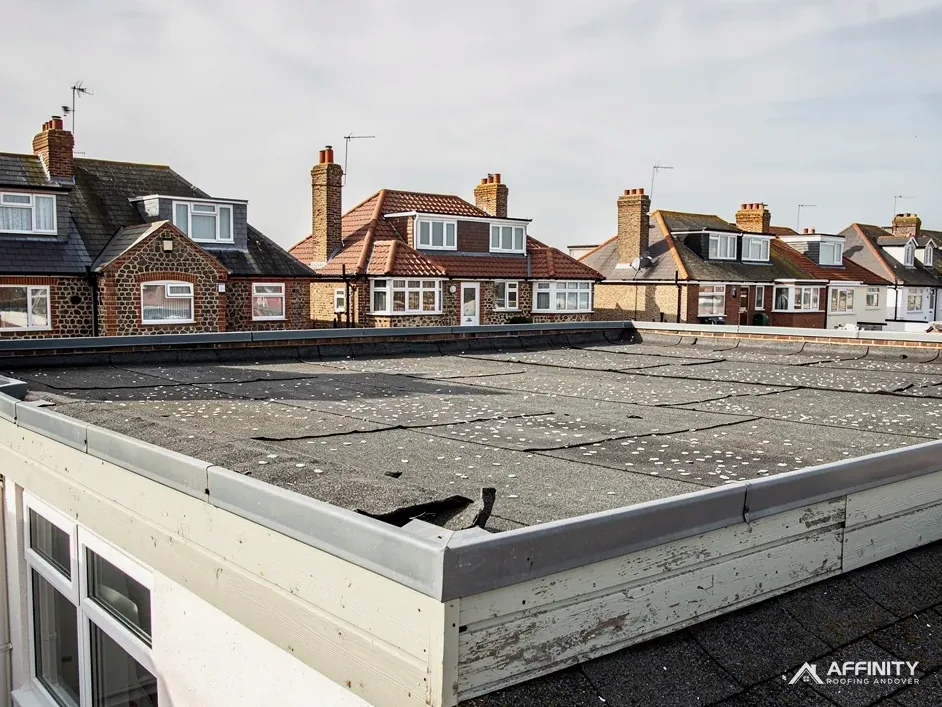
Industrial units have yards, loading bays and space to park a platform. A shop on a high street has a pavement, a delivery window and a neighbour on each side. An office above a parade has a flat roof reached through a first-floor window. The roof work is similar in kind, because water is water, but nearly everything around it is different.
Our work covers retail parades, offices, surgeries, halls and flats above units, alongside industrial and farm buildings. The covering is often a flat roof of felt, single-ply or a poured system, sometimes with a parapet and a box gutter, sometimes a pitched roof of slate or tile hidden behind a decorative front. Access is the hard part. A scaffold on a town-centre pavement comes with licensing from the road authority, the crew has to work around shoppers, and the repair has to fit the times when the premises can be disturbed.
This guide covers what makes shop and office roof repair distinct: getting to the roof, the licences that may be involved, the flat roof types found over units, planning around opening hours without promising times, VAT, and how a survey turns into a written price.
Shops and offices, not only industrial units
The range of buildings we repair is wider than the factory estate. Corner shops, terraced parades, small offices, surgeries, takeaways, community halls, pubs and flats above shops all have roofs, and a good many leak at the same few points.
What differs from an industrial roof
The roofs are smaller and more varied. A parade may share one roof over several tenancies, with each unit owning or leasing a different part. A shop front often hides a pitched section behind a parapet, or a flat roof behind a mansard. Chimneys, extractor flues and air-conditioning plant crowd the surface. The building next door may be taller, shading the roof or channelling water onto it.
Who is responsible
Responsibility for repair depends on the lease and the title. A tenant may repair what is demised to them while the landlord looks after the structure and the common parts. We repair what you instruct us to repair, and we describe what we find in photographs so that those responsible can agree who pays. A leak into one unit may start in a neighbour's section.
What stays the same
The method is constant: survey, photographs, a plain explanation and a written price. Our commercial roofing page lists the systems we repair and replace, and its principles apply to a small shop roof just as they do to a large unit.
Tell us which part of the building is yours, so the survey can focus on it, and send the lease plan if you have one.
Reaching a town-centre roof: access and scaffold licences
On a high street, the first question is how to get safely onto the roof, and the second is who has to be asked before a scaffold goes up.
Access options
Some roofs are reached from inside, through a hatch or a first-floor window. Some need a ladder from the yard behind. Others call for scaffolding on the front or the side, or a mobile platform parked at the kerb. The choice follows the height, the type of work and what lies below. A small patch can need little more than a ladder and a safe route. A re-cover or a parapet repair needs proper edge protection, which usually means scaffold.
The licence question
Under section 169 of the Highways Act 1980, a scaffold that obstructs the road or pavement is allowed only with the highway authority's consent in the form of a licence. In Andover and across the Test Valley that is Hampshire County Council, whose own page tells scaffolders to lodge the application at least 10 clear working days before erection, with no extensions granted. Fees run at £211.90 for the first 2 weeks and £72 for each extra 2 weeks, and Hampshire County Council allows no extensions. Hoarding costs extra.
For shops over the border, Wiltshire Council expects the supplier of the scaffolding to apply through MiPermit. Wiltshire Council charges £143.80 with over 3 working days' notice and £164.70 with less. Each of its licences lasts 28 days, and hoarding is licensed separately.
Private land
No licence is needed for scaffolding inside a private yard or on a private road, so a unit with its own forecourt may skip the process altogether.
Flat roofs above shops and offices
Many shop and office roofs are flat or nearly flat, and the same few faults recur. Understanding them helps an owner judge whether a repair or a replacement is the sensible answer.
Common coverings
Felt is widespread on older parades. Single-ply membranes, such as PVC, TPO and EPDM, are common on newer or refurbished roofs. Lead appears on parapets and gutters. Poured and liquid-applied systems turn up where the roof is full of awkward details. Our guides to built-up felt and single-ply roofing explain how each behaves.
Where shop roofs leak
Leaks cluster at the parapet and the upstand, where the roof meets a wall. Box gutters between roofs, or between a roof and a taller building, silt up and overflow. Outlets block. Rooflights and hatches have seals that age. Plant fixings and cable routes pierce the covering and are rarely sealed again after the engineer leaves. A leak that appears on the ceiling of a shop may travel along a board or a beam for some distance before it drips, which is why the stain is often not under the fault.
Falls and drainage
A flat roof needs a finished fall to drain. BS 6229:2025 retains a minimum 1:80 for roofs of this type, and IKO advises designing for 1:40. If water lies for long after rain, something is blocked or has moved.
Repair or replace
For scale, MyJobQuote gives around £650 as the 2026 average for a roof repair, a typical UK figure for repairs in general. A survey tells you whether yours is a repair or a replacement.
Planning work around opening hours
A shop's income depends on being open, and the programme for a roof repair has to respect that. We plan with you, but we avoid promising times we cannot control.
What we can arrange
Noisy and dusty tasks can be set for the quietest part of the day. Deliveries of materials can be timed to avoid peaks. Work above a service counter, a shop floor or a customer entrance can be sequenced with protection below. Some work can be done out of hours, on an early start, an evening or a weekend, where the building and its neighbours allow it. Out-of-hours work has to fit the site's own rules, and noise near flats above can restrict what is possible.
What the weather controls
Roofing is outdoor work, and rain, wind and frost decide what is possible on a given day. We do not promise a finish date, because we cannot control the weather. We give you the planned order of work and keep you told of changes.
Protecting the shop below
Where the roof is opened, the area below is covered or cleared, stock is moved or sheeted, and customers are kept out of any zone where something could fall. For food premises and others with strict hygiene needs, we agree extra measures with the manager before the first day.
Emergencies
Where water is coming in, the first step is a temporary cover or patch, whatever the hour, to make the roof safe. The permanent repair is planned afterwards, and your records of the damage help if there is an insurance claim. Our answer on what to do about a commercial roof leak sets out the first steps.
Responsibilities, shared roofs and CDM
Fixing a commercial roof counts as construction work under CDM 2015, the regulations that set out safety duties for it. For a small repair the duties are light, but they are real.
Duties by project
A single contractor prepares the construction phase plan (regulation 15(5)). Once a second contractor joins, regulation 5(1) has the client name a principal designer and principal contractor. A householder's duties pass to the contractor only for domestic work, so a shop owner or landlord is a commercial client with duties of its own.
Information the contractor needs
We ask whether an asbestos register exists. HSE's starting point is to presume asbestos in any building that dates from before 2000, whether put up or refurbished then. Older flat roofs and their soffits can contain it, and nothing is disturbed until the position is clear.
Shared roofs
On a parade, a repair to one section can affect the next. Tell the other owners and the managing agent before work starts, and agree who pays for the common areas. Our photographs record the condition of every section we open, which helps avoid disputes.
Neighbours and the public
The pavement stays open to shoppers wherever possible, with barriers and signs where it cannot, and falling-object cover goes over every public route. Delivery routes and crew parking are agreed so neighbouring premises are never blocked.
VAT, costs and what the quote contains
Costs on shop and office roofs depend on factors the survey finds, and a figure quoted in advance would be a guess.
What sets the price
The extent of the damage matters most. After that come the covering, the access (ladder, platform or scaffold, and whether a licence is needed), the size and number of details, protection for the premises below, out-of-hours working and whatever else the survey shows. Two shops with the same leak can have very different bills, and a scaffold on a busy street can be a large share of a small repair.
VAT
The standard rate is 20%. A business customer's position can differ from a homeowner's. The domestic reverse charge is limited to supplies between VAT-registered businesses reported under the Construction Industry Scheme; a private householder sits outside it entirely. A registered business should ask its accountant how it applies. Check each quote you hold for whether VAT and scaffolding are inside the total.
Our quote
Our survey leads to a single written total for the agreed work, and the method is set out beside it. Citizens Advice suggests collecting 3 written quotes or more, which is sound practice.
Starting
Describe where the leak shows, how the building is entered and when it can be disturbed. We report back with photographs and a clear recommendation on repair or renewal. Our guide to planned commercial roof maintenance shows how regular visits cut the number of emergency calls.