The short answer
It depends on the covering, and published figures are typical ranges, not promises. HomeBuilding gives Welsh slate 100+ years, plain concrete tiles 40 to 50 and EPDM 25 to 30, while Less puts EPDM at 30 to 50. The covering is often outlived by the fixings and underlay beneath it, and a warranty and a lifespan are different things.
Pitched coverings: slate, clay and concrete
For natural slate, HomeBuilding's supply-only table gives Welsh slate as 100+ years, Spanish natural slate as 75 to 100 years and reclaimed Welsh slate as 50 to 80 years. Those are published typical ranges for the material, and they assume the fixings hold.
Clay tiles are quoted by HomeBuilding at 60 to 80 years. Marley refers to a BRE figure of a minimum life expectancy of 60 years, and that figure is for clay tiles only, so it should not be applied to concrete.
For concrete, HomeBuilding gives 40 to 50 years for plain concrete tiles and for Double Roman, which is the name for a large, interlocking concrete tile with a pair of rolls. Marley puts roof tiles at around 60 years but is clear that the number is no warranty. Two sources, two answers, so we name both.
Fibre cement tiles, the Eternit type, are given as 30 to 40 years by HomeBuilding.
None of these numbers is a promise about your roof. They describe the material in normal conditions, and a roof can fail early because of poor fixing, ventilation problems or storm damage, or run on past the range with careful repair.
Flat roofs, lead and zinc
Flat roof coverings have shorter published lives, and the figures do not all agree. For EPDM, a rubber membrane, HomeBuilding says 25 to 30 years while Less says 30 to 50 years. For GRP, glass-reinforced plastic, HomeBuilding gives 25 to 30 years and Less 25 to 40. For torch-on felt, HomeBuilding gives 10 to 15 years and Less 10 to 20.
Lead and zinc sit at the long end. HomeBuilding gives lead flat roofing as 60 to 100 years. MyJobQuote says lead flashing can last for more than 80 years, and that is a floor, not a limit. VMZinc cites the BRE Environmental Product Declaration for zinc at 100 years.
The differences between the figures come down to the quality of the installation and the details. Falls matter on a flat roof, and so do the upstands, the outlets and the way each seam is made. A membrane that ponds will wear faster than one that drains.
For a conservatory roof, polycarbonate is quoted by HomeBuilding at about 10 years, and The Eco Experts say about 10 to 15.
If you are weighing up a flat roof, our main roofing page explains how we read the roof before we recommend repair or replacement.
Why fixings and underlay often go first
A covering is only held on by what is behind it. Under a slate or tile sit the battens, the nails or clips, and the underlay. Those parts take the weather that gets past the surface, and they are in the dark, which means nobody notices until something slides.
On older slate roofs the iron nails can corrode and let slates slip one after another, a pattern called nail sickness. Our answer on replacing a single slate describes it. The slates are fine; the way they were held is not.
Underlay ages as well. Felt and membranes dry out, tear at the laps and let in wind-driven rain. A tile that is still sound can sit on an underlay that is long past its best.
The result is that a roof can need substantial work while the visible covering looks acceptable. That is why a survey looks beneath the surface, from the loft, at the timbers and the roof's underside.
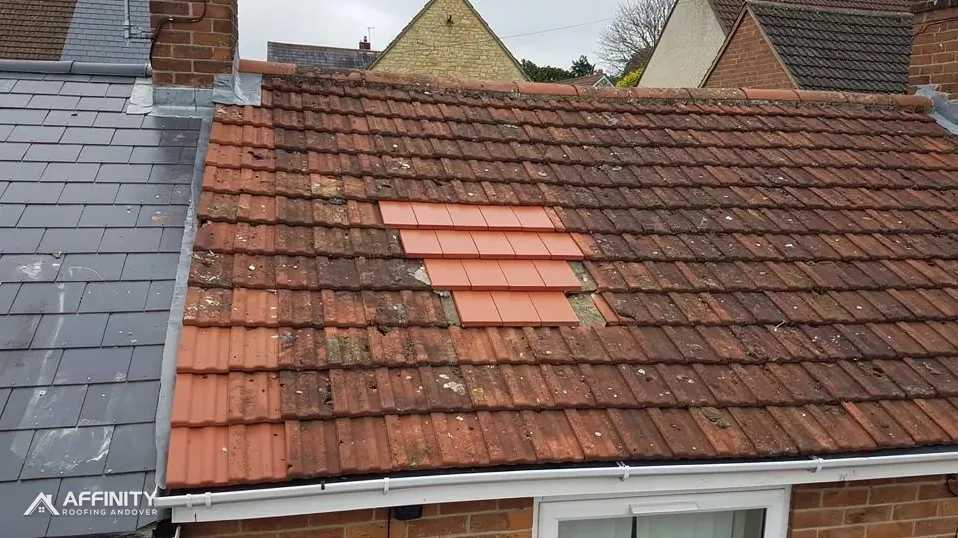
Where the covering is sound and the fixings are failing, the answer is often to lift and re-fix and reuse the sound tiles or slates, not to replace them.
A warranty is not a lifespan
People often take a guarantee period as the expected life of a roof. It is not. A warranty is an undertaking about defects for a set number of years, and the roof may last far longer, or occasionally fail earlier for a reason the warranty does not cover.
Marley makes the same point about its own 60-year figure: it describes expectation, not a promise. The same logic applies to any published range. It describes a typical outcome, and your roof may be better or worse.
What you can do is look after the roof, so that it reaches the upper end. Clear gutters, remove debris where it collects, replace a slipped tile quickly, have flashings checked, and keep an eye on the loft for damp. Our yearly maintenance checklist lists the jobs.
When a roof nears the end of the range, do not panic. Ask for a survey with photographs, an opinion on how much life remains, and a plain comparison of repair with replacement. That is more useful than a number.
The likely answer is a mixture: patch what can be patched and plan for the rest.