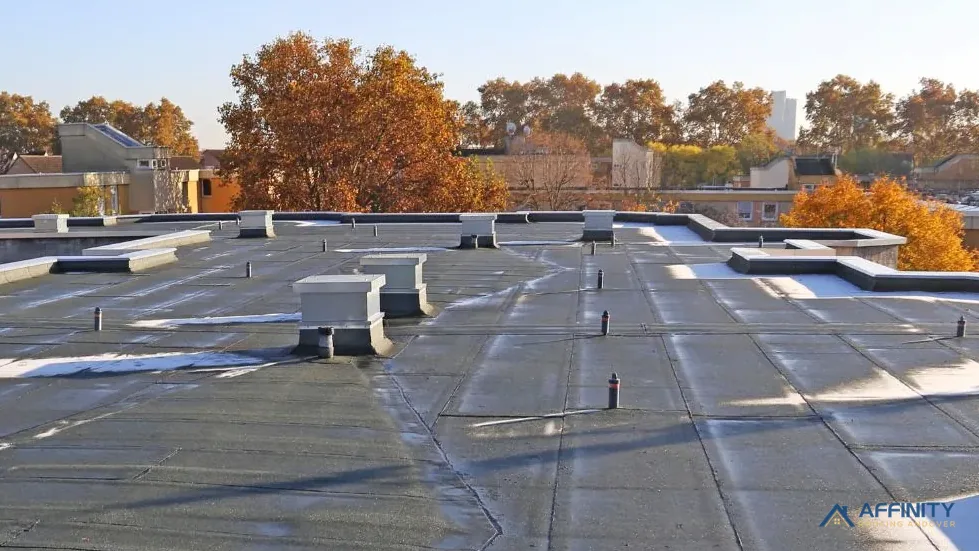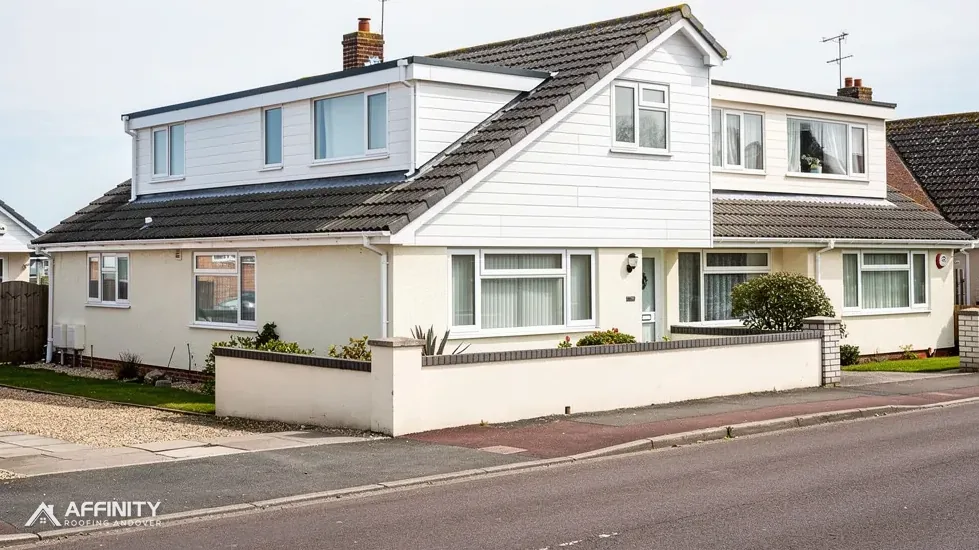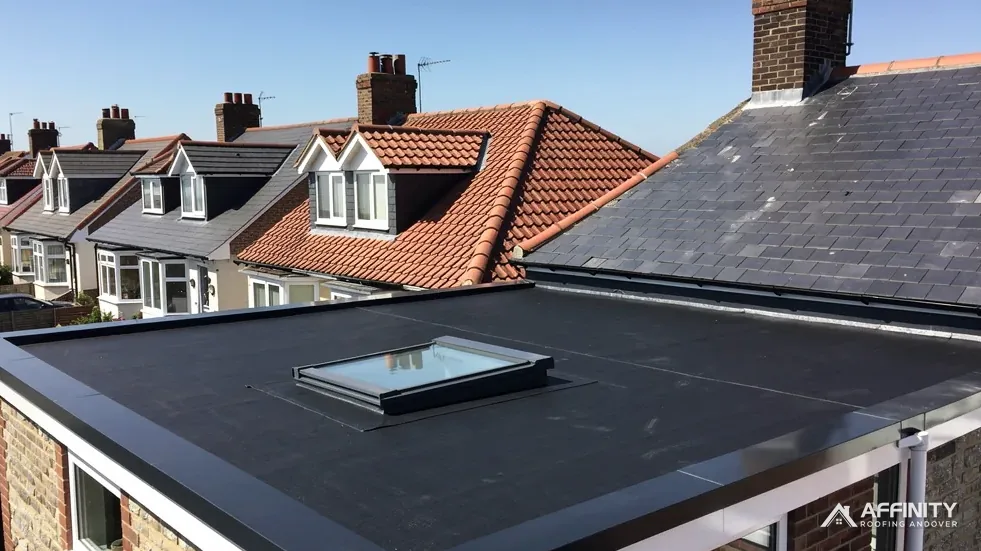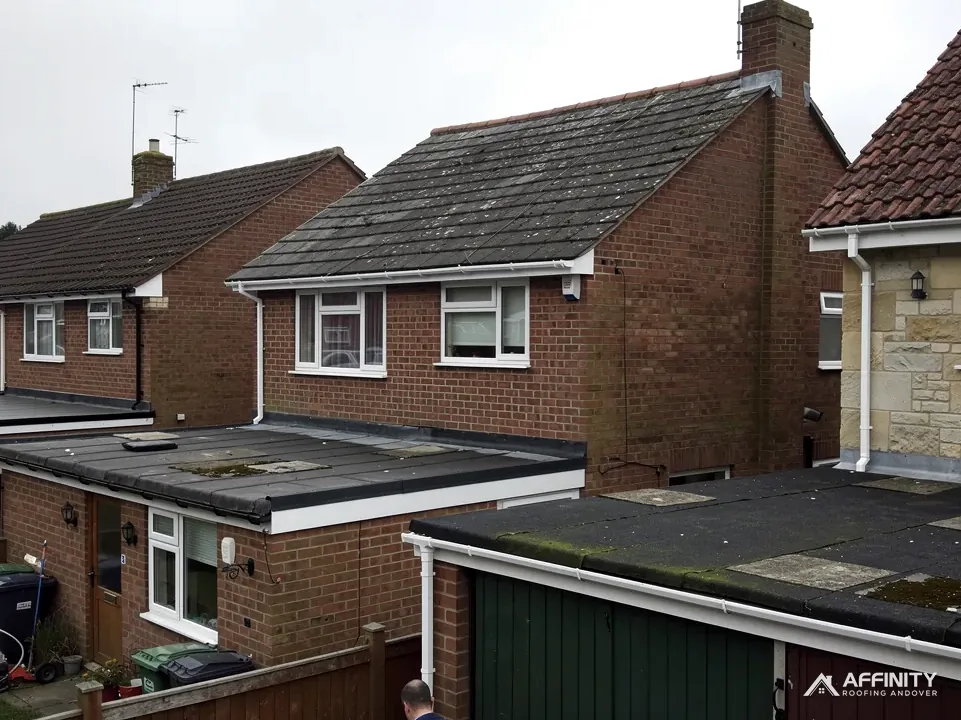
A flat roof sits on a garage, a kitchen extension, a porch or a dormer, and sooner or later its covering reaches the end of its life. When the time comes, three materials dominate the choice: EPDM, GRP and felt.
EPDM is a synthetic rubber, supplied as a single large sheet and stuck down. GRP stands for glass-reinforced plastic, which is fibreglass: a liquid resin is worked over a glass mat and sets hard. Felt, in its modern torch-on form, is a bitumen sheet laid in layers and heated to bond it. Each has defenders, and each has trade-offs that depend on the shape of the roof, the way it is used and how it is laid.
This post compares the three on the points that matter for a house or garage around Andover: typical lifespan, cost guides, how each is repaired, how it copes with foot traffic and what the roof has to be built like beneath it. It does not name a winner. Which covering fits turns on the particular roof over your extension, and the survey settles that.
How the three coverings are made
It helps to picture each material before you compare them, because the way a covering is laid decides where it is likely to fail.
EPDM arrives on a roll, and on a small roof the installer can often cover the whole surface with one sheet, so there are no joints across the middle. The sheet is bonded to the deck with adhesive and turned up the walls, with joints and corners finished using tapes and flashings. Failures tend to start at the edges, the corners and the places where something pierces the sheet, and not in the broad field.
GRP is built in place. A glass mat is laid on the deck, resin is rolled over it, and a topcoat gives it colour and a finish. When cured, it forms a continuous surface with no joints except at the trims. Its rigid nature suits some roofs and not others, since a deck that moves can crack the layer.
Felt is a built-up system. A modern torch-on roof has a cap sheet over one or more underlying layers, bonded together with heat. Its seams and its details, such as the upstands and the drips, are where care is needed, and the quality of the work counts for a lot.
For all three, the roof structure beneath matters as much as the covering. The deck must be sound and dry, and the falls must be right, which we come to in section three. A premium covering on a failing deck will fail early.
Lifespan, cost and the numbers behind them
Two guides give lifespans and costs for these coverings, and they do not always agree, so the table names both. Read every figure as a general guide rather than a promise, and keep in mind that a warranty is a different thing from a lifespan.
| Covering | Typical life, HomeBuilding (Sep 2025) | Typical life, Less (Oct 2026) | Supply-only price per m², HomeBuilding |
|---|---|---|---|
| EPDM | 25 to 30 years | 30 to 50 years | £105 |
| GRP | 25 to 30 years | 25 to 40 years | £110 |
| Felt (torch-on) | 10 to 15 years | 10 to 20 years | £65 |
The per-square-metre figures are for supplying the material only. They are not the cost of a finished roof, and they should never be multiplied into a total for your garage.
For finished jobs, Which? (November 2025) gives £1,400 to £3,500 to lay a new felt roof over a single garage measuring 6 m by 3 m, and £1,950 to £4,000 where the new deck is finished in PVC, EPDM or another non-felt material. Both exclude VAT. Less (October 2026) gives £1,200 to £2,500 for a 15 m² garage. MyJobQuote (Oct 2026) puts EPDM at around £60 per square metre and an average rubber roof at around £1,050.
The figures are far apart because the guides measure different jobs. Size, access, deck repairs, insulation and the number of upstands and rooflights all change the total. You get our price in writing once the survey is done, as a single figure covering everything. For the wider picture, see our guide to the cost of a new flat roof.
Falls, ponding and the deck underneath
Flat roofs are deliberately given a gentle tilt, called a fall, so rain drains to an outlet and cannot linger on the surface. How much tilt, and how it is measured, is where a flat roof can go wrong.
The standard that applies is BS 6229:2025, the code of practice covering flexible waterproof membranes laid over a continuous deck. It replaced the 2018 edition, withdrawn in December 2025. It applies to roofs with a pitch no greater than 10 degrees, and it covers membranes only, not lead. It keeps 1:80 as the least fall the finished roof may have across its general areas and in internal gutters. IKO advises designing for 1:40 instead, so that the finished roof still clears 1:80 once the structure has settled and the tolerances are allowed for.
Why does this matter when you are choosing a covering? Because none of the three will rescue a roof that holds water. Standing water speeds up wear at seams and joints, and it is the usual complaint on roofs that are failing early. A re-cover is the moment to correct the falls, with tapered insulation or new firrings, not to repeat the old pattern.
So the membrane on top is just one piece of the work. A responsible survey looks at the deck for rot or movement, at the outlets and the gutter for blockages, and at the upstands and flashings. Our guide to flat roof ponding sets out what we look for.
The thermal side matters too. Renovation of a flat roof, including replacing the waterproof membrane, is covered by Part L, which for existing roofs uses a threshold of 0.35 and an improved figure of 0.16 W/(m²·K), so insulation is part of the plan.
Foot traffic, repairs and what goes wrong
How the roof will be used is a better guide to the covering than any brochure. A roof that nobody walks on has different needs from one that carries a small terrace, a satellite dish or a path to a hatch.
Foot traffic
If the roof will be walked on regularly, ask the installer which surface they would use and what protection they would add: walkway pads, boards or a finished topcoat. GRP forms a hard surface that is easier to walk on, while a rubber sheet or a felt cap may need protecting where feet land. Whatever is chosen, heavy furniture and planters should not stand on the bare membrane.
Repairability
All three can be patched. A puncture in EPDM is usually mended with a patch and adhesive, a crack in GRP with resin and glass, and a blister in felt by cutting, drying and re-bonding. The question is how long the patch holds and whether the underlying cause has been found. A roof that is repaired every winter is telling you something about the deck, the falls or the age of the covering.
Common faults
Look for pooled water, blistered or lifted laps, cracks at corners and edges, splits along the junction with a wall, and blocked outlets.
Patching makes sense when the fault sits in one place and the deck underneath is sound. Once faults show up all over the roof, a new covering is the better choice. The photographs from a survey show which applies, before any price is given.
Extensions and garages around Andover
Flat roofs turn up on all kinds of buildings across Andover and the Test Valley villages, and no street or estate has a standard type. What a house or garage has depends on when it was built and what has been done since, which is why a survey comes before any recommendation.
Extensions are the common case. A rear kitchen or utility extension often has a flat roof with a rooflight in it, plus a wall to flash against on one side. The flashing at that wall, the rooflight upstand and the outlet are the places to inspect on a roof of that kind. If the extension is new, ask the builder what covering was laid and who is responsible for it.
Garages are the other common case, and some older garages have corrugated sheet roofs. For anything built or refurbished before 2000, the HSE's advice is to presume asbestos is there, so sheets of that kind need identifying before anyone cuts, drills or removes them. Our guide to garage roof replacement options covers it.
Planning rules may reach an extension's flat roof on a listed house, or a house inside a conservation area, so ask Test Valley Borough Council before changing anything visible from the street. A re-cover in the same material on the same line is the least likely to raise questions.
For a leaking roof that cannot wait, we make it safe first and then put the permanent repair on a survey basis.
Finally, think about access. A scaffold or a tower may be needed to reach the roof and carry materials, and it affects the price.
Choosing for your roof
There is no best covering, only a best fit. These points narrow it down.
- How long will you stay? A short stay favours felt or a repair, while a long one favours a covering with a longer typical life.
- Is the roof simple or complicated? A plain rectangle suits a single sheet, while a roof with many penetrations needs a lot of detailing whichever material you choose.
- Will anyone walk on it? That points towards a hard topcoat or a protected walkway.
- What is the deck like? Rotten boards or poor falls must be corrected first.
- What does the budget allow once access and insulation are counted?
Ask every roofer who quotes to name the covering, the deck repairs allowed for, the insulation and the falls they are aiming for. Ask whether the price includes VAT and scaffolding. Citizens Advice suggests collecting 3 or more written quotes, and the answers to these questions are the way to compare them. Ask for one total price, not a breakdown of items.
After the work, ask for the details of the covering and the installer's written terms for it, and store them with the property deeds. Any warranty on offer is the installer's promise and says little about the material's likely life.
Our survey photographs the deck and the details, and each option is explained before one written price is given. Where patching is the better buy, our report says so plainly. Our flat roofing page explains the process.