
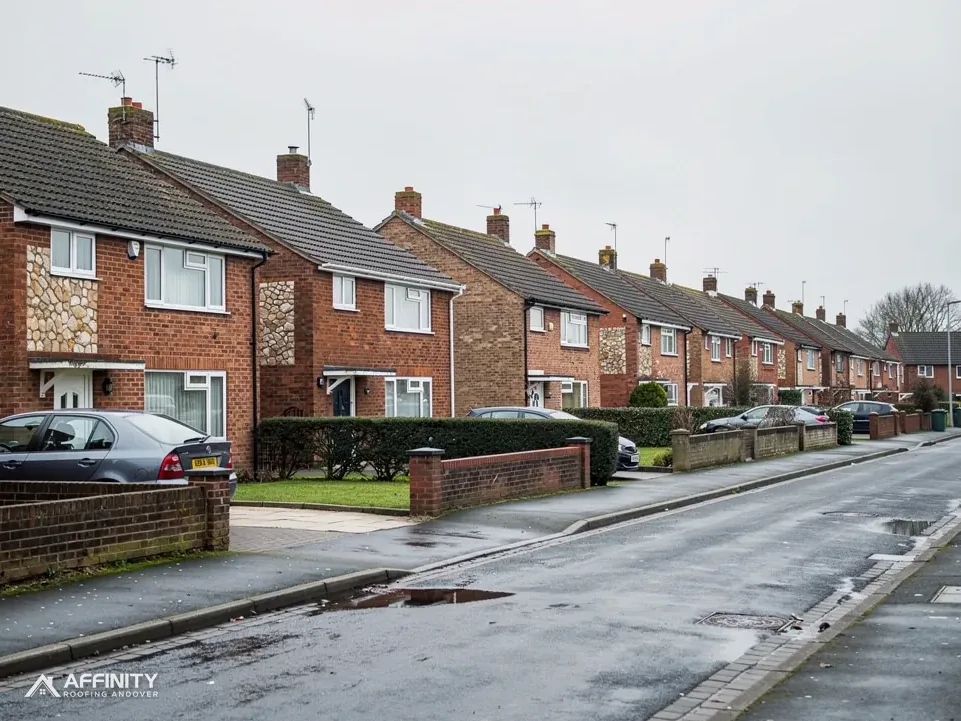
Roofers in Woolton Hill
Pitched slopes, flat extensions and rooflines in a downland village
Woolton Hill sits wholly inside the North Wessex Downs National Landscape, under Basingstoke and Deane, with 4 listed buildings near its centre. Each roof is surveyed first.
Woolton Hill roofs, church to flat extension

Church of St Thomas
A Grade II church first listed on 30 May 1984, whose roof works run through a faculty and not the council.

Wellbrook House
A Grade II listed house, also first listed on 30 May 1984, where any repair is matched to the old covering.

Houses with flat additions
Homes whose garages, porches and extensions have flat roofs, checked for falls, outlets and edges.
Woolton Hill north of Highclere
Highclere lies south of Woolton Hill and Burghclere east, with Enborne and Speen north and Newbury north-east. Roofing work in each of those places is part of what we do.
- Distance
- 12.7 road miles north-east of Andover
- Planning
- Basingstoke and Deane Borough Council
- Council
- Basingstoke and Deane Borough Council and Hampshire County Council
The Woolton Hill roof report
Local editionWoolton Hill, HampshirePitched, flat and roofline work on the downs
Woolton Hill roofs: four listings, a National Landscape and the case for reading a flat roof carefully
Woolton Hill sits entirely inside the North Wessex Downs, in Basingstoke and Deane, with only four listed buildings near its centre. Here we cover who decides, what flat roofs need, and how pitched slopes and rooflines are surveyed.
Four listings in a National Landscape
The whole of the ground for some way around Woolton Hill lies within the North Wessex Downs National Landscape, the designation formerly named an AONB. Historic England's list, on the other hand, records only 4 listed buildings within about 500 metres of the village centre. A roof in Woolton Hill is therefore protected by its setting more than by its neighbours.
The Church of St Thomas is listed Grade II (list entry 1308259, first listed 30 May 1984), and so is Wellbrook House (1092421), listed on the same date. The village War Memorial (1392697) is listed Grade II as well, though it has no roof to repair. The church is in use for Anglican worship, so its roof works are cleared with a faculty and not with the council.
Wellbrook House, being listed, adds a step: Basingstoke and Deane Borough Council must grant listed building consent for work touching its character, beyond planning and building control. We start from a matching repair, and anything that would alter the look of the covering is put to the council in writing before a price is set.
The downs designation works differently. It does not add a permission; it adds weight to appearance. The downs body gives advice and nothing more, which leaves Basingstoke and Deane as the authority that rules on a Woolton Hill roof. A new dormer or any other change of shape meets stricter rules inside the designation; plain repairs proceed just as they do across the borough.
The nearest conservation areas to the village are East End and North End, which lie a little way off. Those names point you to the council's map but say nothing about your own gate, so the council is asked about your address and the reply is filed.
Whether an Article 4 direction applies to a Woolton Hill house is the council's to answer. The roof-related directions it describes concern four conservation areas in Basingstoke town, and we do not assume anything beyond that. Our planning permission for roof work guide gives the national picture.
Highclere lies a short way south, with the same council and the same downs designation, so the rules read across between the two villages. Each address is still checked on its own, because a listing or a conservation boundary can fall on one house and miss the next.
Few listings mean few surprises, though not none. A house beside the church or near Wellbrook House deserves a look at the list before the survey, and we do that as a matter of routine, filing the result with the photographs.
Reading a flat roof: falls, membranes and years
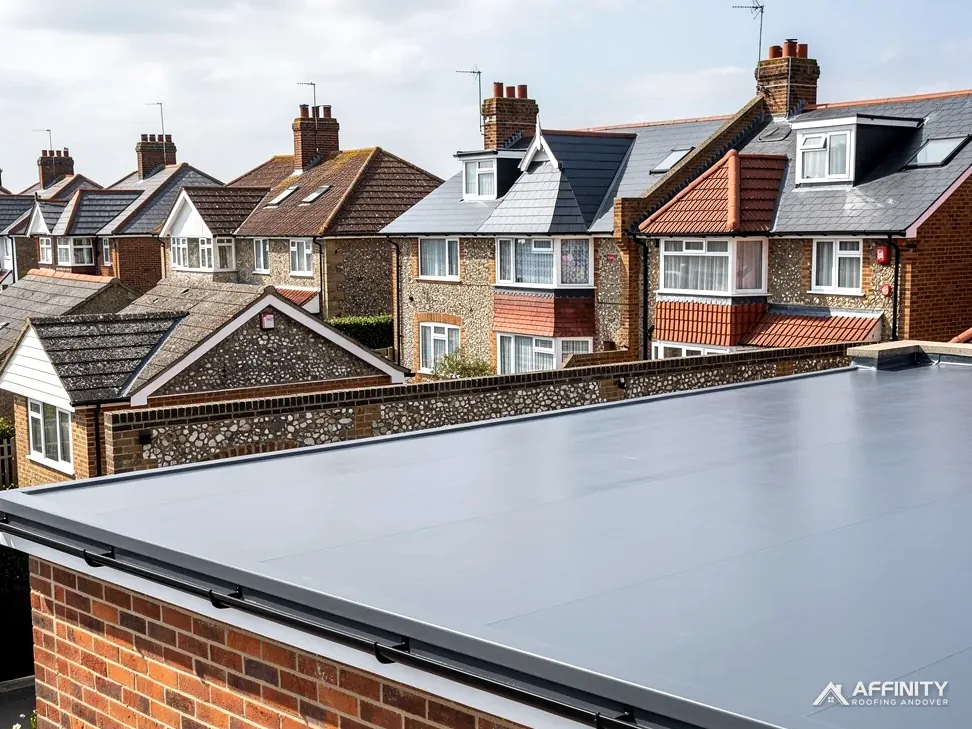
A flat roof is rarely flat. It is laid to a fall so that water runs to an outlet, and when the fall is wrong the water stands. The current British Standard, BS 6229:2025, covers flexible-membrane roofs of 10 degrees pitch or less. Its finished-fall minimum is 1:80.
Designers aim higher: IKO's advice is to design for a 1:40 fall. A roof built with no fall, or that has lost it, shows standing water, which is the first thing we photograph. BS 6229 covers flexible membranes only; lead roofs follow a different standard.
Covering matters too. EPDM, a rubber membrane, has a typical life of 25 to 30 years according to HomeBuilding and 30 to 50 years according to Less. The two sources disagree, and we name both. Felt (torch-on) is quoted at 10 to 15 years by HomeBuilding and 10 to 20 by Less, and GRP at 25 to 30 and 25 to 40 years. These are typical figures, never promises.
Common faults are plain to see. Ponding, split seams, blistered felt, lifted edges and blocked outlets are the signs, and each one gets a photograph. Trouble often shows first as a stain on a ceiling below, so the stain is traced back to its source before a patch or replacement is suggested.
The paperwork follows the same pattern as any roof. The Planning Portal's cut-off, under 25 per cent of the building envelope and under 50 per cent of the roof, applies to flat roofs just as to pitched ones. Basingstoke and Deane's team, on 01256 844844, is asked about anything near the line.
Our flat roofing page sets out the choices between repair and replacement, and how each is priced after the survey.
Gutters need a fall as well. Brett Martin gives 1 mm for every 600 mm of run, and a gutter that sags between brackets holds water that should be leaving. On a flat extension attached to a pitched house, the point where the two roofs meet is the first place we look, because water from the upper roof lands on the lower one.
Upstands, the short vertical edge where a flat roof meets a wall, are the other weak point. A membrane lifting there lets water behind it, and the repair is a patch, not a new roof.
Where a flat roof is beyond repair, replacement is planned around the weather. A membrane cannot be laid in the wet, so the work waits for a dry spell, and the old covering comes off only as far as can be re-covered before the working day ends.
“Woolton Hill's downs advise, Basingstoke and Deane decides, and every flat roof needs its fall read first.”
Pitched slopes, rooflines and a Hampshire licence
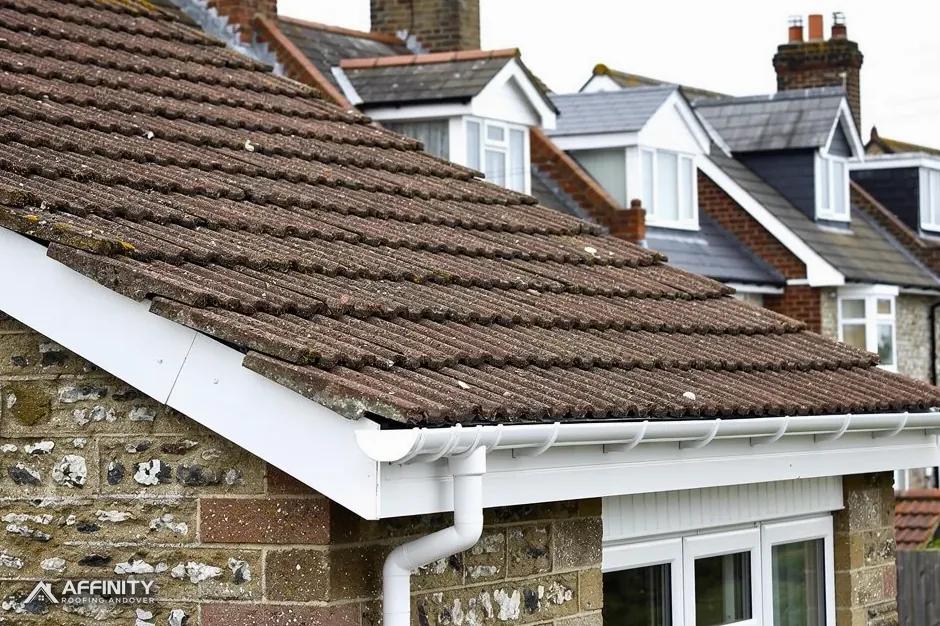
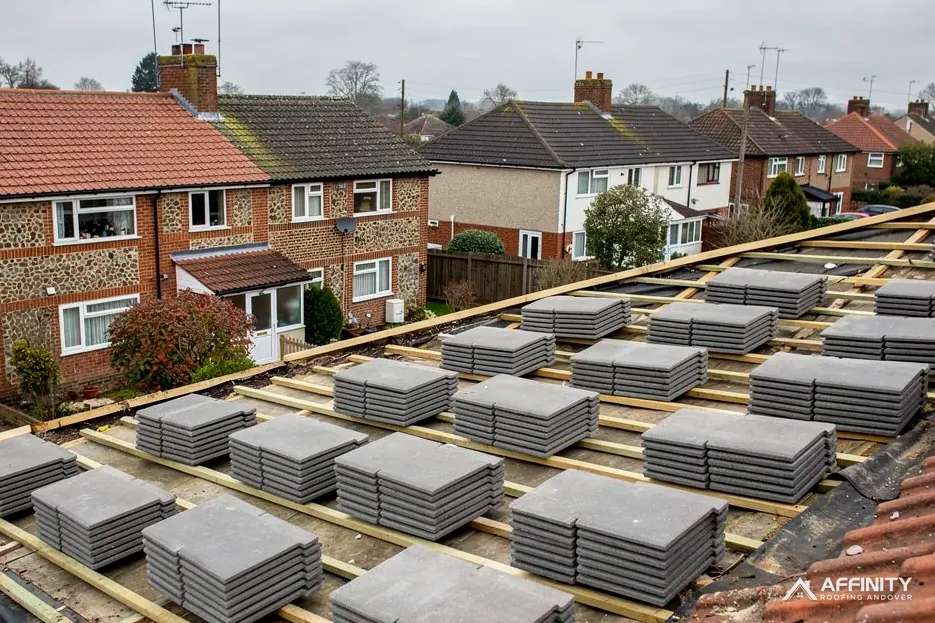
Pitched roofs are surveyed slope by slope. Every slope is looked at from the ground first, then from a tower or the roof; the ridge, hips, verges and valleys are photographed up close, along with the way each tile or slate is held. The loft comes next, where daylight at the eaves and dark patches on timber tell their own story. Our pitched roofing page describes the work.
The roofline is the edge: fascia boards, soffits and guttering. Rain leaves the roof along that edge, which means a rotten fascia or a clogged outlet can ruin a covering that is otherwise sound. Our guttering, soffits and fascias page explains what is checked and what a repair involves.
Licences for scaffold on a public road come from Hampshire County Council under section 169 of the Highways Act 1980; the borough council issues none. For Hampshire County Council the applicant is the scaffold firm, not you, and Hampshire County Council's rate is £211.90 on application for the first 2 weeks, then £72 per further 2 weeks.
A lead time of 10 clear working days applies, hoarding costs extra, and extensions are refused. Private roads are outside the scheme, and so is a drive or garden, so a house set back from its lane can often be scaffolded from its own plot. We check access first and say which case applies.
Valleys and abutments, where two roofs or a roof and a wall meet, are the first places for leaks to start. Lead flashing is long-lived, so a fault is more often a lifted edge or a split than a total loss, and a proper repair is preferred where one can be made.
Roofs in rural villages are sometimes shared with wildlife. Droppings in a loft or a bird carrying material to the eaves are signs we note and tell you about before work goes on, because a nest in use is left alone.
Each job ends with a clean site and new photographs beside the survey set. Every survey finishes with a single written total that already takes in scaffolding, licensing where needed, the roof work and clearing the waste. Next to it sits a note of the consent route.
Tidiness is part of the job. Deliveries are timed to keep the lane clear, and each evening the site is left safe, swept and closed up against the weather. At the end, fresh photographs sit beside the survey set so a buyer or a surveyor can see the roof before and after.
Pitched, flat and roofline work in Woolton Hill



Woolton Hill roofs: downs, flat roofs and licence
What fall should a Woolton Hill flat roof have?
BS 6229:2025 puts the minimum finished fall at 1:80, and IKO suggests designing to 1:40. Standing water after rain shows that a fall has failed. The standard covers flexible membranes only, so lead roofs follow a different one, and ponding is photographed before a patch or a replacement is proposed to you.
How many years does an EPDM flat roof last in Woolton Hill?
The sources differ. HomeBuilding gives a typical life of 25 to 30 years for EPDM, and Less gives 30 to 50 years. Both are typical figures and not promises, and the roof's condition at survey counts for more than its age. We photograph seams, edges and outlets, then say plainly whether repair or replacement makes sense for your roof.
Does the North Wessex Downs partnership approve a Woolton Hill roof?
No. The partnership offers advice on planning and Basingstoke and Deane Borough Council decides. A change in a roof's shape meets stricter rules inside the National Landscape, while repairs and matching re-coverings go through as elsewhere in the borough. The council is asked before anything that alters a roof's look is priced, and you receive its reply.
Who licenses scaffold on a Woolton Hill road?
Hampshire County Council, which is the highway authority. It charges £211.90 for the first 2 weeks and £72 for each further 2-week period, hoarding extra, and Hampshire County Council has the scaffolding company apply, with 10 clear working days' notice. The borough council issues no licences, and scaffold wholly on private land needs none.
Ask for a Woolton Hill roof survey
Pass on the address and attach a picture. A survey comes next, then one written price and the borough's view.
10-year workmanship guarantee, in writing.