
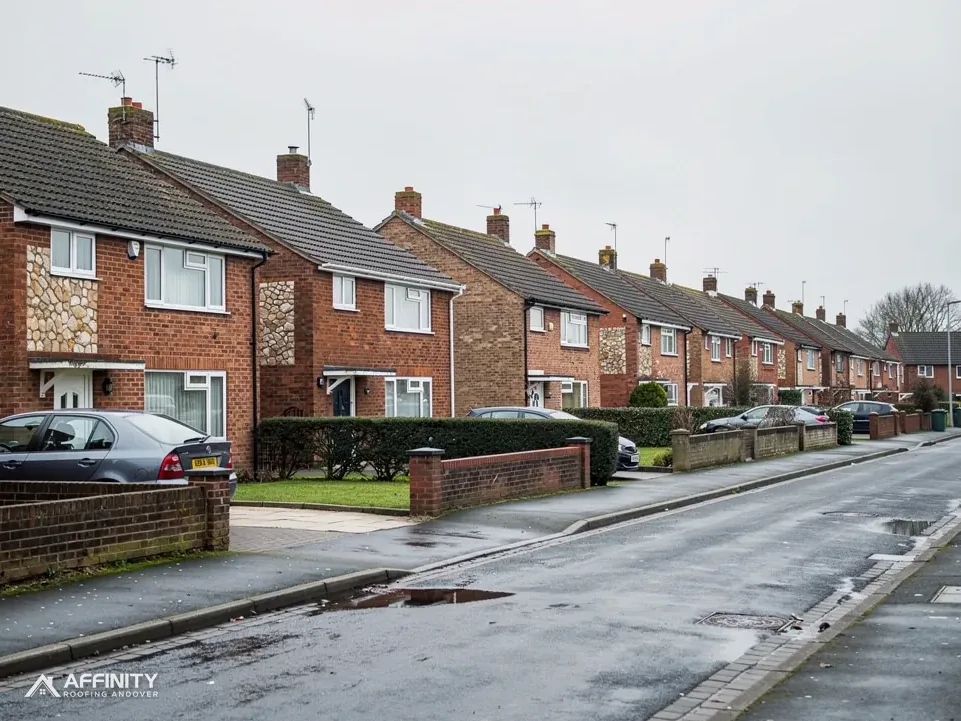
Roofers in Fordingbridge
St Mary's tower, the Old Manor House and the river bridge
Fordingbridge has 6,155 residents in its parish and 47 listed buildings inside about 900 metres of the town point. A survey comes before any repair or replacement.
Fordingbridge roofs, pitched, flat and listed

Around St Mary's church
Grade I and first listed on 30 September 1964, the parish church has listed houses close by.

Old Manor House
Grade II* and first listed on 30 September 1964 like the church, so its roof work starts with consent.

Streets by the Avon bridge
Houses and shops near the Grade II* road bridge over the Avon, where we check conservation-area status first.
Fordingbridge and the Avon valley villages
Downton lies to the north, Redlynch to the north-east, Landford further north-east and Whiteparish beyond it. Our surveys reach all of them.
- Distance
- 29.9 road miles south-west of Andover
- Planning
- New Forest District Council
- Council
- New Forest District Council and Hampshire County Council
The Fordingbridge roof report
Local editionFordingbridge, HampshireA town on the Avon
Fordingbridge on the Avon: a Grade I church, a scheduled bridge and a council with its own team
Fordingbridge lies south-west of Andover, 29.9 miles by road, in the New Forest District Council area. This report covers how the council handles roofs, which listings and Article 4 areas touch the town, and how scaffolding is licensed.
A town of 6,155 and one district team
At the 2021 Census the parish counted 6,155 usual residents, and the town takes in a wide run of house types. It sits in the area of New Forest District Council, which is the local planning authority, and Hampshire County Council is the highway authority. Fordingbridge lies outside the New Forest National Park, so its planning applications go to the district council.
Building control is also the district council's. It runs its own team from Appletree Court on Beaulieu Road in Lyndhurst, with an enquiries line on 023 8028 5245. When a Fordingbridge job needs an application, the paperwork goes to Lyndhurst, and we tell you so in advance.
For re-roofing, the Planning Portal draws the line. A job that touches less than 25 per cent of the building envelope and less than 50 per cent of the roof sits outside the usual requirement for an application. Shop flat roofs, house pitches and extension roofs all come under the same test, and only the size of the job moves them across it.
The other trigger is weight. A heavier covering that adds 15 per cent or more brings Building Regulations approval into the picture, with a structural check advised. That matters on an older roof whose timbers were framed for clay or slate and not for heavy concrete tile.
Owners who prefer a private route can use a registered building control approver instead, a role regulated since April 2024. We lay out both routes and tell you in writing which body your job needs, before a scaffold date is fixed.
Planning is separate, and it depends on the building. Our guide to planning permission for roof work covers houses, flats and listed homes. Shops, and flats above them, sit differently from houses, and that is worth knowing before any plan is drawn. If the building is let, the same questions go to the landlord, and we copy the survey pictures to whoever needs them.
A town like this offers terraces, detached houses and shops with rooms above them. A terrace may share a ridge and a party wall with the house next door, a shop may have a flat roof behind a parapet, and a detached house may have its own hips and valleys. The survey starts by working out which you have, because the failure points and the approvals differ. A parapet gutter behind a shop front, for instance, fails in a different way from an eaves gutter on a house, and needs a different repair. Ownership above a shop can be split between landlord and tenant, so we ask early who holds which part of the roof.
St Mary's, the Old Manor House and the Avon bridge
Grade I status belongs to the Church of St Mary (National Heritage List entry 1350974), first listed 30 September 1964. The Old Manor House carries Grade II* (entry 1167019) with that same date, and the road bridge over the River Avon is Grade II* (entry 1301381). Fordingbridge Bridge is a scheduled monument (entry 1003452), within about 500 m of the town centre. Historic England's list holds 47 listed buildings within about 900 metres of the town point.
The Fordingbridge conservation area lies within about 0.75 km of the centre, as mapped from the boundaries the district council shares with the national planning data. Inside it, what a roof looks like from the street gets closer attention, and any change of shape or material is worth raising with the planning team first.
Two Article 4 directions in the council's published data intersect this area: Article 4 Direction 97/2 and the Marl/Puddle direction. Before you alter anything visible on the roof, ask New Forest District Council whether either direction reaches your address, and keep its reply.
The consent routes differ by building. If your house is listed, listed building consent is required before work that would alter its character. St Mary's still serves an Anglican congregation, which means a faculty, not listed building consent, governs repairs to its roof. A scheduled monument needs scheduled monument consent for works to the monument itself, which is a Secretary of State matter and has nothing to do with the houses beside it.
Rainwater from a roof has to go somewhere, and in a river town the drains matter. We check gutters, hoppers, outlets and downpipes as part of the survey. Where a downpipe runs into an old clay drain at ground level, we note it, since a blocked gully can look like a roof leak from inside. Water that backs up in a gutter spills over the fascia and runs down the wall, and it does more harm to old brickwork than a missing tile does.
For a house in the old core, we photograph the roof as it stands and write down what we find under the covering: batten condition, underlay, the fixing of the ridge, the lead at chimneys and abutments. Those notes decide whether a patch is enough. They also give the council something concrete if a question comes back.
The older streets reward a slow look. A roof that seems plain from the road can hide a valley behind a gable or a chimney shared with the neighbour, so the report covers every pitch.
“Fordingbridge's roofs answer to a council that does its own building control in Lyndhurst.”
Scaffold on a town street, and the work
Section 169 of the Highways Act 1980 licenses scaffolding that occupies the road or pavement. In Fordingbridge the licensing body is Hampshire County Council, not New Forest District Council. On Hampshire County Council's page the scaffolder applies, acting for the customer. Hampshire County Council charges £211.90 on application for the first 2 weeks, then £72 for each further 2-week period, and the application must reach the county ten clear working days ahead. Extensions are not offered, which is why we settle dates early.
In a town centre the frontage matters. A shop with a flat roof behind a parapet, or a terrace whose front doors open onto the pavement, may well need a road licence. A house with room in front may not, because a scaffold kept wholly on private land needs no highway licence. We note which case yours is at the survey.
The work covers more than tiles. We take pitched roofing for houses with a slope to repair or replace, flat roofing for extensions, garages and shop roofs, and guttering, soffits and fascias along the eaves. A flat roof has its own failure points: ponding where the fall is poor, split seams, and upstands at walls that have lifted. Good falls matter more than a good membrane, and we look at both. A split seam or a blocked outlet is quick to fix when it is found and expensive once the deck beneath has soaked, so we check the fall and note any water still standing a day after rain.
Roofline work is where a roof meets the wall. Fascia boards that have rotted let water behind the gutter, and soffits that have opened let in birds and damp. We photograph the full run before touching a board, so you see which lengths have failed and which are sound.
A repair is the answer when the covering still has years in it, and the pictures show whether it does. A replacement is the honest answer when the battens have gone soft and the underlay is split, and the pictures show that too. One written price follows either way, and the site is left tidy.
Shop and unit roofs get the same survey. The owner may be a landlord and the occupier a tenant, so the written price goes to whoever instructs us, and the report can go to both on request. On a flat commercial roof we look at the membrane, the seams, the drainage outlets and the upstands, and we photograph the whole roof as it stands, since a roof that is seldom walked on hides a lot until it leaks.
Pitched, flat and roofline work in Fordingbridge

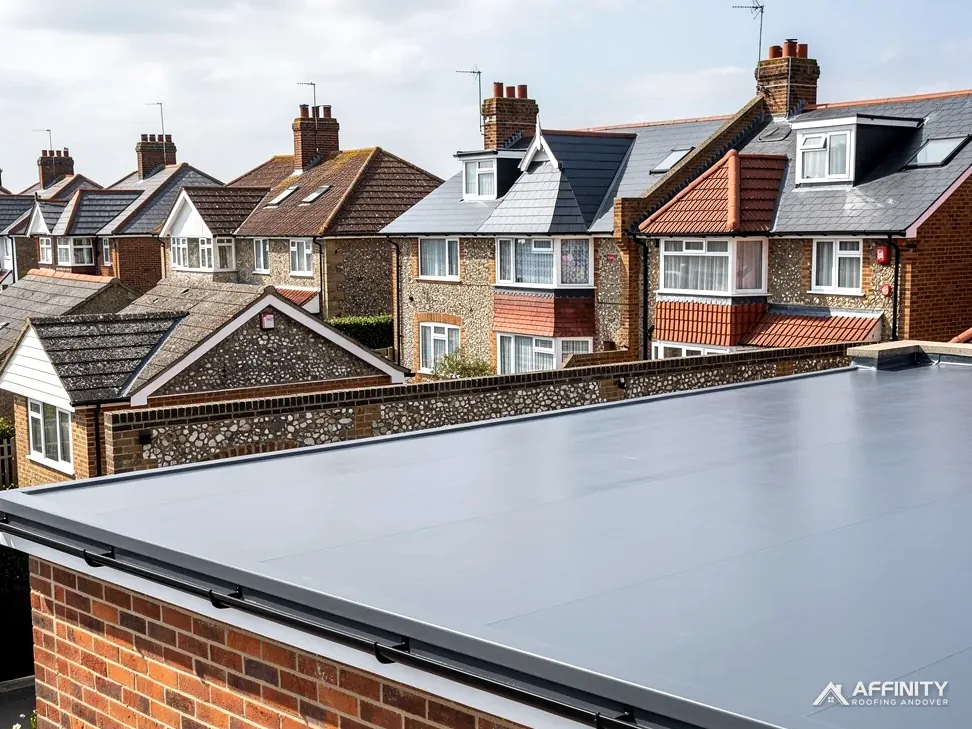


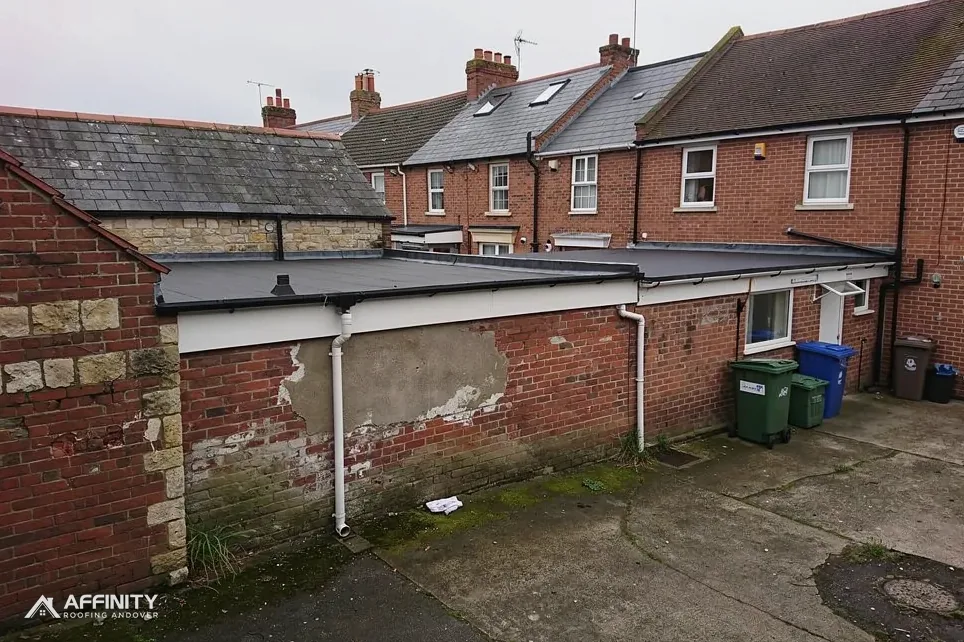

Fordingbridge roofs: bridge, church and flat roofs
Can I replace a flat shop roof in Fordingbridge without an application?
Often, if the work touches under 25 per cent of the envelope and under 50 per cent of the roof, building control does not need an application, though planning for flats above a shop is a separate question, covered in our planning guide. A heavier new covering needs approval. The district council's team is the place to confirm it for your address.
Does the scheduled bridge affect roofs near it?
Works to the monument itself, the bridge, need scheduled monument consent; the houses beside it are separate. Those houses may still be listed or inside the conservation area, and those routes apply instead. The council's planning team can confirm which status your building has, and we photograph the roof for the file.
What do Article 4 Direction 97/2 and Marl/Puddle mean for my roof?
Only the notices say what each removes, and New Forest District Council's planning team holds them. Ask the council whether a direction applies to your address, and ask for the reply in writing. We then plan the roof work around the answer, not around a guess. A short reply settles it before any order is placed.
Who arranges scaffolding permission on a Fordingbridge street?
Hampshire County Council licenses scaffolding there, and the scaffolder applies to it on your behalf; the county needs the form ten clear working days in advance. Hampshire County Council's fee is £211.90 on application for the first 2 weeks, then £72 for each further 2-week period. Private land needs no licence. Extensions are not offered, so a late consent decision can cost an extra fortnight's charge.
Up the Avon from Fordingbridge
Fordingbridge roof survey first
Pass us the postcode and a picture. We survey, check with New Forest District Council, then quote one written total.
10-year workmanship guarantee, in writing.