The short answer
Only with the neighbour's agreement, and it is wise to have that on paper before the booking is made. Your roofer cannot assume access to next door's garden, drive or flat roof. The Party Wall etc. Act covers defined works to shared walls, not a general right to stand scaffold on someone else's land. If the scaffold sits on the pavement, the highway authority licenses it instead.
Asking, and getting it in writing
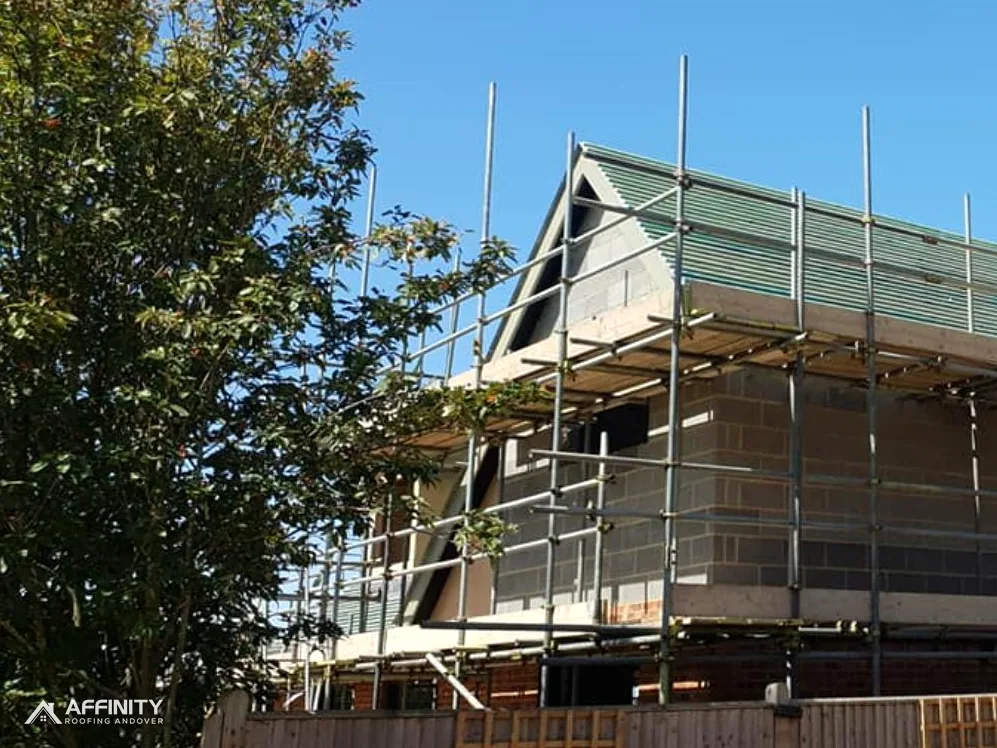
The ground next door belongs to your neighbour, so a scaffold there needs their consent. Ask early and politely, before the programme depends on it. Explain what the scaffold is for, how many days it will stand, how wide it is and where the base plates, the steel feet that spread the load, will sit.
A short written note works better than a spoken yes. It should give the date range, the position, any plants or fences to be protected, and who to contact if something is damaged. Ask for a reply by message or letter and keep it with the quote. If the neighbour is a tenant, the landlord may need to agree as well, so find out who owns the property.
Do not treat silence as agreement. GOV.UK's party wall guidance warns that a lack of reply is not consent. That line is about party wall notices, but the lesson carries over: wait for a clear answer, and include a contact number for the scaffolder so a problem can be raised quickly. A neighbour who feels informed is easier to work with throughout, and a courteous note about noise and dates helps whatever the answer turns out to be.
Where the Party Wall Act stops
People often mix up two separate things. The Party Wall etc. Act 1996 lets a building owner carry out certain defined works to a shared wall, such as trimming back a chimney breast that projects (section 2(2)(g)), once notice has been served at least two months ahead (section 3(2)(a)). Where the neighbour does not agree, surveyors are appointed.
That is a procedure for those works. It is not a route to putting scaffold on a neighbour's land, and a party wall notice should not be read as permission to use their garden. Consent for access is a separate matter.
If you cannot tell which applies to your job, ask a party wall surveyor, who deals with these questions, rather than building control. Our answer on party wall notices for roof replacement describes when a notice is needed for roof work. If the neighbour says no, the roofer should have a plan B: a scaffold wholly on your land, a narrower lift, or a mobile tower for a small repair.
When the scaffold goes on the pavement
Some houses have no room at either side, and the only space left is the pavement or road. That is highway land, not private land, so section 169 of the Highways Act 1980 applies and the licence comes from the highway authority.
For Andover and other Hampshire district addresses, that authority is Hampshire County Council. Hampshire County Council wants the application lodged by the scaffolding firm, with at least 10 clear working days in hand, and it charges £211.90 for the first 2 weeks of a licence and £72 for every further 2 weeks, though it asks for no licence where the scaffold stands on a private road.
In Wiltshire, MiPermit is the online route, used by whoever supplies the scaffold, and licences last 28 days. West Berkshire Council takes applications from scaffolding providers, not from residents. Where the highway authority is elsewhere, ask who applies. Our answer on scaffolding for a new roof goes through the licence, and the roof replacement hub explains the job around it.
If next door says no
A refusal need not end the project, though it alters the plan. Thank the neighbour whatever the answer, since a refusal is their right. The roofer may be able to scaffold your own side only and work from there, or use a hung scaffold, a platform supported from the building, if the house suits it. For a small repair, a roof ladder or tower on your own land may be enough.
Each alternative has an effect on cost and on safety, and the written quote should say which one is assumed, so that you are not surprised by a change of method on the day. If the roofer priced the job on the basis that next door's garden would be available, the price needs revisiting when the answer comes back.
Nobody should put scaffold on a neighbour's land without consent, even briefly. It creates a dispute that outlasts the job, and it can cost you the goodwill you need for the party wall junction on a terrace. Our answer on re-roofing a terraced house explains the points specific to a shared roof line.