The short answer
Usually not with an automatic right. The 14-day cooling-off period for contracts made at home does not apply when you specifically ask a trader to visit for an urgent repair, which is regulation 28(1)(e) of the Consumer Contracts Regulations. You can still dispute poor work or a price that was never agreed, so settle exactly what the emergency job covers in writing before it starts.
Why the 14 days usually falls away
You may have heard of a 14-day cooling-off period, and it is real. A roofer who surveys your house and then has you sign a contract in the lounge falls under it, and you can withdraw without giving any reason. For services, the clock starts the day after the agreement is signed.
An emergency call is treated differently. Regulation 28(1)(e) of the Consumer Contracts Regulations 2013 removes that right where the consumer has specifically asked the trader to visit because a repair cannot wait. Citizens Advice makes the same point: an automatic cooling-off period is absent when you call a business in for urgent work at home.
So a sentence you may see online, that you can always cancel within 14 days, is wrong for this situation. It is right for planned work that a roofer sells you at the door or signs up at home after a routine survey. It is not right when water is coming through the ceiling and you ring someone to come out.
The trade-off is simple. You are asking for speed, and the law lets the roofer start without waiting out a cooling-off period.
What you can still do
Losing the cooling-off right does not leave you unprotected. Section 49 of the Consumer Rights Act 2015 says a trader must use reasonable care and skill when doing the work, and section 52 requires a reasonable time where none was fixed in advance. A roofer cannot remove that liability with small print.
If the work is poor, you can insist on a repeat performance to put it right. Where that fails, further remedies exist, including a price reduction. They sit apart from any cooling-off period and cover emergency jobs exactly as they cover planned ones, so a rushed repair still has to be a competent one. Photographs of the finished work are useful evidence if there is ever a dispute.
You also keep the ordinary right to stop a job that has not begun, as long as you pay a fair amount for anything already done, such as time spent on site or materials ordered. What counts as fair depends on the facts, so keep the exchange of messages.
For advice on your own position, ring the Citizens Advice consumer helpline on 0808 223 1133. It can look at your contract and what was said, which no general page can.
Agree the scope in writing
The best protection in an emergency is a short written note of what the urgent job is. Without one, a make-safe can slide into a full repair, and a full repair into a re-roof, with each step billed as if you had agreed to it.
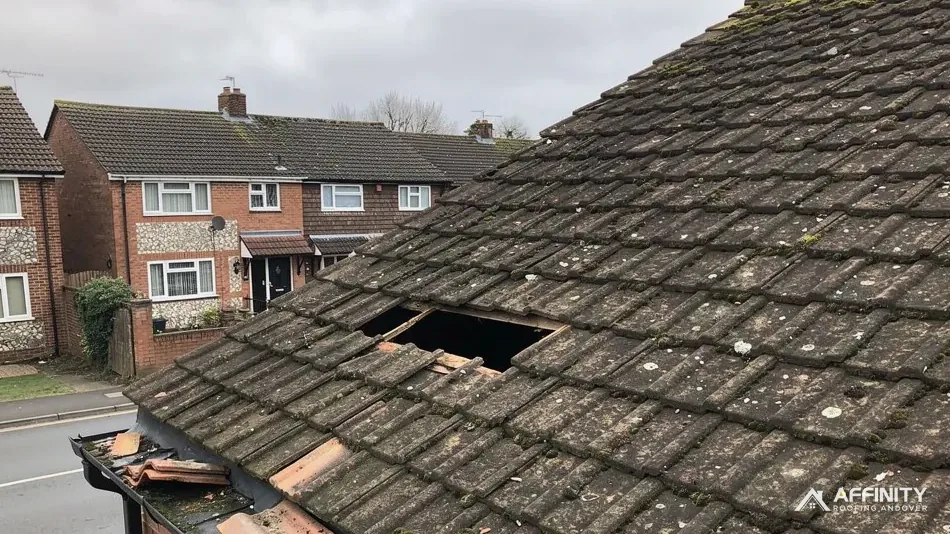
A good note answers four questions. What will be done today: covering a hole, clearing a blocked outlet, securing loose tiles. What it is meant to achieve: stopping water getting in until a proper repair. What it costs as one total, with VAT stated. And what is not included, such as any permanent repair, which would be quoted separately after a proper look.
A text message or WhatsApp reply is enough, provided it is written down and you keep it. Before anything else is done, ask for the answers to those four questions and wait for the reply.
That is how we handle roof repairs that start as emergencies. A make-safe stays a make-safe, and the permanent repair follows a survey, with pictures of the damage and one written price. Our guide to temporary roof repairs shows what a make-safe covers.
Stopping a job that has grown
The cooling-off exclusion is for the urgent repair you asked for. It is not an open door for everything a roofer then proposes. Once the roof is safe, the next stage is usually a different kind of decision: a proper repair, or a larger job, priced after a survey.
If a roofer suggests extra work while on site, you are entitled to say no, to ask for a written price and to take a few days. You are also entitled to get other written quotes. Citizens Advice suggests collecting at least 3 from different traders before you choose one, and a roof that has been made safe gives you the time to do that.
Be wary of anyone who says the make-safe will not hold unless the whole roof is replaced today. A good surveyor can show you the evidence in photographs, explain what is failing and let you decide.
If you are unsure whether a later contract carries a cooling-off right, the helpline above can say. Our guide to written roof repair quotes explains what to expect on paper.