
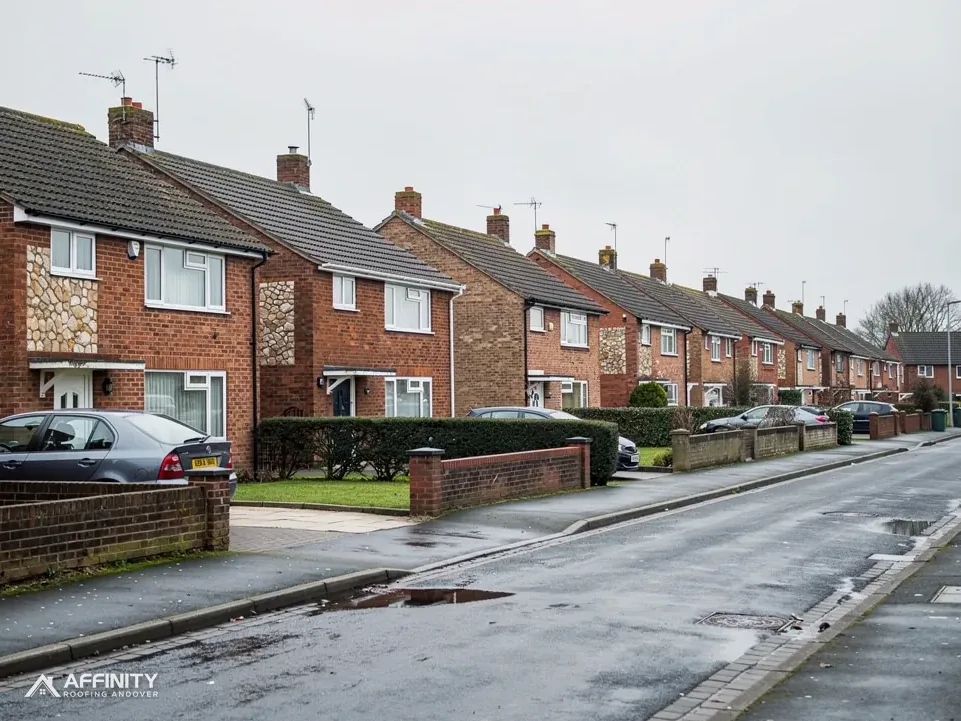
Roofers in Thatcham
A Berkshire town with a Grade I school and a conservation area
Thatcham has 25,466 residents, a conservation area and 35 listed buildings close to the centre. We examine every roof from above and photograph it before setting a price.
Thatcham roofs, from the Bluecoat School outwards

The Old Bluecoat School
Listed Grade I, first listed on 10 November 1983, among 35 listed buildings within about 900 metres of the centre.

St Mary's and old houses
The Church of St Mary, Grade II*, with The Grange and The Priory, each listed Grade II, close by.

Flats, shops and family homes
A town of 25,466 residents where houses, flats and commercial roofs each follow a different consent route.
Thatcham among the Kennet valley towns
Cold Ash and Hermitage lie to the north, Bucklebury to the north-east and Woolhampton to the east. Newbury, Shaw and Greenham are west and south-west, Bishops Green south.
- Distance
- 21.7 road miles north-east of Andover
- Planning
- West Berkshire Council
The Thatcham roof report
Local editionThatcham, BerkshireA Kennet valley town of 25,466 residents
One council, one Grade I school: how a Thatcham roof is cleared
Thatcham is 21.7 road miles from Andover, a Berkshire town of 25,466 residents. The report sets out who rules on a roof, what 35 listed neighbours, including a Grade I school, change, and how flats and commercial roofs are treated.
A town of 25,466 under one council
Thatcham is a large town, with 25,466 usual residents at the 2021 Census, and it answers to West Berkshire Council, a unitary authority. That single council makes the planning decisions, licenses scaffolding on the highway and, with Wokingham Borough Council, runs the building control partnership. No county council sits above it. For a homeowner it means one set of offices and one reference trail, whether the job is a patch or a full re-roof.
Building control is handled by Building Control Solutions, known as BCS, the collaborative partnership between the two councils. Its enquiries line is 0300 790 0580. A Thatcham re-roof that needs checking goes to BCS, which is not the team serving Hampshire addresses and does not share their number. A registered building control approver is the alternative, a private route regulated since 6 April 2024, and our survey notes travel with whichever body you choose.
Whether a roof job needs a building control application depends on how large an area is renewed and how heavy the new covering is. The Planning Portal's yardstick lets work on less than 25 per cent of the building envelope, and less than 50 per cent of the roof, go ahead without one. A covering 15 per cent heavier needs approval, with the structure examined first. That national test is the yardstick in West Berkshire, as it is across the area.
West Berkshire Council also decides whether an Article 4 direction touches a Thatcham address. We ask the council, with your address, before pricing any proposal that changes the roof's appearance.
Thatcham's roofs vary widely, and each sort has its own paperwork. A house, a block of flats and a shop are treated differently under planning, and the survey sorts out which you have before anyone quotes. A written note of the answer stays with the photographs.
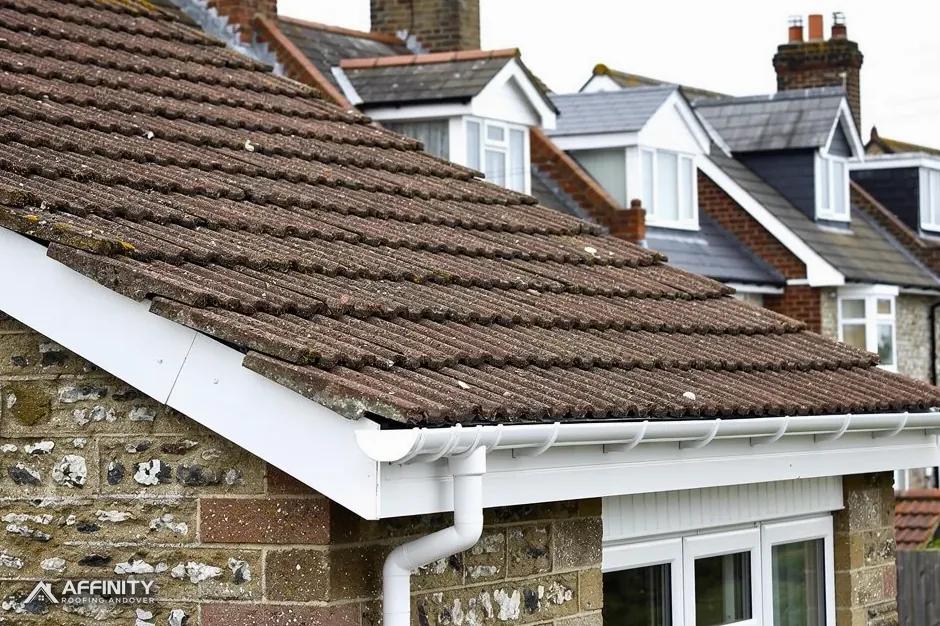
A place this big generates plenty of small, routine jobs: a lifted ridge tile, a leaking valley, a blocked outlet on a garage roof. We keep those simple, and say plainly when no form or approval is needed at all. A survey that finds only a slipped tile ends with a repair, not a sales pitch for a new roof.
Traffic and parking matter more in a town. A scaffold or a skip may need space that neighbours also use, so the survey notes where each can stand, and the dates are set to cause the least trouble to the street.
The Old Bluecoat School, St Mary's and 35 listings
The National Heritage List records 35 listed buildings within about 900 metres of the centre of Thatcham. The Old Bluecoat School is listed Grade I (list entry 1303195, first listed on 10 November 1983). St Mary's church is Grade II* (1155799, first listed on 6 April 1967), and The Grange (1117288) and The Priory (1303152) are Grade II. For a town centre, that is a dense and distinguished cluster.
A listing protects the look of a building as well as its bones. Swapping the covering for something different, altering the pitch or cutting a new opening each count as a change, and each wants consent in advance. Repairing with like materials is where talks with West Berkshire's planners begin, and our guide to listed building roof repairs goes through the process.
St Mary's is an Anglican church where services continue, so repairs to its roof follow the Church of England's faculty system, not the council's. A Catholic or Methodist church uses its own scheme instead, and a Quaker meeting house needs consent like any listed building. Whoever looks after a church roof in Thatcham should name the denomination when booking, since the survey is written for the route that applies.
Thatcham's conservation area is mapped within about 0.75 km of the town centre. Houses inside it are held to a stricter standard on visible changes, so an unlisted owner should call the council before changing a roof's colour or material. Whether your address is inside is a question for the council's map, which is read before any price.
Large old roofs call for care. A large old roof can carry long ridges, valleys and chimneys, and the lead work must follow the original method. We survey such roofs from a tower or a scaffold, photograph each valley and abutment, and record the fixings. That record is what lets a supplier match old tiles and lets the planners read an application at first sight.
On smaller listed houses the same method works at a smaller scale. Where old tiles are sound they are lifted, graded and put back, and new ones fill only the gaps.
A building of Grade I rank takes hours to survey, not minutes. Long runs of ridge and gutter, tall chimneys and lead valleys have to be reached and photographed one by one, by tower or scaffold, and the notes record where each bit of old material sits so that repairs can follow its pattern.
Older town houses can have parapet gutters, hidden valleys and lead-lined channels behind brick, which are easy to miss from the street.
“Thatcham's roofs run from a Grade I school to flat garage roofs, each with its own consent path.”
Flats, shops and the weekly scaffold fee
Flats are treated differently from houses under planning. Householder permitted development rights do not apply to flats, so an alteration to the appearance of a flat's roof or a block's roof goes to West Berkshire Council for permission, where the same change on a house might not. We ask who owns the roof, because in a block it is often a freeholder or management company and not the individual flat owner who instructs the work.
Commercial roofs, on shops, units and offices, bring their own questions: the area is larger, access is by ladder or tower, the membrane or sheeting has to be identified, and the building may be in use during the work. Our commercial roofing surveys take all of that into account, and the written total says what the tenant must allow for, such as parking, deliveries and noise.
For a shop or unit, access is agreed with the tenant in advance: when the roof can be reached, where staff and customers park, and whether deliveries must carry on. A short note of those arrangements goes into the survey sheet.
Where scaffolding has to occupy the highway, West Berkshire Council licenses it under section 169 of the Highways Act 1980. West Berkshire Council's charge is a base fee of £125 plus £71 for each week the licence runs, and its page puts the application with a scaffolding provider rather than the resident. Applications are lodged 10 working days or more before erection.
A weekly charge rewards a tight programme. For a larger flat roof or a shop front, we work out the number of weeks before the scaffolder is booked, and order the membrane or the sheets ahead, so the licence does not run while a lorry is awaited. A yard behind a unit may sit wholly on private ground, outside the licence, and so may a private road.
If water comes through the ceiling of a flat, the cause may lie in a neighbouring flat or in the common roof. Report it to the managing agent or the freeholder as well as to us, since the building's insurance may be arranged by them. Photographs with dates help every party, and we take them during the visit.
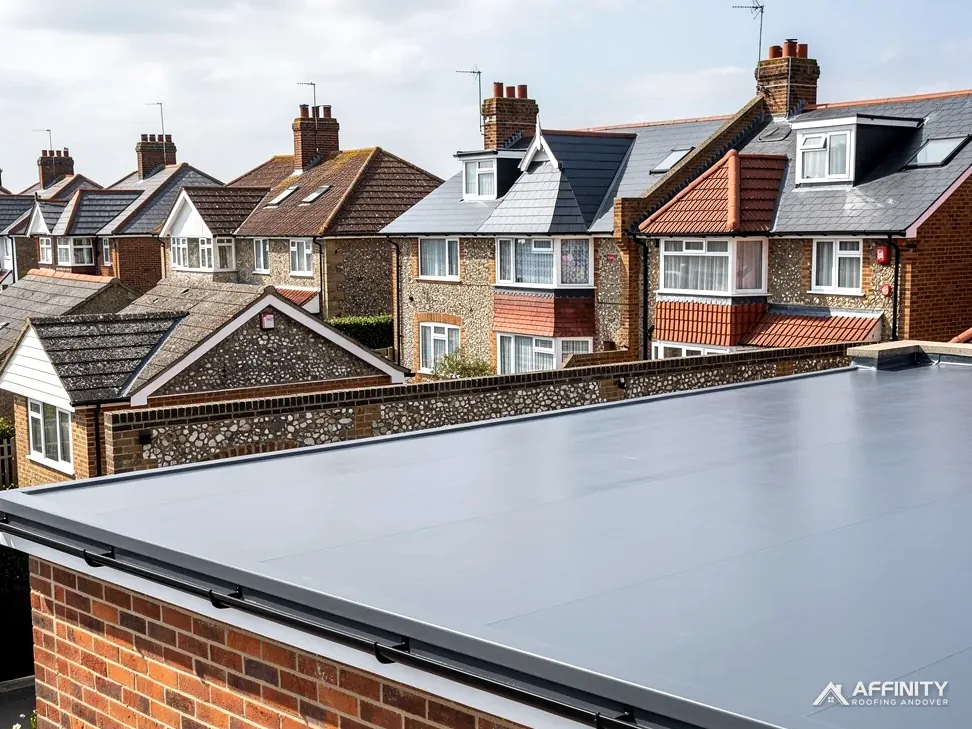
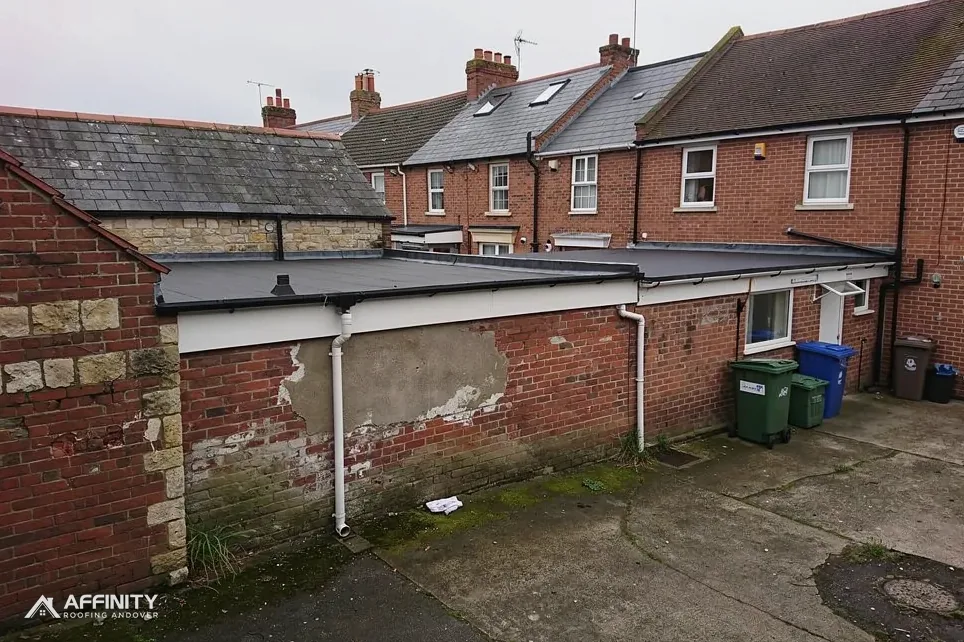
For houses, roof repairs and flat roofing cover most visits: a slipped tile, a split seam, a blocked outlet, a flashing that has lifted. Flat roofs on garages and extensions should shed rain by a working outlet, and standing water after rain tells you about the falls.
When a ceiling is already wet, the roof is covered first. The proper repair follows once the photographs show the cause.
Ways we look after Thatcham roofs


Thatcham roofs: the Grade I school, flats and the licence
Can the roof of a flat in Thatcham be altered without permission?
Householder permitted development rights do not cover flats, so altering the roof's appearance goes to West Berkshire Council for permission. Repairs in the same material are ordinary upkeep. In a block, the freeholder or management company usually controls the roof, so check who must instruct the work before booking a survey, and ask for their permission in writing.
What does a Grade I listing mean for a Thatcham school roof repair?
The Old Bluecoat School is listed Grade I, and works that alter what makes it special need listed building consent first. Matching materials are the opening position, and West Berkshire Council's planners decide. We photograph and measure every slope so that the application shows the roof, the fixings and the lead work clearly.
How is West Berkshire's scaffold licence priced for a Thatcham job?
West Berkshire Council charges £125, plus £71 per week, so the number of weeks matters. A scaffolding provider applies, with 10 working days or more to spare. We fix the number of weeks before booking the scaffolder, and order materials first. Private roads and yards need no licence, whatever the building.
Who checks building regulations on a Thatcham commercial roof?
BCS, run jointly by West Berkshire Council and Wokingham Borough Council, on 0300 790 0580, unless you choose a registered building control approver. A covering that weighs 15 per cent more calls for approval, with a structural look first. That goes on the survey sheet, and the reply comes to you.
Kennet valley neighbours of Thatcham
Book a Thatcham roof survey
Book by sending an address and photo. West Berkshire routes are settled first, and one written total follows.
10-year workmanship guarantee, in writing.